• Skip to primary navigation
  • Skip to main content
  • Skip to primary sidebar
  • Skip to footer

BJU Press Blog

  • Home
  • Shop
    • Shaping Worldview
  • Simplified Homeschool
  • Successful Learning

Invisible Subjects: Taking Time for Heart Matters

January 30, 2018 by Karin

heart matters with mom
On paper, your homeschool day is neatly scheduled, but you probably didn’t schedule the following:

  • 9:15 a.m.—Kindergartener throws his pencil down, saying, “I just can’t write the letter s.”
  • 10:22—Fifth grader protests when her little brother wants to join in her science experiment.
  • 1:05—First grader covers his ears defiantly rather than listen to you explain the math problem he completed incorrectly.
  • 1:12—Third grader keeps daydreaming instead of completing her worksheet.
  • 2:47—Ninth grader complains, “Why do I have to learn algebra if I’ll never use it in real life anyway?”

Heart matters are the invisible subjects that we often sweep aside. If I’m focused on checking off the school subjects on my daily plan, I’m likely to let attitude issues frustrate me rather than seeing them as a prime opportunity to help my children mature in working through these invisible subjects in a way that honors God.

Heart Detector

When the ear-piercing smoke alarm interrupts my dinner-making, I don’t ignore it or take out its batteries—I check to see what’s burning. Similarly, an outburst from a child should prompt me to action, not merely to move on from the interruption but to address the heart matters.

Since I tend to be task-oriented, my natural reaction is to feel irritated at the disruption. If I respond to my children’s frustration by getting frustrated myself and demanding results, they will feel the hypocrisy. So I need to adjust my perspective before I can help my child adjust his or hers.

Often when I’m dealing with an attitude problem with a child, it brings to the surface heart matters of my own to acknowledge and address, such as impatience. Homeschooling means Mom is enrolling herself in the school of patience!

Heart Shepherd

How can I shepherd my child’s heart when she has gone astray into a thicket of thorns? It might take some loving and firm shepherding before she’s receptive to counsel. Once I have helped my child calm down, I can purpose to follow-up, so we can discuss character from a biblical perspective:

  • Creation: God created us to give Him glory (sorry, throwing a fit doesn’t do that).
  • Fall: The reason we fall short of glorifying God is that we are children of Adam (Romans 5:12).
  • Redemption: We can be born again as children of God through faith in His Son (John 3:3–8).

Countless other topics might be helpful, such as discussing the sovereignty of God. He is in control, allowing situations in our lives for good (even that pesky little brother), though we may not understand it at the time. Ask your child questions such as, “What do you think you can do if you begin to feel upset about this again? Are there any Bible verses that can guide you?”

Heart Keeper

Next time you’re making tea, notice that it’s the flavor of the tea—whether bitter or sweet—that seeps out of the tea bag when you add hot water. Similarly, “hot water situations” reveal what’s in our hearts. We must be depending on the Lord in prayer so we can rejoice in trials, respond wisely, grow in steadfastness, and glorify God (James 1:2–5).

While academics is important, that kind of learning will come more easily if we help our children succeed in the invisible subjects, keeping our hearts diligently.

Keep your heart with all diligence,
For out of it spring the issues of life. (Proverbs 4:23)
Filed Under: Simplified Homeschool Tagged With: Character, character building, heart matters

Dividing Fractions a Simpler Way

January 25, 2018 by Ben

dividing fractions printable
The twelve-year-old’s T-shirt reminded me of my own homeschool experience with fractions and made me chuckle with delight. The shirt said, “Did you know that 5 out of 4 people struggle with fractions?”dividing fractions materials

When I was in the upper elementary grades, my mom switched us from a homeschool math program that used a hands-on approach to a program that was trendy among homeschool families at the time. It was during that phase of my math education that fractions became increasingly difficult. I had to multiply and divide with fractions, and it was all so confusing. Why is it that when I multiply, I get a smaller number, but when I divide, I get a larger number?

I think the hands-on approach would have helped me understand the basic arithmetic of fractions. If your child is struggling with dividing fractions, try the following hands-on approach to see if it helps. (I found this activity in BJU Press’s Math 6 textbook, which has lots more hands-on activities for teaching fractions and other challenging math concepts.)

dividing fractions circlesInstructions

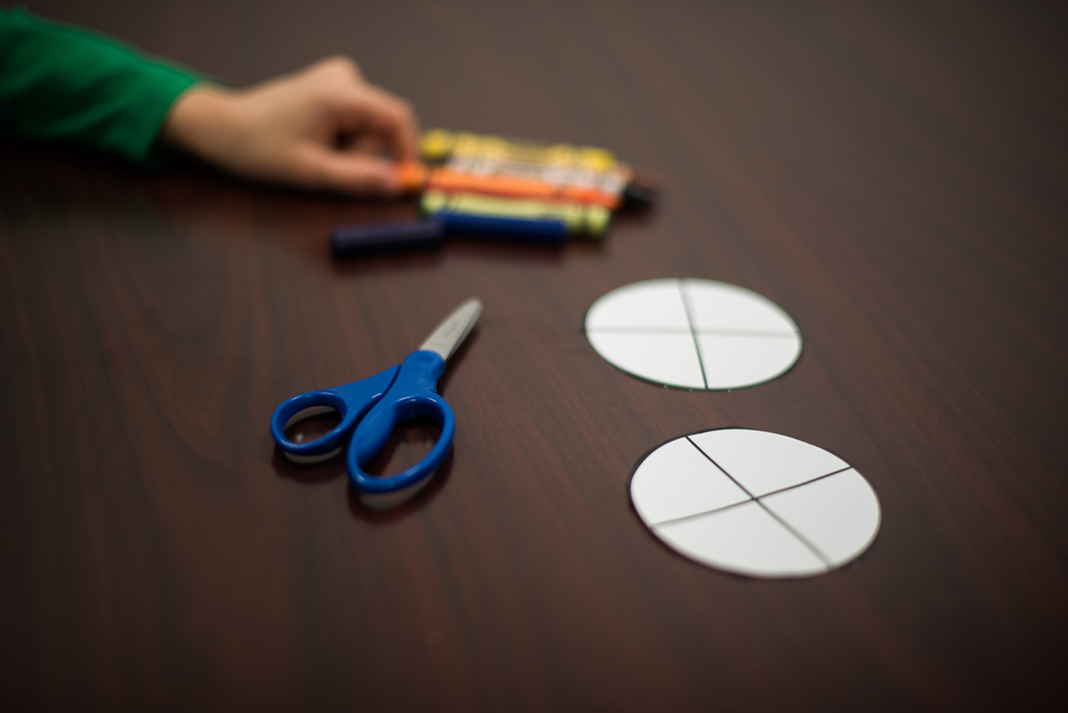
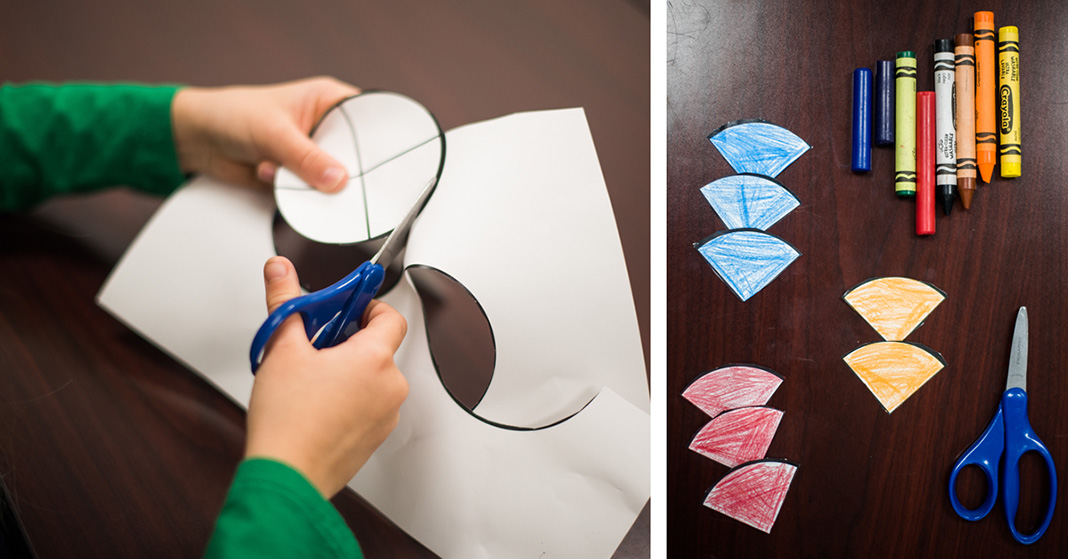
  • Print out these circles and have your child cut along the outer solid lines. (Note: You can also use two apples instead.)
  • We’re going to work through the problem 2 ÷ ¾, but that’s rather abstract, so let’s use a real-world problem.

“We want to make apple tarts. Each tart requires ¾ of an apple. We have two apples. How many tarts can we make?”

dividing fractions cutting

  • Start with the two complete circles. These represent the number of apples we have.
  • Ask: “How do we need to cut the apples to make the tarts?” Since we’re going to need to separate out ¾ of an apple, the answer is “into quarters” or “into fourths.”
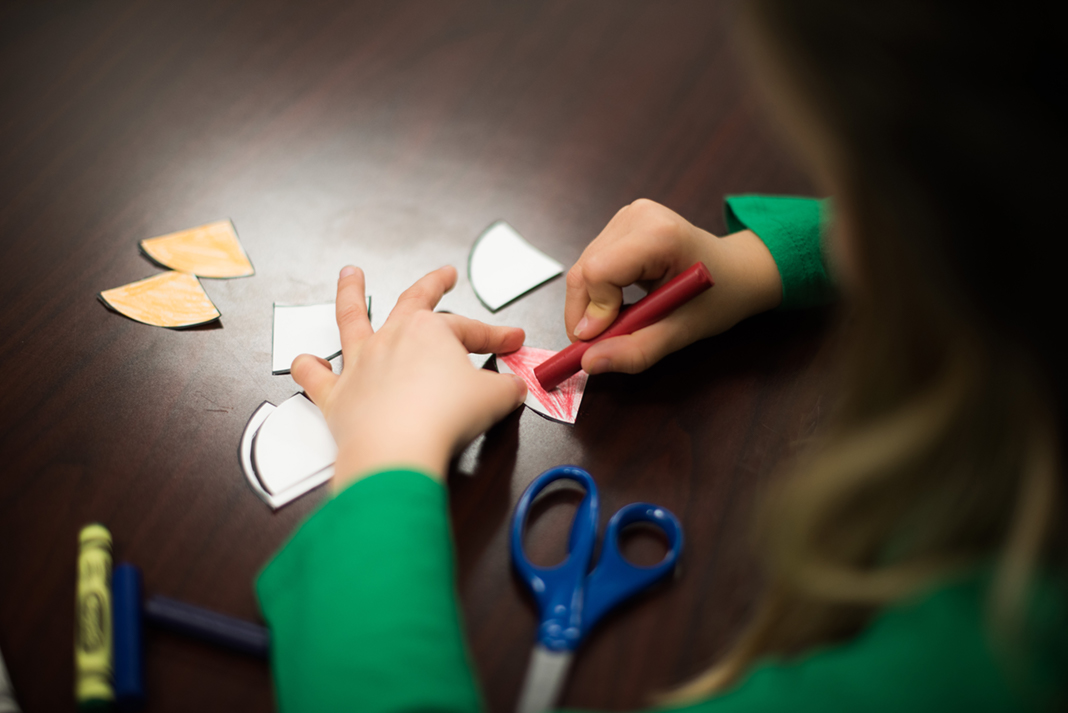
  • Now cut the whole circles into fourths.
  • Ask your child: “How many fourths are needed for each tart?”
  • Now have your child separate the fourths into piles of three.
  • Ask: “How many piles of three do you have?” Answer: 2
  • Ask: “How many quarters are left?” Answer: 2

Expressing the Answer

This might be tricky, but we want to express the exact number of tarts we can make. We could answer, “Two tarts,” but we would have two fourths or ½ an apple left over.” If we want to make a tart with the remaining apple fourths, how much of a tart could we make?  We would say, “Two and two-thirds tarts.” This confused me as a child. Why would I use thirds when I started with fourths? Walk your child through these questions to help with understanding:
dividing fractions coloring

  • Ask: “How many fourths do we need to make a whole tart?” Answer: 3
  • Ask: “How many fourths do we have left?” Answer: 2
  • Ask: “If it takes three to make a whole tart, and we have two of the three to make a whole one, how would we write that as a fraction?” Help your child see that the bottom number of the fraction tells us how many parts make a whole, and the top number tells us how many parts of that whole we have. So the whole tart has three parts (apple fourths), and we have two of those three parts or ⅔.
  • So we can make 2⅔  apple tarts with 2 apples.
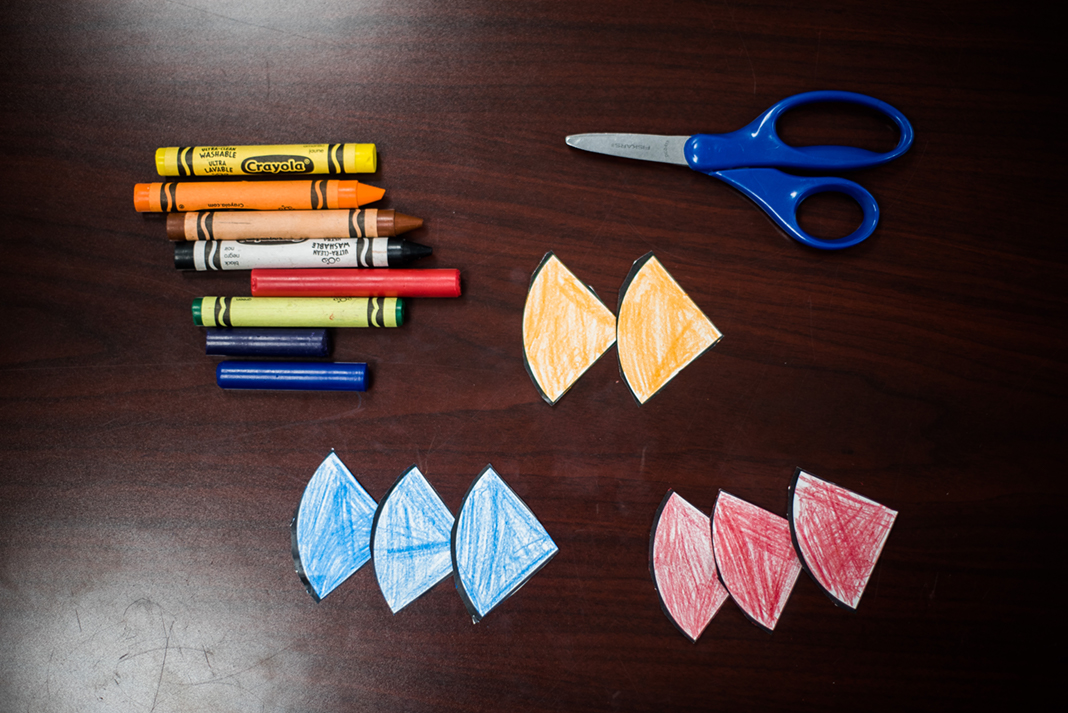
  • Have your child color each group of three fourths and the two remaining fourths a different color so they can see which group of fourths will go into each tart.
  • Help your child write out how this would look as a math problem and solution: 2 ÷ ¾ = 2⅔.

dividing fractions completeWhy Hands-On Works

Working through this activity helped me understand some math that always challenged me as a child and into adulthood. Using hands-on activities helps many of us understand math. That’s because math is an expression of physical realities. When we see, touch, and talk about those physical objects that math is representing, the math makes more sense.

So if your child is struggling with fractions, try this and some other hands-on activities.


Filed Under: Successful Learning Tagged With: Fractions, hands-on learning, homeschool, homeschooling, math, Math 6, math comprehension, math manipulatives

Midpoint Checkup: How’s Your School Year Going?

January 23, 2018 by Guest Writer

homeschool checkup
The first half of the school year is over, and you may be doing a mental checkup of your homeschool program. How is it working for you so far? What strengths and improvements do you see in your children? Here’s what a few of your fellow homeschoolers had to say about their experience with BJU Press materials this year.

The Unlikely Homeschool: Language Arts

Over at The Unlikely Homeschool blog, Jamie shares her reasons for switching to the BJU Press English program from another language arts curriculum right in the middle of the school year. She felt that the other English curriculum wasn’t providing her kids with a big-picture view of language—the “why” for all the grammar facts and rules. In contrast, BJU Press language arts teaches writing and grammar side by side, showing that proper grammar is crucial to smooth, effective written communication. A writing unit supports and reinforces every new grammar skill; and homeschool students learn many different forms of writing in the process.

Not Consumed: Early Reading Skills

It’s so exciting to teach your child to read and watch as the skill develops. For Kim at NotConsumed.com, some of the best early readers come from BJU Press. The creative, interesting storylines keep her son coming back for more, eager to read each day. As the books build fluency and skills, they also help young readers develop a love for reading through exciting fiction, tales of foreign missionaries, and Bible stories as well.

Janelle Knutson: Distance Learning Video Lessons

Janelle Knutson decided to give BJU Press Online Learning a try last year, and this year she went all out with video lessons for many of her fifth grader’s homeschool subjects. The blend of video classes, colorful textbooks, and teacher support works well for Janelle’s family. She’s able to stay involved in her daughter’s education while allowing her to work independently sometimes. Independent work is a vital skill for homeschool kids, especially those in large families where a mom or dad must teach multiple grade levels throughout the day.

Are you thinking of making a midstream switch to BJU Press textbooks or Distance Learning? Contact us so we can answer your questions and help you with the details.

• • • • •

Rebecca is a work-at-home freelance writer, novelist, wife, and the mom of two bright-eyed little ones. She credits her success in writing and her love of books to her own mom, who homeschooled three kids from pre-K through high school.

Filed Under: Successful Learning Tagged With: BJU Press Reviews, distance learning, homeschool, homeschool program

First-Grade Weather Report Activity

January 18, 2018 by Jenna

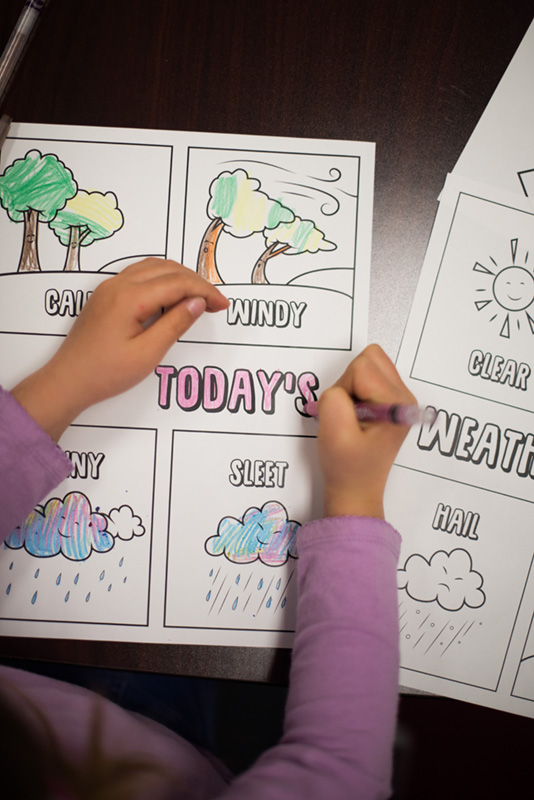
weather report printable
Weather reports are a key part of our modern society. How many of us start each day with our Bibles, breakfast, and a quick check of the day’s weather report?

We rely on God’s Word to help direct us through the decisions we make from day to day. But we also rely on tools God has given us, such as meteorology, to make more informed choices. For instance, should you take an umbrella or wear a coat? These choices often won’t make the difference between pleasing God and succumbing to sin, but they help us stay healthy, safe, and on time.

This weather reporting activity includes a fun printable to help children use what they’ve learned in the lessons about weather and to be more aware of how weather affects choices. If you’d like to share your child’s weather report, we’d love to see it!

weather report materialsMaterials for a weather report

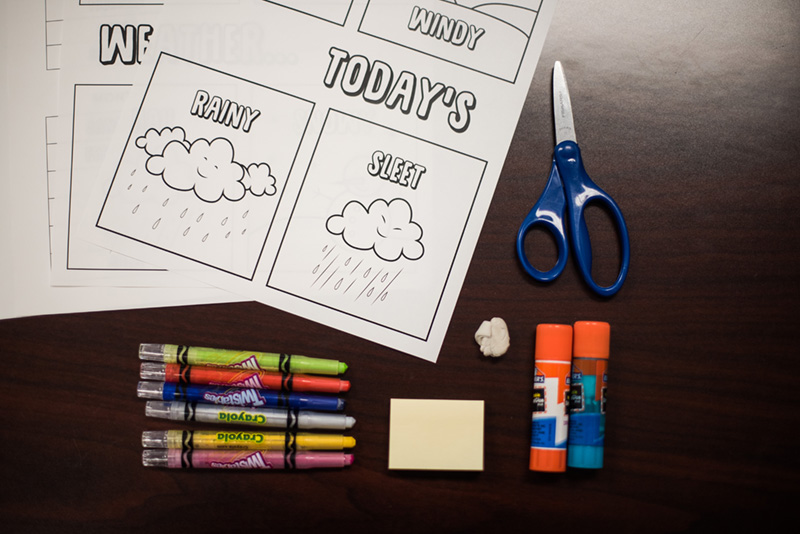
  • Printable weather sheets
  • Crayons, markers, or colored pencils
  • Glue or tape
  • Sticky putty
  • Sticky notes
  • Scissors
  • Posterboard or corkboard
  • Video recorder

weather report coloringInstructions

  1. Print out weather sheets and allow your child to color them as much as desired. You could use this time to talk about what was presented in the lessons, or just enjoy the time together.
  2. Cut out and color movable arrows.
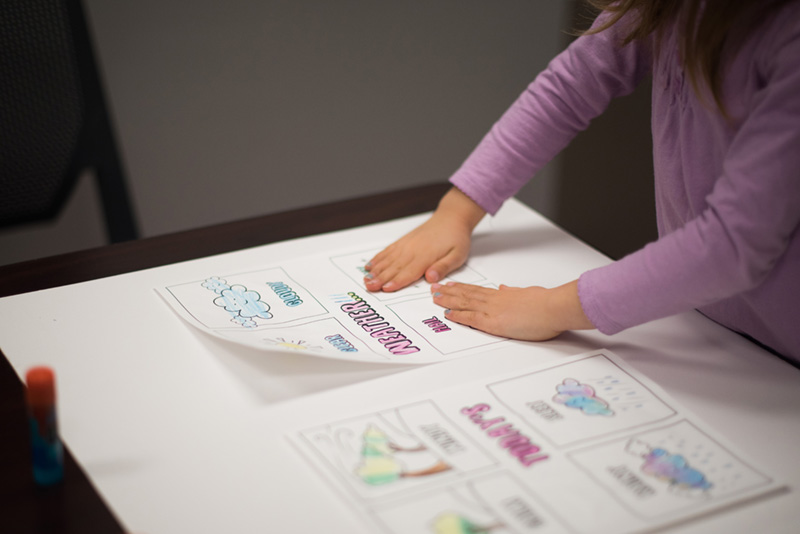
  3. Use glue or tape to stick weather sheets to your board. We used a posterboard and glue. You may also choose to use a corkboard and thumb tacks, or you could even laminate your weather sheets so they last longer.
  4. Look up the day’s weather on a trusted weather channel. Have your child note the day’s temperature, wind speed, and the conditions.weather report sticking
  5. Stage and record a weather report. Use the arrows to mark the approximate temperature, the day and month, the windiness, and the applicable conditions. We used sticky putty so we can move the arrows around and sticky notes for the day’s number so it can be changed out. The report should include advice based on the weather conditions. What kind of activity is it a good day for? Is it a good day for a picnic, or should you go puddle jumping instead? Will it be snowy enough to build a snowman or windy enough to fly a kite?

Filed Under: Successful Learning Tagged With: science activity, weather repot, wise choices

When Does a Tool Become an Idol?

January 16, 2018 by Justin

Technology is great. Computers allow us to do work not possible before. Smartphones give us access to a world of information in the palm of our hand. Even video games can be a good way to unwind or socialize. But what happens when technology becomes more like an idol than a tool?

You’ve probably seen a group of friends or family members sitting around a table without saying a word while everyone stares into his or her smartphone. Ever see a child who’s so fused into an iPad that she can’t be content without it? What about a young man who spends most of his life in a virtual game world to the neglect of his education, his career, and his walk with God?

Are these really idols?

When we think of idols we usually picture statues made by pagans that are worshiped as gods. We may not worship our electronic tools, but sometimes we give them a level of attention that only God deserves. The Bible says the greatest commandments are to “love the Lord your God with all your heart and with all your soul and with all your mind” and “love your neighbor as yourself” (Matthew 22:36–40). So when does technology become an idol? When it hinders our ability to act on those commandments.

Here’s a personal example:

Last week I sat on the couch with my four-month-old son on my lap making silly faces and laughing. I usually make a special effort to limit my smartphone usage around him and give him my full attention, but my pocket vibrated.  Completely without thinking I pulled out my phone to read the notification. It was not important, but I proceeded to let it hold my attention until I noticed that the huge smile on my son’s face had become a pushed-out bottom lip. I felt terrible and convicted.

My attention to my phone was preventing me from showing my son the love that the Bible commands me to. Would I want someone to suddenly ignore me for an email? Of course not.

What can we do?

• Be aware

Sometimes the most dastardly idols are the ones that disguise themselves as a normal and necessary part of our lives. I often ask myself, “Could I reasonably live without this?”  If the answer is no, the reasoning had better be that it helps me fulfill a biblical mandate such as providing for my family, loving God, or loving others. If the thing doesn’t meet that criteria and is taking up a sizable amount of my time and attention, it might be time to cut back.

• Power down or put away

Ever since the incident with my son, I’ve been trying to be extra careful. I put my phone in my office when I get home, and it stays there until I check it for important notifications before bed. The ringer is on loud enough for me to hear it ring if someone calls. At our house, video games are an infrequent activity that we do as a family, not individually. I know many families that have successfully boosted family time and reading time by limiting device usage at the dinner table and in the evenings. Do whatever works for your family.

• Clean house

Sometimes completely getting rid of a device is the best way to remove the temptation to idolize it. This has been hard for me in the past because technology is valuable and throwing it away or selling it at a loss seems wasteful. In these cases I’ve found that the best thing to do is to stick it in a closet somewhere. If it’s a game or app, uninstall it for a while. Taking a few weeks or months off from something can be eye opening. If you don’t miss it, you may not need it at all. If you miss it greatly for the wrong reasons, you’ve identified an idol.

What steps have you taken to identify and remove potential tech idols from your home? Let us know in the comments!

Filed Under: Shaping Worldview Tagged With: computer, idol, smartphone, technology, time

  • « Go to Previous Page
  • Page 1
  • Interim pages omitted …
  • Page 68
  • Page 69
  • Page 70
  • Page 71
  • Page 72
  • Interim pages omitted …
  • Page 152
  • Go to Next Page »

Primary Sidebar

As parents, teachers, or former homeschool students, we are passionate about homeschooling from a biblical worldview. We hope these teaching tips, fun activities, and inspirational stories support you in teaching your children.

Email Signup

Sign up for our homeschool newsletter and receive select blog posts, discounts, and more right to your inbox!

Connect with Us!

                    Instagram     

Read Posts on Specific Subjects

Early Learning
Foreign Language
History
Language Arts
Math
Science

Footer

Disclaimer

The BJU Press blog publishes content by different writers for the purpose of relating to our varied readers. Views and opinions expressed by these writers do not necessarily state or reflect the views of BJU Press or its affiliates. The fact that a link is listed on this blog does not represent or imply that BJU Press endorses its site or contents from the standpoint of ethics, philosophy, theology, or scientific hypotheses. Links are posted on the basis of the information and/or services that the sites offer. If you have comments, suggestions, questions, or find that one of the links no longer works, please contact us.

Pages

  • About BJU Press
  • Conversation Guidelines
  • Terms of Use & Copyright

Archives

© 2026 · BJU Press Homeschool