• Skip to primary navigation
  • Skip to main content
  • Skip to primary sidebar
  • Skip to footer

BJU Press Blog

  • Home
  • Shop
    • Shaping Worldview
  • Simplified Homeschool
  • Successful Learning

Lego® Role-Play for Learning History

March 1, 2018 by Ben

lego role-play duplos and minis
My oldest daughter learns verbally. She reads with understanding and incorporates new vocabulary into her responses to questions about material she’s learning. That makes teaching history to her easy and enjoyable. I am verbal, too, when sharing historical narratives and explaining conflicts of the past.

So I was surprised when she started struggling early in third grade. She wasn’t failing quizzes or even struggling to answer my comprehension questions, but I could tell she wasn’t getting it. More importantly, the joy was slipping away.

History’s Challenge

Some of the most exciting parts of history revolve around explorers, generals, and inventors. We enjoy teaching the feats of these larger-than-life individuals that feed our children’s imaginations. But some of the most significant turning points in history involve legal documents. These documents addressed the most contentious issues but often feel stale and irrelevant to our young children.

For my daughter and me, one challenging document is the most important document in American history—the Constitution. In talking about it with my daughter, I could tell from her responses and glazed eyes that debates over representation weren’t exciting her. But I knew this was too important for her to miss.

Legos and History

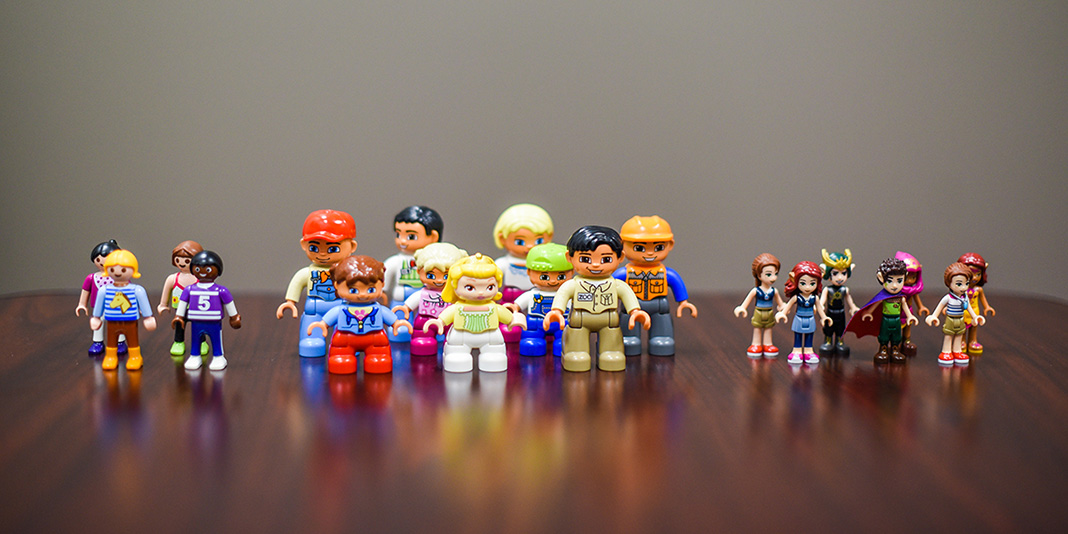
The next evening, I asked my daughter to find all of our Lego, Duplo®, and Playmobil® mini figurines. We were going to do some Lego role-play.

We divided up the mini figurine groups based on type and called them “states.” The Duplo “state” had the highest population of the three, and the Playmobil “state” had the smallest population. Then we worked through the proposals for representation at the Constitutional Convention.

Under Madison’s proposal, we decided that each “state” received one representative for every three “people.” After counting out the representatives, I asked, “Who would like this proposal?”

She responded, “The Duplo people!”

“Why do they like it?”

“They get the most votes in Congress.”

role-play duplos win
“What about the small state proposal?”

“They would get one vote each.” So we worked out representation for the “states” under this proposal.

“Who likes this proposal?” I asked.

“The Playmobil people because they get an equal vote.”

role-play Lego minis win
Finally, we worked through the Great Compromise. By the end of the lesson, I could see the Lego role-play had really helped her grasp an important concept in civics.

Making History and Civics Concrete

Usually when we read about history or civics, it’s abstract—at least to some degree. Illustrations and photographs can help turn those concepts into something your child can see. But many such discussions may be difficult for a child with relatively few life experiences to relate it to.

Role-playing enables you and your child to take these abstract ideas and make them concrete—so concrete that you may find yourself pushing “Lewis and Clark’s boats” up the “Missouri River.” This fun, family-building experience helps your child turn verbal details into active learning.

Checking Your Child’s Learning

Let’s suppose I think my daughter has a handle on the idea of supply and demand. It may even appear that she grasps how railroads and steamboats affected the relationship between farms and cities.

But when we role-play it, I can see what my daughter really understands as she recreates a city and a farm. We can talk through how railroads enable farms farther from the cities to support larger populations in those cities. When she uses supply to describe the “food” and demand to relate to the mini figurines that are “hungry,” I can tell that she gets it.

I’ve found that these hands-on activities make powerful assessment tools for evaluating my child’s learning.

Choosing Hands-on Learning

If your child is beginning to get that glazed-over look as you discuss US history, break out a hands-on activity. We used Legos, but you can use stuffed animals or Popsicle® stick people instead. Help your child by turning abstract readings about the past into active, hands-on learning.
Filed Under: Successful Learning Tagged With: Christian Homeschooling, Constitution, hands-on learning, history, Role-play

And Then . . . Story Prompts and How to Use Them

February 27, 2018 by Jenna


Some people are writers; some people aren’t. And some people learn to be writers. If you have a budding writer in your home but aren’t a natural or learned writer yourself, you may find it difficult to help your child cultivate this skill. One tool you might consider using is story prompts.

What Is a Story Prompt?

Story prompts can be short or long, funny or serious, based on fact or on fiction. There are scene prompts, first-line prompts, last-line prompts, character prompts, picture prompts, and—my favorite—dialogue prompts. But most importantly, prompts are always specific and centered on details that can capture the imagination.

A prompt doesn’t lay out the whole story. It just gives a slice of an idea that can become a whole story. For example, here’s one of my favorite dialogue prompts: “Is it a requirement for supervillains to go to lame pun school?” One writer could take this prompt and write a scene with a hero criticizing a villain’s monologue. Another might take it in a completely different direction.

The right story prompt lets ideas bloom like flowers in a garden.

How Do You Use a Story Prompt?

Writers need to be writing all the time. Published authors don’t disagree about that. And for your young writer to grow his skill, he may need more opportunities to write than a regular homeschool day may provide. Orson Scott Card once said, “Everybody walks past a thousand story ideas every day.” But even a writer may not always see them. Keeping a healthy batch of story prompts allows you to give your young writer a place to go to for ideas and a chance to use his imagination outside of regular school assignments.

The story prompts you choose for your child should call for him to write a scene, a short story, or a description of a character or setting. The response should be short but can be longer if your child wants to expand it into a well-developed story.

Possible Creative Writing Story Prompts

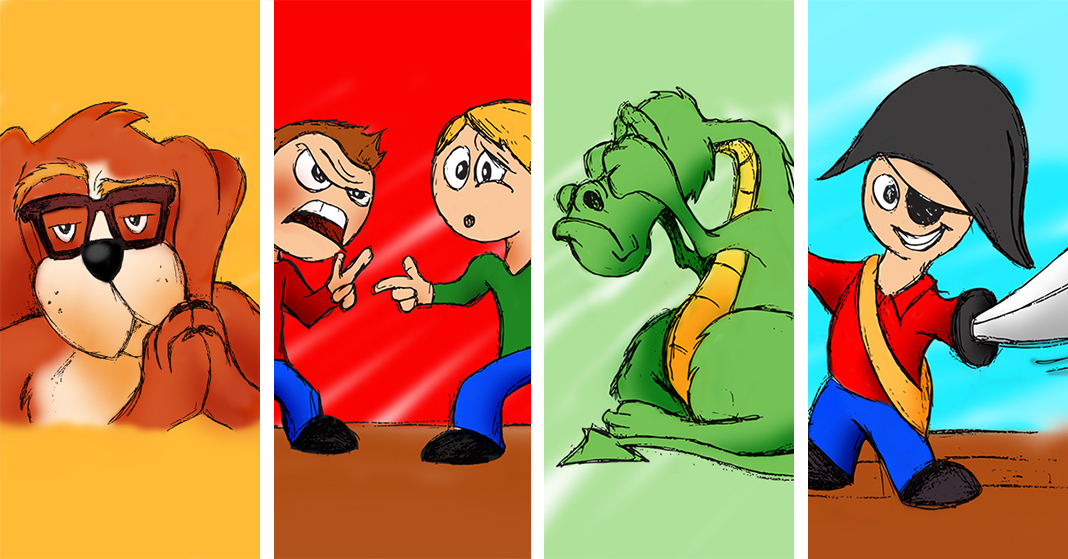
  • Write a short story that ends with “And that’s what happens when you’re raised by pirates.”
  • Start a short story with “This time, it was the princess’s turn to rescue the dragon.”
  • Write a scene in which two characters say this to each other: “So what’s your plan?” “My plan was to follow your plan!”
  • The government has developed an intelligence-boosting drug, and one of the testers’ pets has been eating it. Describe what happens to the pet.
  • Write a short story that starts with the first line of a hymn.

If you would like to print out visuals for these story prompts, download a printable version.

You could put your collection of prompts into a story-prompt jar for your child to pick from once or twice a week. What kind of stories will your young writer create? We’d love to hear about them!


Save

Filed Under: Successful Learning Tagged With: creative writing, story prompts, teaching writing

Activity for Simplifying Ratios

February 22, 2018 by Ben

simplifying ratios cover
Ratios compare two quantities that are related. It’s a concept that can be challenging for kids to understand. As a child, I could solve problems related to ratios, but I never quite “got it” . . . that is, until my mother was teaching me how to half a recipe. For the recipe to work, the relationship of all the ingredients needed to remain the same. So, we divided all of the parts by two.

My mom wasn’t trying to teach me a math lesson that day, but she pointed out how important ratios are in the kitchen to solve a basic problem. I received understanding that day by getting my hands involved in learning as we solved an actual problem.

We can help children begin with understanding if we start teaching math with a hands-on activity that solves a real-world problem. So here’s a simple activity to help children master the concept of ratios and use them to solve a problem. I found the inspiration for this activity in BJU Press’s Math 5 Teacher’s Edition, where you can find scores of other hands-on activities that can help your children understand math concepts.

Making a snack

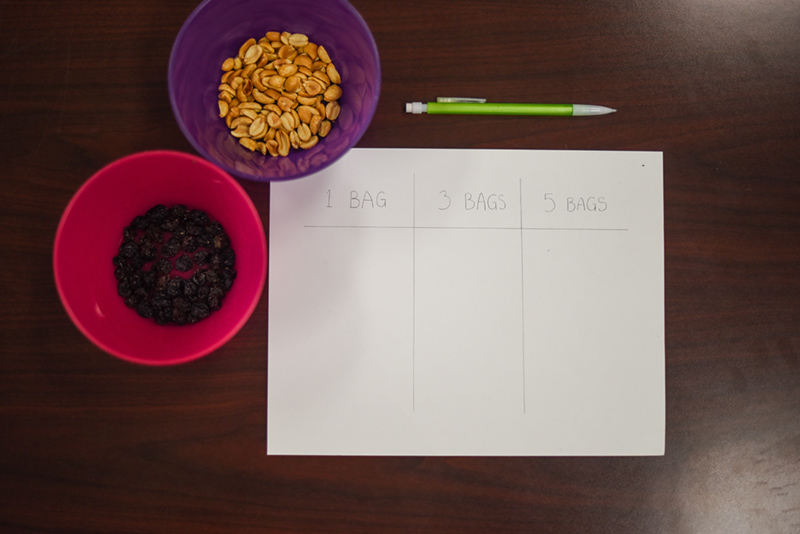
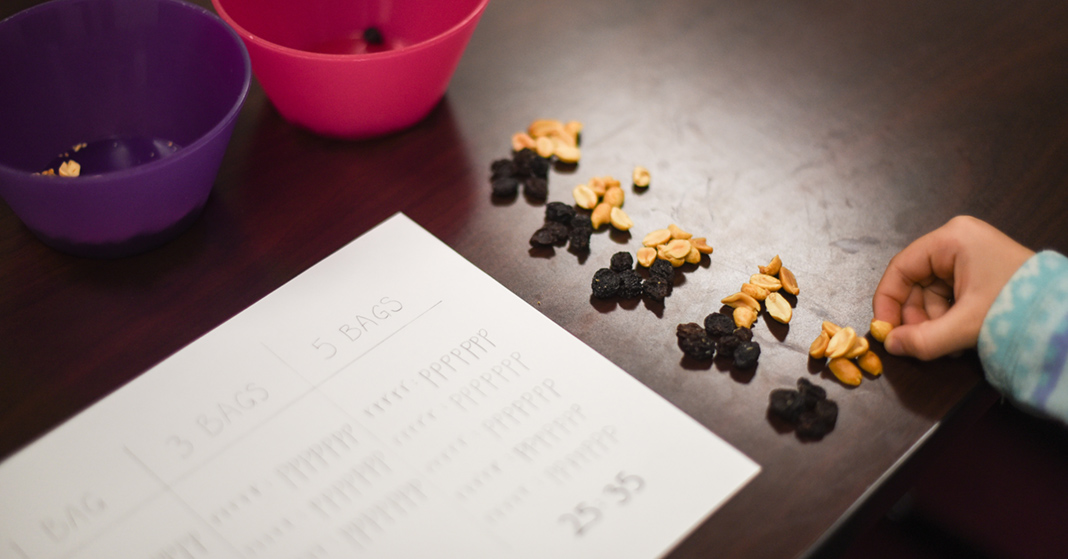
We want to make a simple trail mix for a hike. Each member of our family needs a miniature snack bag of raisins and peanuts.

We want to have a consistent snack bag, so each bag needs to have 5 raisins for every 7 peanuts. Ratios can help us get the right amount of ingredients for every family member to have the same snack.

simplifying ratios materials

Sketching out the ratios

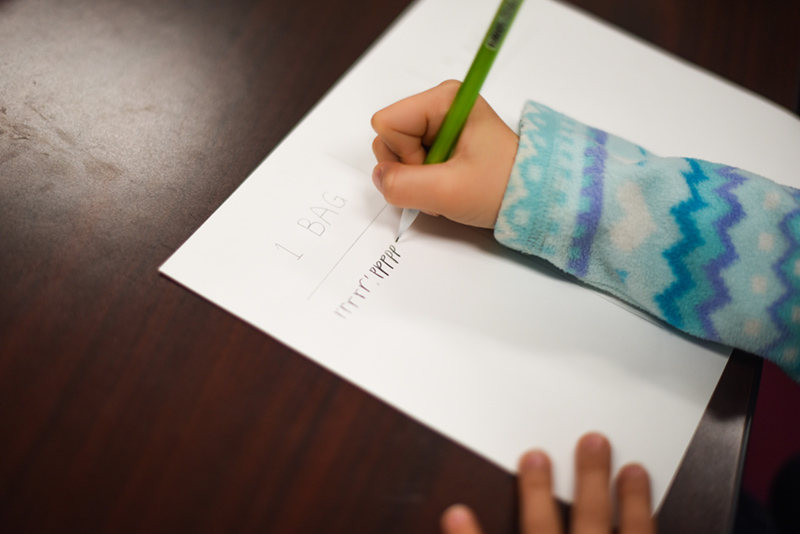
Let’s start with paper and pencil, but without diving into abstract equations. To help children grasp the idea of ratios, we can represent each raisin with the letter r and each peanut with the letter p. We use a colon instead of the word to. Let’s start with just one bag.

1 bag

  1. rrrrr:ppppppp

Your child probably won’t need to count, but let’s write out the ratio for one bag.

5 raisins: 7 peanuts

So counting the r’s and p’s will be more helpful when determining the number of raisins and peanuts needed for the three children on the hike.

simplifying ratios procedure

3 bags (3 children on the hike)

  1. rrrrr:ppppppp
  2. rrrrr:ppppppp
  3. rrrrr:ppppppp

15 raisins: 21 peanuts

How many r’s are there? How many p’s?

Does the number of raisins or peanuts change for each bag? This question helps your child see that a ratio is expressing a consistent relationship, in this case raisins and peanuts in the miniature snack bag.

Now let’s suggest we make bags for Mom and Dad too.

5 bags (total family members)simplifying ratios sorting

  1. rrrrr:ppppppp
  2. rrrrr:ppppppp
  3. rrrrr:ppppppp
  4. rrrrr:ppppppp
  5. rrrrr:ppppppp

25 raisins: 35 peanuts

Now your child can count the r’s and p’s or multiply each number in the ratio by 5 to determine the total number of raisins and peanuts needed for the hike. You might also want to mention to your fifth grader that writing out r’s and p’s is useful for seeing how ratios work, but it’s not a fast way to solve the problem. Multiplying is the quickest way to solve with ratios.

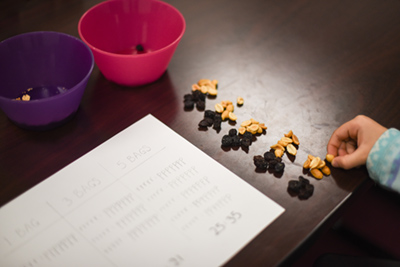
So for the whole family, we need 25 raisins and 35 peanuts.simplifying ratios completed

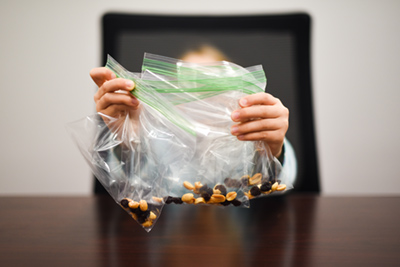
Now have your fifth grader count out the total number of raisins and peanuts into distinct piles of 5 raisins and 7 peanuts each. Then put the piles into sandwich bags. Of course, you could adjust the snack portions according to your family’s needs. Now you’re ready for a hike!

Using Ratios

Ratios are useful in helping us determine the total needed before we begin the project. That way we can check our supplies before we get started and make a run to the grocery store if needed. Once we’re ready to begin a project, the ratios help us create consistent snacks.

Consistency is critical in baking at home. But ratios also help construction workers, restaurant owners, manufacturers, and a host of other professionals as they order the appropriate amounts of supplies before they begin a large-scale project. And they will use ratios to consistently use those supplies. When children see how they can use ratios like professionals do in planning and executing projects, they will have a concrete understanding of the concept.

Filed Under: Successful Learning Tagged With: hands-on learning, math, Math 5, Teaching for Understanding

Loving Your Homeschool Pets

February 20, 2018 by Jenna

love your pet day
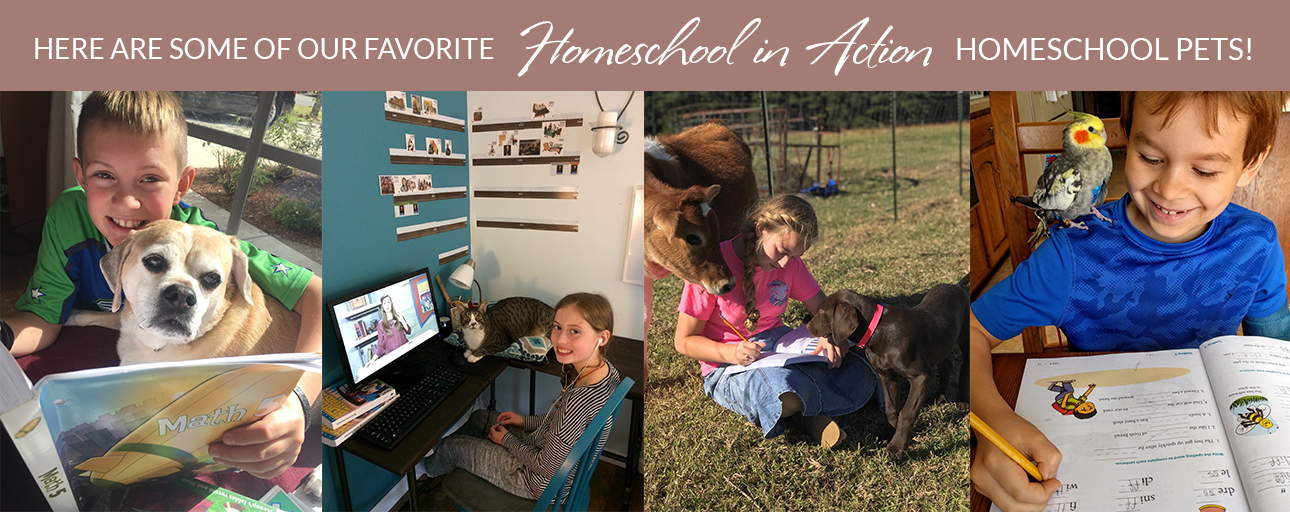
Did you know that today, February 20, is national Love Your Pet Day? It’s also the perfect day to bring your homeschool pets in on the learning.

In October last year, BJU Press invited you to share photos of your homeschool experience with us in the Homeschool in Action Photo Challenge, and one of the categories was “homeschool pet.” Inspired by some of our favorite entries to the homeschool pet category (see below), here are some little-known facts about pets.

Dogs

  • Every dog’s nose print is as unique as a human fingerprint.
  • Dogs aren’t completely colorblind. They have receptors to see blue and yellow.
  • They also have night vision.
  • Australian shepherds aren’t from Australia. They’re an American breed.

Find out more about dogs from the American Kennel Association.

Cats

  • The design of cats’ ears helps them to survive falls from more than thirty stories high.
  • A group of adult cats is called a clowder, and a group of kittens is a kindle.
  • A cat’s tongue feels rough because it’s covered with tiny barbs that direct food to the throat. These barbs also help them drink and groom.
  • When a cat rubs against you with its nose, it’s saying it likes you. Cats use the scent glands on their cheeks to mark their territory.

Get more facts about cats from Purina.

Cows

  • Cows can see in color.
  • You may have heard that cows have four stomachs, but it’s really only one with four compartments. The main one can hold up to fifty gallons of food.
  • A cow typically spends six to eight hours a day eating and just as long chewing its cud.

Learn more about cows from Farms for City Kids.

Cockatiels

  • Australian shepherds may not be from “down under,” but cockatiels certainly are!
  • Cockatiels enter their nests tail-first.
  • A cockatiel can mimic sounds much like a parrot does.

You can find out more about cockatiels from Kids Answers.

Keep an eye out on our Facebook and Instagram pages because we’ll be sharing our own pets with you soon. Want to share your homeschool pets with us? Be sure to use the hashtag #lovemyhomeschoolpet and tag us with @bjupresshomeschool.

homeschool in action love your pet day


Filed Under: Successful Learning Tagged With: birds, cats, cows, dogs, homeschool pets, pet facts

The Dangers of Comparison

February 15, 2018 by Megan

pray about comparison“Homeschool moms are like bullies. They can be brutal to each other.”

Ouch. My friend’s blunt statement shocked me a bit, but I knew it was true, at least to a degree. My own heart’s wounds bore testimony, and, if I were really honest with myself, I knew I had probably inflicted wounds on other moms’ hearts too.

Sometimes my wounds came from direct hits—someone would say something that would sting, that would make me want to run and find a quiet place to weep. Sometimes the hits were more indirect as I struggled with being left out of some of the homeschool subgroups around me.

But none of those wounds compare to the ones that I continually inflict on myself. The ugly truth is that I am my own biggest bully through comparison.

Discouragement and Defeat

A lot of my heart-wounds have come from comparing myself to other people. I’m very good at uncovering the ways I come up short in comparison to others. So my thoughts are too often filled with if onlys. If only I were smarter, prettier, more in shape, had better-behaved children and so on, things would be so much better.  These lies do nothing but provide fuel for my feelings of discouragement and defeat.

Pride

Of course, comparing myself with others sometimes has the opposite effect, puffing me up with so much pride that I can’t see myself clearly. Sins go unnoticed and unconfessed. My relationships suffer. The damage is awful.

Fighting Comparison with the Gospel

So how do I fight back against my inner bully? By skillfully wielding the sharp, two-edged sword given to me by my heavenly Father—His Word. I must saturate my mind with the Bible if I am to have any hope of victory at all.

My best defense when I am tempted to compare myself with others is to meditate on the gospel. The gospel reminds me that I am precious in the sight of God—so precious that He paid the ultimate price for my redemption. I may not be as pretty as Mary, as smart as Jane, or as organized as Susan, but with all my faults and failings, I am beloved by my Father in heaven.

The gospel also reminds me that without Christ, I am nothing. So what if I excel in a particular area?  All those feelings of self-righteousness are filthy rags before an all-holy God.

Comparison is a dangerous business. If you struggle with this like I do, I highly recommend the book The Battle Within by J. Robin Wood. She includes scriptural battle plans for fighting off pride and other damaging emotions as well as showing how to deal biblically with the expectations that we place on ourselves. If you’re interested in learning more about how this book has helped me, check out my earlier post “Hope for a Weary Soul.”

Filed Under: Shaping Worldview Tagged With: comparing homeschools, comparison, encouragement, homeschool families

  • « Go to Previous Page
  • Page 1
  • Interim pages omitted …
  • Page 66
  • Page 67
  • Page 68
  • Page 69
  • Page 70
  • Interim pages omitted …
  • Page 152
  • Go to Next Page »

Primary Sidebar

As parents, teachers, or former homeschool students, we are passionate about homeschooling from a biblical worldview. We hope these teaching tips, fun activities, and inspirational stories support you in teaching your children.

Email Signup

Sign up for our homeschool newsletter and receive select blog posts, discounts, and more right to your inbox!

Connect with Us!

                    Instagram     

Read Posts on Specific Subjects

Early Learning
Foreign Language
History
Language Arts
Math
Science

Footer

Disclaimer

The BJU Press blog publishes content by different writers for the purpose of relating to our varied readers. Views and opinions expressed by these writers do not necessarily state or reflect the views of BJU Press or its affiliates. The fact that a link is listed on this blog does not represent or imply that BJU Press endorses its site or contents from the standpoint of ethics, philosophy, theology, or scientific hypotheses. Links are posted on the basis of the information and/or services that the sites offer. If you have comments, suggestions, questions, or find that one of the links no longer works, please contact us.

Pages

  • About BJU Press
  • Conversation Guidelines
  • Terms of Use & Copyright

Archives

© 2026 · BJU Press Homeschool