• Skip to primary navigation
  • Skip to main content
  • Skip to primary sidebar
  • Skip to footer

BJU Press Blog

  • Home
  • Shop
    • Shaping Worldview
  • Simplified Homeschool
  • Successful Learning

When Homeschooling Gets Hard

March 27, 2018 by Megan

homeschool encouragement on a bench
Sometimes homeschooling is not fun.

Like when you’ve been up most of the night with a sick baby. Or when you have serious cabin fever after being stuck inside for days. Or when your to-do list is overwhelming you—again.

In the craziness of trying to manage a busy household, sometimes it is tempting to look for an easier way. A different schooling option. A curriculum that requires less work from me.

I’ve had moments when I’ve wanted to completely abandon this homeschooling adventure, and if you’ve homeschooled for any length of time, you’ve probably have had those moments too.

But then there are moments that remind me why I started on this homeschooling journey in the first place. For example, before Christmas, my third grader and I were reading an article in Reading 3 about astronauts and what they thought about God. After reading Gherman Titov’s remarks about how he hadn’t seen anyone out there in space so he couldn’t believe in God, my daughter stopped reading and said, “Well, of course, he couldn’t see God! God is a Spirit.”

And that wasn’t the only clue that she was beginning to see the world through a biblical worldview. One day, when we were on our way to our weekly piano lesson, she told me,  “Even though I’m not very good at piano yet, maybe someday I’ll be able to play well enough to play hymns so other people can sing along to worship God.”

It’s sometimes tempting to think of homeschooling as a burden. But it’s not. Homeschooling is an investment. It’s an investment that costs me significant time and resources. But it’s worth it. My daughter is worth it. She’s getting more than just a quality education. She’s learning how to view the world around her through scriptural eyes. That’s the most important thing I could ever teach her.

Weary mom, take heart. You will never regret the investment that you make in your child. The days may be long now, but you, your children, and even your grandchildren will reap the benefits of your investment for years to come.


Filed Under: Simplified Homeschool Tagged With: encouragement, hard days, homeschooling

A Third-Grade Probability Activity

March 22, 2018 by Megan

Probability activity with pom poms
Probability. It’s the reason my kids are required to wear a helmet when riding a bike and a seatbelt when riding in the car. It’s what determines the rate I pay for home and auto insurance and what helps me decide whether it’s worth purchasing an extended warranty for my vehicle. And it’s a challenging concept for an eight-year-old to grasp.

I know because my husband and I tried to explain it when we introduced our third grader to the board game Settlers of Catan. But she didn’t get it. Probability was a brand-new concept for her and, as with all new math concepts, she needed a hands-on activity to help her understand how it works.

Thankfully, Math 3 from BJU Press uses a simple hands-on activity to illustrate the concept of probability.

Materials Needed for This Probability Activity

  • Five different colors of pom-poms (blue, green, purple, red, and orange)
  • Small opaque bag
  • Printout

probability activity materialsGet Ready for Learning Success

Start by putting pom-poms in the bag (5 blue, 5 green, 2 purple, 2 red, and 1 orange). Explain to your child that the term probability refers to how likely or unlikely something is to happen. Ask him to predict what color pom-poms he will most likely get when he pulls out one. What color(s) is he least likely to pull out?

probability activity handoutDeepen Understanding Through Discovery

Now, it’s the child’s chance to test out his predictions. Instruct your child to reach into the bag and pull out a pom-pom without looking. Then he should make note of the color by placing a tally mark in the corresponding column on the probability handout before tossing the pom-pom back into the bag. Do this twenty times. (Hint: If you have preschoolers at your house, this is a great activity to get them involved in “school” too. Have them pull out the pom-poms one by one and see if they can name the color.)

doing the probability activityCommunicate Results

Now it’s time to do something with that data. Help your child turn the tally chart into a bar or line graph and report the findings. Did his predictions match the results? Why or why not?

My third grader was so fascinated by this activity that she wanted to do it again. So she did—several times in fact.  Each time she used a different mix of pom-pom colors and tried to predict the results. As her understanding grew, so did the accuracy of her predictions. And so did her excitement about learning. It was a great day.

Be sure to check out BJU Press’s Math 3 curriculum, which inspired this activity. You can get ideas for more math activities by clicking on the links below.
Dividing Fractions a Simpler Way
Activity for Simplifying Ratios

charting probability activity

Filed Under: Successful Learning Tagged With: homeschool math, math, math manipulatives, probability

Multicultural Literature Sparks Kingdom Thinking

March 20, 2018 by BJU Press Writer

multicultural literature artifacts

Why Should You Teach Multicultural Literature?

We humans can easily get caught up in our own little worlds. This is especially easy to do when life gets busy. However, incorporating multicultural literature into our children’s education is worth the effort because of what it teaches them.

Made in God’s Image

It’s important to teach our children that God made all people in His image (Genesis 1:27). As image-bearers, people from around the world use their gifts to contribute to art and literature, and we can learn from their perspectives.

United in Christ

Additionally, we have brothers and sisters in Christ from around the world! Revelation 7:9 says that “all nations, and kindreds, and people, and tongues, stood before the throne, and before the Lamb.” Reading multicultural literature provides an opportunity to explain to our children that, even though we may be from different cultures, we still can fellowship with people from around the world and will one day fellowship with them in heaven.

Of course, we can value and learn from multicultural literature even if it is not written by Christians. Knowing that we will share heaven with people from around the world should make us interested in their perspectives.

Bubble Popped, Eyes Opened

Every culture has its strengths and weaknesses that we can learn from. As a junior in high school, I had the opportunity to go on a missions trip to Saint Vincent, an island in the Caribbean. Experiencing the third-world conditions, my little American self felt stretched. But I learned so many valuable lessons from experiencing a different culture.

I experienced the joy of having the connection of Christ with people that I had nothing else in common with. I also learned from the strengths of the island culture. As an American, I was used to structure and time-sensitivity. Yet the island Christians had a good sense of what is ultimately important—people. Timeliness is important, and we should still be conscious of that. But, in the end, people trump time and my agenda. Typically, it’s harder for us to evaluate our own culture since we see it as the norm. But when we contrast it with another culture, it’s easier to separate our cultural traditions from what is actually biblical.

The people there were also thankful for the little things, and was I ever thankful for a bed that didn’t have bugs crawling through it when I got home! In more ways than one, I came back changed: I had a new perspective—a more thankful one. I also had a burden for souls around the world.

Whether you send your child on a missions trip or not, you can still teach them some of these valuable lessons through other people’s literature and art.

How Can You Incorporate Multicultural Literature?

Even if you see the value of incorporating multicultural literature, it may seem like an intimidating goal. BJU Press has taken that stress away by making available excellent resources that can guide your child through diverse literature from a biblical worldview perspective.

I was especially impressed with American Literature. In our American Literature textbook, your child will read excerpts from slaves like Phillis Wheatley and Frederick Douglass to Harlem Renaissance poets including Langston Hughes and Countée Cullen. He will also experience life from Asian American perspectives like Li-Young Lee and Amy Tan and Latino American perspectives like Sandra Cisneros—all in light of a biblical worldview.

The Teacher’s Editions is also extremely valuable in helping you navigate these different cultures. As you embark on this journey of educating your child, BJU Press is committed to supporting you along the way.

Are You Promoting Kingdom Thinking?

As we learn from image-bearers around the world, our perspectives broaden, and we are reminded of what heaven will be like—beautifully diverse and united in Christ.

• • • • •

Stephanie holds a bachelor’s in English education, and her favorite type of literature is multicultural literature. She is passionate about helping people know and defend their faith and is currently working on a master’s in Christian apologetics. In her free time, Stephanie enjoys spending time with her husband, crafting, and reading apologetics books, particularly works by C. S. Lewis.

Filed Under: Shaping Worldview Tagged With: literature, multi-ethnic literature, multicultural literature, teaching literature

In-Depth Worldview Education

March 15, 2018 by Ben

worldview education globes
Some Christian educators watch with concern as students finish a “Christian worldview education.” They observe that sometimes these students are too quick to label ideas such as feminism and Marxism in order to dismiss them without engaging with understanding.

This can be a real problem. If students fail to understand ideas that they don’t agree with, they won’t be able to communicate thoughtfully about false worldviews. But what can we do to help them think biblically about distorted worldviews?

The problem is not with worldview education but with how worldview is taught. Worldview education must go beyond rote memorization of charts with categories. Instead, students must be taught to analyze from the correct biblical perspective (i.e., through the lens of  Creation, Fall, and Redemption). Only then will they be able to evaluate precisely how false worldviews twist God’s good design.

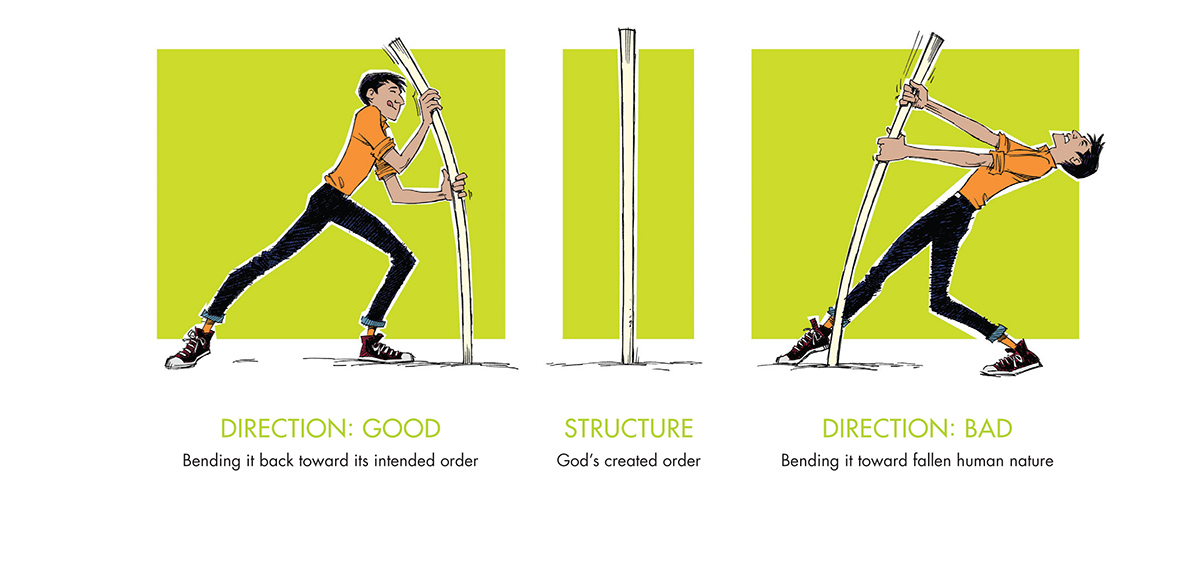
One way to represent Creation, Fall, Redemption is to illustrate it with the terms structure (God’s creational norms) and direction (bending God’s norms in a fallen direction or bending fallen direction back towards God’s creational design). In other words, children must understand how creational norms and sinful direction work in the formation of wrong ideas.

Creational Norms

We teach our children in order to impart wisdom to them, but where can wisdom be found? It begins when our children fear the Lord by submitting to His wisdom rather than embracing evil (Prov. 9:10). God reveals His wisdom in Scripture, but Scripture also directs us to observe God’s wise design in creation (Ps. 19:1; Prov. 8:22–31).God created His world to work in a certain way—according to His blueprint of wisdom.  So paying attention to how God created the world to work in the beginning reveals principles for living according to His wise design in the present. These principles can be called “creational norms” because they were present at creation.

There are creational norms for marriage (Matt. 19:4–8), economics (Exod. 20:9; 2 Thess. 3:11–12), science (Gen. 8:22), and every other facet of life (Isa. 28:24–29). In some areas, we have direct comment from God’s Word. Others come through careful observation of creation.

Sinful Direction

Of course, each of us is corrupted by the Fall. We inevitably bend God’s creational norms in a way that suits our sinful ways. Some people push against the norms a little and some push a lot. In every case, sinners think of their vision of bent norms as correct and natural. While false worldviews can’t completely ignore creational norms, they bend those norms to fit their vision for individuals and society. The creational norms are still present but in a twisted state.

Redemptive Direction

The challenge for believers is discerning between what part of the sinner’s vision is creational and what part is sinful direction. Christians have an obligation to identify creational norms. Of course, we’re going to engage with many ideas that push these norms in a bad direction. Some of these bad directions have been codified into law and large institutions.

When we encounter these norms, bent in a sinful direction, we should seek to live faithfully in light of redemption by pushing back in a redemptive direction, that is, back toward their creational state.worldview education direction vs. structure

The Case of Marriage

Creational Norm

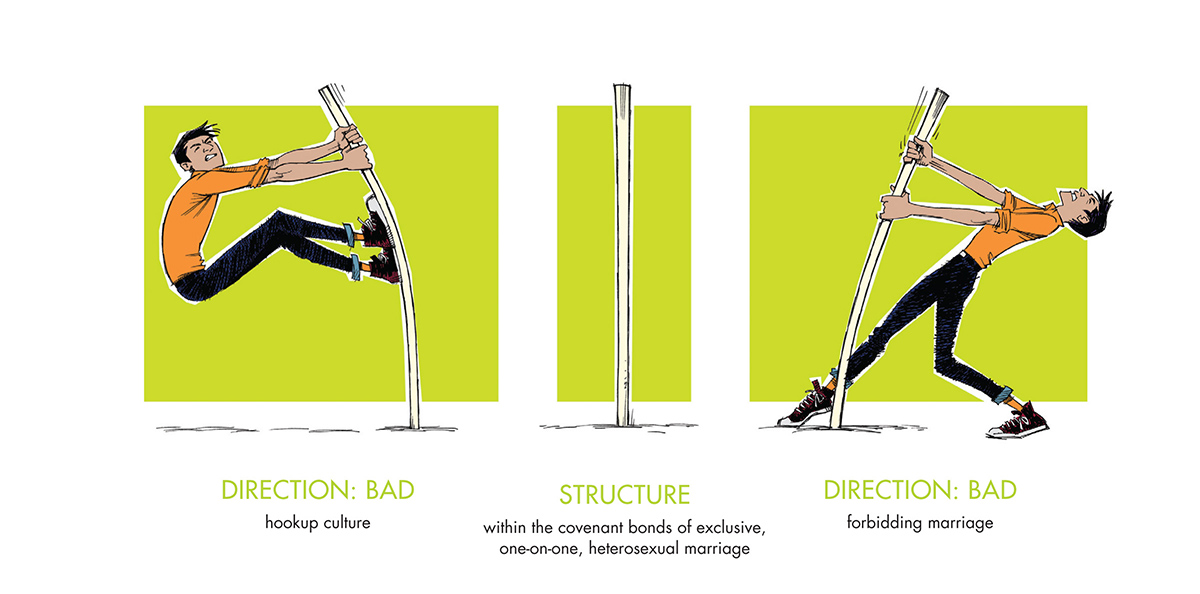
A discussion of creational norms and sinful direction is difficult to understand without an example. So let’s examine marriage as an illustration of how these principles work out. God created marriage when He made humans male and female. He even gave us a direct word on what marriage should look like in Genesis 2:23–24. This passage outlines the creational norm for marriage.

Fallen Direction

Very quickly after the fall, people started bending marriage in various sinful directions. Polygamy and serial divorce were and continue to be serious examples of bending marriage in a sinful direction.

worldview education bad direction vs. structureRedemptive Direction

When God graciously gave his people the law, He pressed them towards the creational norm. We might have predicted that He would ban divorce, but He didn’t. He regulated it very strictly (Deuteronomy 24:1–5). God put in place legal protections for women being divorced by their husbands.

God still hates divorce; Jesus made that clear. But He understood that the people were evil and were going to divorce, so He established laws that protected a woman when a husband decides to divorce.

Reformation

When the Lord graciously gave Israel laws, He modeled a reformational approach to creational norms that has been twisted by the Fall. In a civil setting, He moved His people towards His creational norms without legally requiring something they would not do. To be clear, God calls us to take radical action against personal sin. But in the civil setting, His laws guided His people like children to make reasonable steps toward the norm.

Reformation requires nuance and understanding of the creational norms and the false worldview. Only then can we discern a corrective step that doesn’t create the chaos that comes with radical measures.

Effective Worldview Education

When we teach our children science, history, math, and literature, we want them to develop skills in finding creational norms. As our children grow, they need to learn to understand and evaluate false worldviews that twist creational norms. Finally, our children need to begin learning to create steps to reform within their context.

This kind of worldview education produces children who do more than dismiss. It enables them to create reformation steps in their generation. To help you equip your children to do just that, BJU Press provides in-depth treatment of these concepts in our Biblical Worldview textbook. 


Filed Under: Shaping Worldview Tagged With: biblical worldview, Christian Homeschooling, Creational Norms, Marriage

Literary History: The Missing Links of Literature

March 13, 2018 by Jenna

literary history library
Do you ever feel that, even if your child is doing well in literature, he’s not actually benefiting from it? Literature was always my best subject, but there were many aspects of literature that didn’t always connect for me. I always thought the stories were interesting enough in themselves without all the historical detail. Most discussions about literary history seemed to come from the dustiest and most disused corners of the library.

It’s easy to unintentionally let literature become an island subject. Math almost demands a constant connection to reality, and science and history don’t exist without the real world. But for readers and nonreaders alike, literature can seem like a complete subject with just the stories themselves.

But literature means much more when you understand who the author is and where he or she is coming from.

Understanding Literary History Deepens Meaning

For example, take Jack London. Though London is better known for his novels Call of the Wild and White Fang, your child will study his short story “The Law of Life” in American Literature. In “The Law of Life,” the story follows Koskoosh, an old man who accepts that it’s his time to die. He can no longer contribute to his tribe, so he passively waits for the end. His tribe always leaves the elders behind to die.

I’ve never liked London’s writing because everyone always seems to die, even the dogs. But your perspective on London’s writing changes when you approach it knowing some important history.

London worked hard his whole life, whether he was writing or working in a factory. But no matter what he did, he found little success. His best-known works are all from this period of his life. His efforts to raise himself above the station of his birth largely failed for much of his life. He finally began publishing in leading magazines in the early 1900s. London lived during the height of the progressive movement in the United States and when On the Origin of Species was gaining ground in academic communities. As a result, Darwinism and the beginnings of the American socialist movement were big influences on him.

Knowing these facts, the meaning of “The Law of Life” changes subtly. It’s not just a simple story about an old man giving in to death. Instead, it becomes a statement about how a man, as little more than an animal himself, should accept the inevitability of his death. He once was able to live and contribute, but since he is no longer able, he has no purpose. He must die.

Countering Literary Ideologies Sharpens Thinking

Literature is an ideal vehicle for teaching beliefs. In a story, the author gets to tell everything from one side, and it all makes sense. But without an understanding of literary history, a child may not always see the truth about what he’s reading. After all, from a certain point of view, London’s beliefs about life and death make sense. You should replace a tool once it’s broken or too old to work, shouldn’t you? Animals are often put to sleep once they become too old and sick, aren’t they?

Looking at literature from a historical perspective gives you an opportunity to discuss many of the beliefs that authors have poured into their writings. Once your child is able to recognize the false beliefs that contribute to an idea, he should also learn how to counter them from a correct biblical worldview. Our response to Jack London’s beliefs could be to point out that people are neither tools nor animals. God cherishes the souls of His image-bearers, no matter what they’re physically capable of.

If your child learns to make connections between authors and their backgrounds and beliefs and learns how to assess the beliefs he encounters, he’ll be better equipped to face similar issues in other media, such as movies, TV shows, and even music.

Filed Under: Successful Learning Tagged With: homeschool, Literary history, literary ideologies, teaching literature

  • « Go to Previous Page
  • Page 1
  • Interim pages omitted …
  • Page 65
  • Page 66
  • Page 67
  • Page 68
  • Page 69
  • Interim pages omitted …
  • Page 152
  • Go to Next Page »

Primary Sidebar

As parents, teachers, or former homeschool students, we are passionate about homeschooling from a biblical worldview. We hope these teaching tips, fun activities, and inspirational stories support you in teaching your children.

Email Signup

Sign up for our homeschool newsletter and receive select blog posts, discounts, and more right to your inbox!

Connect with Us!

                    Instagram     

Read Posts on Specific Subjects

Early Learning
Foreign Language
History
Language Arts
Math
Science

Footer

Disclaimer

The BJU Press blog publishes content by different writers for the purpose of relating to our varied readers. Views and opinions expressed by these writers do not necessarily state or reflect the views of BJU Press or its affiliates. The fact that a link is listed on this blog does not represent or imply that BJU Press endorses its site or contents from the standpoint of ethics, philosophy, theology, or scientific hypotheses. Links are posted on the basis of the information and/or services that the sites offer. If you have comments, suggestions, questions, or find that one of the links no longer works, please contact us.

Pages

  • About BJU Press
  • Conversation Guidelines
  • Terms of Use & Copyright

Archives

© 2026 · BJU Press Homeschool