• Skip to primary navigation
  • Skip to main content
  • Skip to primary sidebar
  • Skip to footer

BJU Press Blog

  • Home
  • Shop
    • Shaping Worldview
  • Simplified Homeschool
  • Successful Learning

math

Math Doesn’t Have to Be Scary

January 5, 2016 by Justin

In middle school, I had a math teacher who always began class the same way. He would assign each of us a problem from our homework assignment the night before and have us put it on the chalkboard. We would have to give our answer and show how we got it. My teacher would then label each problem as correct or incorrect. I was fairly good at math and generally got the problem right, but I remember always being terrified that I would do something wrong and that my work would be picked apart in front of the class. I can only imagine how my classmates who struggled with math must have felt. The beginning of math class was my least favorite part of the day. It was probably a nightmare for many others, leading to the “I hate math” mentality that’s so common.

Math is a subject that often creates frustration for both parent and child, but a lot of that frustration can be avoided by using the right approach. When children answer the question correctly on their first try, we celebrate; when they get a question wrong, we tend not to applaud their efforts. These responses can lead your child to believe that there’s no room for mistakes and that getting the correct solution the first time is what they should be trying for.

Working toward understanding

Assessing your child’s level of understanding based on whether or not he gets a question correct on the first try can be misleading. The truth is that a wrong answer can be just as valuable as a correct answer because it helps build a strong understanding of the process used to get to the correct answer. Also, a correct response does not always mean your child has a strong understanding of the concept. It’s important that children know how to learn from their incorrect answers. When mistakes happen, help your child identify all the correct parts of the problem before looking at where things went wrong.

Curriculum matters

Your math curriculum plays an important role in teaching for understanding. Choosing a curriculum that promotes critical thinking over rote memorization is critical. Math problems should ask your children to explain a concept rather than quickly find a solution. Approaching math this way allows children to explore problem-solving strategies. It also teaches them to recognize that there’s often more than one way to understand a concept.

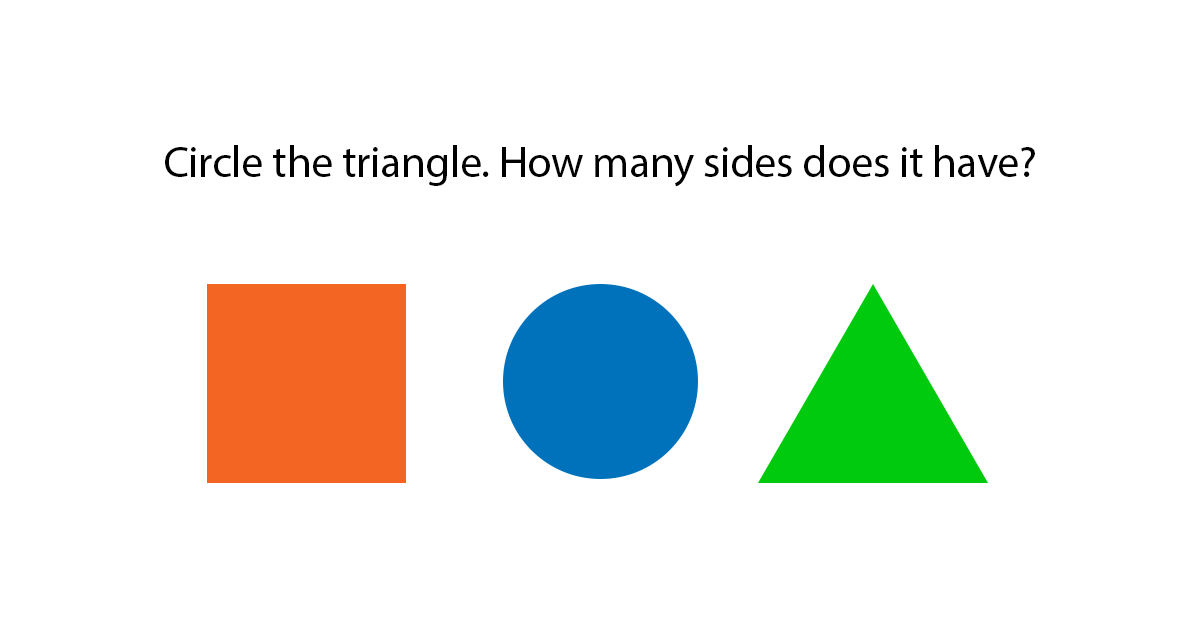
Here’s an example of a typical first-grade geometry question.
WP-sample-math-12-2015

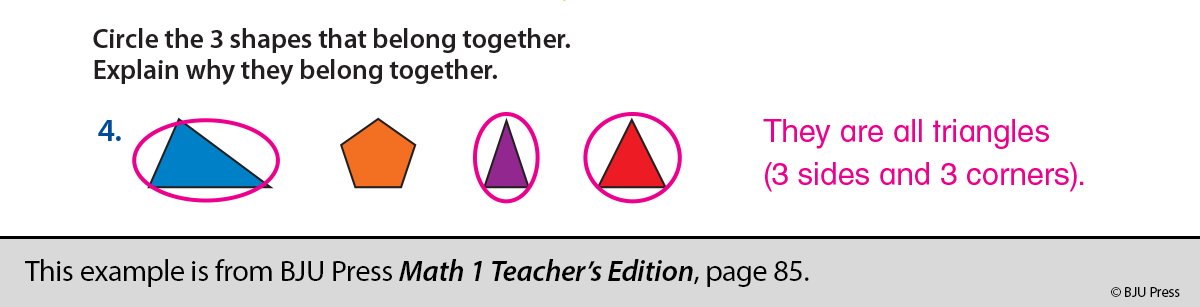
Here’s another question based on the same concept in a way that better promotes understanding.
WP-Math-1-TE-12-2015

The second question allows you to more accurately gauge your child’s understanding of the concept. Including triangles that differ from the typical equilateral type leaves the question open ended. This type of question helps children learn to identify triangles based on the number of sides and corners instead of memorizing what a triangle typically looks like.

When working through this question, your child may not immediately understand that all three-sided, three-cornered shapes are triangles.  But this question provides an opportunity to illustrate the math concept using the three different triangles provided.

Math is a lot less overwhelming to children when they’re working to understand and not just memorize. BJU Press Math provides questions and teaching strategies that can help you put an end to your child’s math frustration.

Filed Under: Successful Learning Tagged With: math, triangles, understanding

Hands-on Learning Involves the Whole Mind

September 17, 2015 by Meredith

telescope outside in backyard on starry night

Family gatherings provide memorable educational experiences. When my dad’s side of the family gets together, we often spend time gazing up at the night sky. It can make for a long evening, but the whole experience is worth it!

Our family scientist sets up his telescope, someone checks the weather, and another person might pull up a star map of the night sky while the rest of us get chairs and blankets to make our hours outside in the cold night air more comfortable.

Once we’re all outside, the “lesson” gets started. We take turns viewing the surface of the moon, a nearby planet, or a passing meteor shower. Conversation centers on the local weather conditions, the size of a celestial object, the color something appears to be and why, or the speed of an object moving through our galaxy. Sometimes we just sit in awe of the greatness of our Creator.

By the end of our night together, we’ve all learned something new without even realizing it because our lesson has been conducted through hands-on learning.

Defining Hands-on Learning

Very simply, hands-on learning is involving one’s whole mind in understanding a concept or principle. The end goal is for the person to be actively involved in the learning process so that he or she can make connections and remember what has been taught. So how do you get that level of engagement for your child?

Involving the Whole Mind

There are two parts to facilitating hands-on learning. They also work hand-in-hand to make learning fun and memorable!

1. The Five Senses

God gave your child different senses that communicate to his brain and define memory. It’s through these experiences of hearing, seeing, smelling, touching, and tasting that he learns. These senses work together in that when something is experienced by more than one of the senses at the same time, that thing is more defined in his mind. There are times when his senses may be hindered (such as when he has a head cold). But maybe your child doesn’t have use of all five senses even when he’s healthy. God has given him everything he needs. If your child doesn’t have use of all five senses, he most likely has one or two heightened senses that compensate for any limitation.

2. Learning Styles

There’s more than one way to learn, but your child does have a predominant learning style that affects how he filters information. It’s important to understand what your child’s learning style is so that you can customize his lessons to fit his needs. Once you know how your child learns best, you can engage him in hands-on learning.

Applying Hands-on Learning

Hands-on learning involves including the different senses and your child’s primary learning styles as you teach and introduce concepts. Making connections in simple ways through different approaches (or senses) can be applied to all academic subjects. Here are some examples.

Science—constellations

  • View the night sky with your child. Sometimes the naked eye might work best when pointing out the whole constellation, but a pair of binoculars or a telescope could also be used. Your eyes will need about thirty minutes to adjust to the outside lighting.
  • Talk about the color, size, and distance of each star. Some constellations appear rather close together, but their stars are actually far apart.
  • Make a constellation finder or plot out the location of stars on a map of the night sky.

Heritage Studies—the American flag

  • Show your child a picture of the American flag. Point out the colors, stripes, and stars. Talk about the flag’s symbolism.
  • Listen to a recording of the national anthem and sing along. Be sure to point out the words that describe the American flag.
  • Draw, paint, or color a picture of the American flag. Discuss the proper way to display it.

Math—multiplication

  • Have an equation written out for your child to see. Another helpful visual might be to use a number chart.
  • Count out loud by a factor of the equation (2s, 3s, 4s, 5s, etc.) so that your child can hear the numbers.
  • Use math manipulatives to make simple groupings. Blocks, coins, and edible treats work well and can add some excitement.

Each of these ideas is simple enough to do at home. They make the learning experience much more enjoyable and engaging for the whole family. That’s hands-on learning at its best!

Filed Under: Successful Learning Tagged With: hands-on learning, history, learning styles, math, science, senses

Storytelling and Worldview

September 10, 2015 by Ben

three beach balls in the blue sky

At times the challenge of developing a biblical worldview in my three little girls, five and under, overwhelms me. How can I equip these young minds with something as complex as a worldview? The writings of Paul David Tripp encourage me. In particular, Paul’s simple explanations and illustrations demonstrate that I can develop my daughters’ worldview.

I love Paul’s story about his three-year-old son, who after falling down the stairs exclaimed, “Thank you!” When Paul asked his son who he was talking to, the boy responded, “The angels. And I know how they did it.”

“Who did what?”

“The angels! One stands on this side, and the other stands on that side. They both hold beach balls. When you start to fall, they put the beach ball out to keep you safe.”

Tripp observes that even three-year-olds interpret what’s happening. In this case, the conclusion was immature, and it confused Sunday school lessons with family vacations. But even very young children are capable of understanding stories, synthesizing them, and using them to explain daily occurrences.

Thankfully, our heavenly Father has given us His perspective in terms of a story. It’s a story that even toddlers and preschoolers can learn and use to interpret everyday life. It’s a true story with a beginning, middle, and end. It’s a story that dramatically affects the way we interpret the learning that makes up education. It’s the story of Creation, Fall, and Redemption.

Creation

The story begins with “God created the heaven and the earth” (Genesis 1:1). But when the story reaches Genesis 1:26–28, we learn that we’re special. God creates man and woman in His own image. God tells them to fill the world with little image-bearers and to take care of the world. Then He gives the first man a home (Eden), a wife (Eve), and a job (to name the animals and to work the garden).

Fall

Then Adam rebels and everything breaks. Death, sadness, and fighting come because of Adam’s wrong choice. His sin means that our hearts have been broken and our minds have been polluted. Adam and Eve make clothes out of fig leaves and then hide from God. Adam blames his wife for the sin, and Eve blames the serpent (Genesis 3:7–12).

Redemption

Next, we see that God immediately sets in motion His plan to redeem His fallen creation (Genesis 3:15). He promises that there will be conflict between the anointed one and the serpent. He promises that the anointed one will win and redeem God’s creation. This redemption plan is fulfilled in Christ’s death on the cross, His burial, and His resurrection from the dead.

The story applied to . . . math?

I share this story, not because it’s new or insightful, but because it’s simple and familiar. This is a story I share with my girls during family devotions. It’s a story they hear in Sunday school, and it affects the way they interpret learning, even math!

  1. Math is a powerful tool to help us take care of the world (Genesis 1:28)
  2. Because of the fall, some people use math to deny God (Romans 1:21–23)
  3. The people of God can live in light of redemption by using math to love their neighbors (Luke 10:27–28)

The Creation-Fall-Redemption story doesn’t make worldview shaping easy, but it does make it attainable for my precious little ones. Using this story to interpret learning is critical for providing my children a thoroughly Christian education.

Filed Under: Shaping Worldview Tagged With: biblical worldview, Creation, Fall, family, homeschool, math, Redemption

Grandmothers Can Be the Best Teachers

May 5, 2015 by Meredith

image of a grandmother and granddaughter video chatting.

With Mother’s Day just around the corner, I don’t want to overlook a very important group of women. They’re called grandmothers. And every child, no matter how old, knows just how grand they are. In fact, grandmothers often have the ability to encourage, inspire, motivate, and instruct children in a way that their own mothers cannot. At least, that’s the role my grandmothers have played in my own life, especially during the years I was homeschooled.

Distance often kept me from seeing my grandmothers face-to-face, but that didn’t stop them from taking an active part in my education. Here are some of the ways they got involved.

Language Arts

Grandma knew written words could make people feel special, and when I had to practice letter writing, she became my pen pal. Her round, flowing script wasn’t always easy to read, but what she wrote told me that I had sent her something important.

Another favorite past time Grandma shared with me as a child was reading. She would often send me books that Mom would incorporate into my lessons. Some of my favorite stories were the ones we read out loud while seated on her high, comfy bed. Uncle Wiggily was and still is quite the character.

Other ideas: Kids love solving puzzles, so try asking your grandkids to help you solve the newspaper’s daily crossword puzzle. Playing a simple game of hangman can reinforce proper spelling. Or start a reading club with just the two of you and later expand it to include their cousins and friends.

Math

Most of my time with both grandmothers was not spent in a kitchen. But in recent years, I’ve had the opportunity to collect their special family recipes and cookbooks. Cooking and baking can be great ways to practice math fractions, especially since the hard work results in a tasty treat.

Other ideas: Counting games are another way to teach sums and times tables. They can be done around the house or while running errands. If you work from home or own a business, your grandkids could play “office” by calculating orders. This teaching moment might work best with a mature young person.

History

Grammie told me stories she remembered about our family heritage. When I had a family genealogy project in elementary school, she sat on the couch for hours telling stories. This trip down memory lane for her gave me a deeper understanding of our family and broader perspective on the society in which she grew up.

Grandma took day trips with me and Mom to historical sites. It became “the thing to do” every time we visited. We often explored places on Georgia’s Antebellum Trail as well as the home sites of famous authors.

Other ideas: Share your perspective on a historical event that has taken place during your lifetime. Introduce your grandkids to people of character that you’re related to or who come from your area. This teaching moment can be done by viewing pictures or art, reading newspaper clippings, and visiting different places.

Science

Every morning Grammie would check her blood sugar and prepare her insulin. That daily routine of hers greatly fascinated me as a young child. It also helped me realize that science has many different facets—even if I didn’t want to learn them!

Other ideas: Demonstrate a plant’s life cycle by asking your grandkids to help you plant flowers or do yardwork. Spend time stargazing on a clear night, and share how our wonderful God made this planet a special place for us to live.

My grandmothers were my favorite teachers because they made ordinary events extraordinary and mundane tasks exciting. They helped me to gain perspective on the past, present, and future. But most importantly they simply invited me to be a part of their lives.

To all grandmothers: Thank you for choosing to invest in the next generation. May God bless you this Mother’s Day!

Filed Under: Successful Learning Tagged With: education, English, family, grandmothers, history, language arts, learning, math, Mother's Day, science

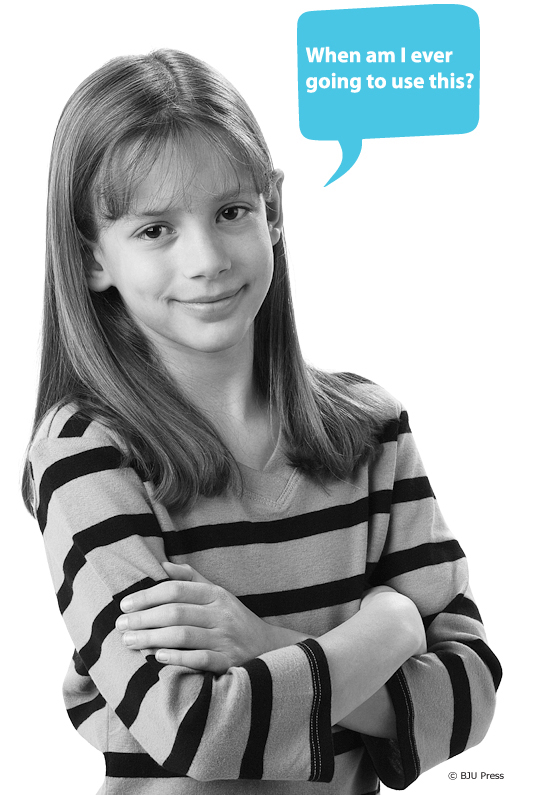
When Am I Ever Going to Use This?

February 10, 2015 by Eileen


WP-Real-World-Learning-2-2015

If your child hasn’t asked this question yet, he will. You probably asked it yourself many times while you were in school. And it is a valid question.

I don’t know many adults who do long division without a calculator or go through the newspaper underlining subjects once and predicates twice.

But consider how many of those grade school subjects have played important roles in your adult life. Were you thankful for your multiplication and division facts while standing in the supermarket last week deciding which brand of detergent to buy? Or when you wrote that important letter for your boss, were you glad you had finally grasped some of those tough spelling words? Did you still think music entirely unnecessary when you had to lead your Sunday school class in the opening singing time?

Depending on our individual fields of interest, we find much of what we learned as children is useful in some way. Even if we never use a particular skill again, learning it builds our overall knowledge and enhances our scope of appreciation. Practice develops our self-discipline, and knowledge develops discernment. How can we communicate this hope-giving truth to children?

Talk about the practical uses of school subjects as you encounter them in everyday life. Around the house, point out the ways you use math: measuring wall space for hanging a picture; adjusting recipes for cooking; balancing your checkbook and paying bills; figuring out medicine dosages; doing simple home repairs or rearranging furniture; measuring and cutting fabric for sewing. Let your child help you do some of these chores as part of his math lesson one day. Or encourage him to count the number of times in a day that he encounters the need for grammar in ordinary tasks—such as making a phone call or writing a journal entry. Have him write a letter to a family member on the computer and use the spell checker to correct his spelling.

For a practical idea on teaching your child how his school subjects may impact his life in the professional world, read How Would I Ever Use This?

How do you share practical uses of school subjects with your child?

Filed Under: Successful Learning Tagged With: communication, English, knowledge, language arts, math, skills, truth

  • « Go to Previous Page
  • Page 1
  • Interim pages omitted …
  • Page 3
  • Page 4
  • Page 5

Primary Sidebar

As parents, teachers, or former homeschool students, we are passionate about homeschooling from a biblical worldview. We hope these teaching tips, fun activities, and inspirational stories support you in teaching your children.

Email Signup

Sign up for our homeschool newsletter and receive select blog posts, discounts, and more right to your inbox!

Connect with Us!

                    Instagram     

Read Posts on Specific Subjects

Early Learning
Foreign Language
History
Language Arts
Math
Science

Footer

Disclaimer

The BJU Press blog publishes content by different writers for the purpose of relating to our varied readers. Views and opinions expressed by these writers do not necessarily state or reflect the views of BJU Press or its affiliates. The fact that a link is listed on this blog does not represent or imply that BJU Press endorses its site or contents from the standpoint of ethics, philosophy, theology, or scientific hypotheses. Links are posted on the basis of the information and/or services that the sites offer. If you have comments, suggestions, questions, or find that one of the links no longer works, please contact us.

Pages

  • About BJU Press
  • Conversation Guidelines
  • Terms of Use & Copyright

Archives

© 2026 · BJU Press Homeschool