• Skip to primary navigation
  • Skip to main content
  • Skip to primary sidebar
  • Skip to footer

BJU Press Blog

  • Home
  • Shop
    • Shaping Worldview
  • Simplified Homeschool
  • Successful Learning

Eileen

Avatar photo

About Eileen

Eileen is a language arts writer at BJU Press. She writes frequently outside of work and also teaches two university-level writing courses. Among her favorite pastimes are reading, hiking to waterfalls, and doing children’s ministry with her local church. Read more posts by Eileen.

The Story Behind Benjamin’s Sling

December 5, 2016 by Eileen

When JourneyForth approached me about writing a Christmas picture book, I jumped at the chance. What could be more enjoyable? I loved writing, I loved the poetic possibilities of the picture book genre, and I loved Christmas. Of course, this was something I wanted to do.

But as I tossed around ideas for the project over the next several weeks, I couldn’t seem to settle on anything. What could possibly be said about Christmas that hadn’t already been said? Or perhaps the better question was how the age-old truth about the meaning of Christmas could be presented in a fresh way. I began to pore over the accounts of Christ’s birth in Scripture, and then I turned to mining my own experience.

book cover of Benjamin's Sling by Eileen BerryThe year before, my mother had become ill suddenly and unexpectedly. At Christmastime she had been a healthy, fun-loving woman in her sixties, still full of energy and zest for life. Then in May we learned that a form of cancer she had battled years before had recurred. I was able to spend only one last week with my mom before she entered the Lord’s presence on June 1, 2008. During the busy days following her death, I was a little numb, and I knew that God’s grace was carrying our family. But when the visits and cards of faithful friends stopped coming and life returned to a semblance of “normal,” I struggled with an emotion I had not expected to feel. I was afraid. I feared that the hollow feeling inside would never go away. I worried that others in our family would develop the same kind of cancer. I was afraid of experiencing more loss.

Gradually in those painful months, I came to realize that my problem was not caused by externals. My fear did not arise from my circumstances. It came instead from a fundamental problem between myself and God. I was afraid to trust the Lord who had redeemed me, written my name on His hands, and proven Himself to me over and over again. He was asking me to trust Him alone—with my past, with my present, with my earthly and eternal future, and with the future of those I loved. After all, He is utterly trustworthy. He can never be or do anything other than good.

When I looked back on all God had taught me over that year before the writing assignment, I knew that my Christmas story had to include both grief and fear. The problem Benjamin the shepherd boy faces is very similar to the one I dealt with. He has experienced loss, and he is afraid to trust. The solution to the problem is the truth of the gospel. Jesus Christ was born to abolish death forever for those who trust Him. He can be utterly trusted. Once I knew what must happen in Benjamin’s heart, his story seemed to write itself. It’s my story. And I hope that it’s your story too.

Read Cosette’s review of Benjamin’s Sling.

Filed Under: JourneyForth Tagged With: author, Christmas, fear, grief, story, trust

The Prepositions of Thankfulness

November 24, 2016 by Eileen

About two months ago, I bought a small throw pillow for a chair in my home. The pillow displayed the word thankful in large gold letters. I had a mission for that pillow. Every time I walked by the chair, the pillow would remind me to think of things I was thankful for. My plan worked for a few days. I would walk past the chair and briefly consider one or two pleasant things that had happened that day. But all too soon, the pillow became both literally and figuratively part of the furniture. I had happened to choose the chair where everything tends to land at the end of the day—my purse, a book or two, the mail, and so on. And as the days passed, my plan got covered up by the busyness of life, just like the word on that pillow.

thankful pillow

The other day, after clearing off the chair, I sat looking at the pillow and thinking about my plan gone awry. That’s when I realized that maybe the plan had been tragically flawed from the beginning. After all, it’s not enough to be thankful for without being, first and foremost, thankful to. My hastily muttered prayers of thanks for this and that blessing as I dash past a pillow are not really what God wants. He wants me to sit down and take time. He doesn’t necessarily want me to tabulate all the ways He has added pleasantness to my life. But He does want me to know Him and thank Him for who He is. He wants me to love the Giver infinitely more than the gifts.

It’s only when I’m being thankful to that I can properly be thankful for. When I’ve taken time to meditate on God’s sovereignty, love, goodness, and wisdom, I can filter everything that happens to me through the lens of His attributes. I can rest my head on a pillow of thankfulness—even when the burdens and problems of life multiply or when nothing about my day stands out as a singular blessing. I can be thankful for anything that draws me closer to the God I am thankful to.

Look for ways you can be Sharing God’s Good Works with your children.

Filed Under: Shaping Worldview Tagged With: Giver, giving thanks, God's sovereignty, thankful

The Story Behind Buttercup Hill

June 21, 2016 by Eileen

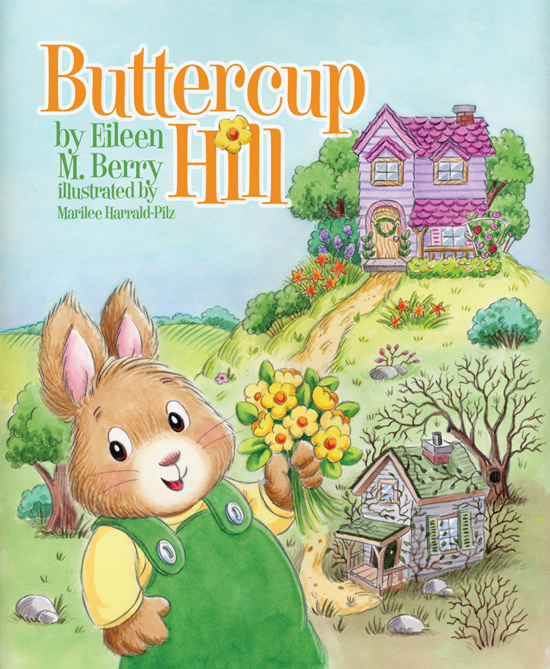
Almost every fable has a story behind the story. On the surface we see fanciful animal characters engaged in lively action, but the story is carefully crafted to touch on a real-life truth. Buttercup Hill is a fable that tells a deeper story than the surface one. It shares a lesson that I learned somewhat painfully, but a lesson well worth learning.

BJU Press book cover for Buttercup Hill by Eileen Berry

The lesson began with a few simple statements that I’ve never forgotten. For several years I had worked in a ministry to children in a needy neighborhood. One of the people our group was attempting to serve leveled a rather harsh accusation at our ministry. “You don’t really care about us. You just come out of your fortress to do good deeds and then go running back. You don’t really want to get to know us.” Although I didn’t feel like the accusation was completely accurate, it cut me deeply. I knew that, although I dedicated time each week to the ministry, I hadn’t been doing all I could to really be a friend to these needy families. That comment resulted in a lot of prayerful thought about what else I could be doing for the families I was trying to serve. I could invite a child to be my guest for a special event. I could open my home for cookie baking. I could volunteer at a school. I could drop a pie by a house at Thanksgiving. Or I could just spend a few extra minutes on a front porch, listening and trying to understand. There’s almost always more we can do to be a friend.

And so I decided to explore in a story the idea of what it means to minister to needs through friendship. Hopkin Fleet and his mother want to help their needy neighbors. But until the Flops understand that the Fleets want to be friends, their overtures are not accepted. The Fleets have to leave their comfort zone, inviting the Flops into their personal space, sharing themselves as well as their things. They sacrifice to come alongside their neighbors in a crisis. And when the crisis has passed, the result is a beautiful garden—and a friendship—lovingly planted and cared for.

Read the opening pages of Eileen’s chapter book for young readers, Buttercup Hill.

Filed Under: JourneyForth Tagged With: family, friendship, ministry, story

Above the Storm

September 24, 2015 by Eileen

billowy clouds in the blue sky

I was aboard a small jet, flying home. On the ground far beneath us were thunderstorms. But above the clouds, the plane was flying through one of the most peaceful, beautiful worlds I’ve ever seen. The clouds spread out in a panorama of white beneath the plane like a blanket of snow. Some clouds towered up like mounds of cotton-candy all around us. The sun’s rays slanted across the billowy masses, turning portions of clouds to pink and gold. I felt as if I were traveling through a fantasy world, a world so soft and still that nothing could ever trouble it. Looking at those clouds from above, no one would ever guess that storms were going on down below them.

This is where I’m supposed to live all the time, I realized. Above the pressures of life, in a world where God’s presence shines on the clouds and where His peace rules.

I pondered that thought as we jetted on through the white, fluffy wonderland. Why is it so hard to live above the daily grind? Why is my vision so easily clouded by the storms of doubt, worry, and frustration with everyday problems? Why do I often live beneath the dark, gray undersides of the clouds instead of up here where I see them as soft, shining pillows on which to lay my head?

There’s a sense in which we choose which side of the clouds we see. We choose the dark underside when we forget to pray. Philippians 4:6–9 reminds us that in order to have God’s peace protect our hearts and minds, we have to come into His shining presence. We have to come with thanksgiving. We have to bring our specific requests to Him instead of succumbing to worry. And then we have to consciously choose to dwell on what is beautiful and true.

I don’t seem to need any help seeing the gray clouds swollen with rain in my sky. But I know I desperately need God’s help to obey, to trust, to love Him with all my mind, and to continually choose the world above the clouds.

Be careful for nothing; but in every thing by prayer and supplication with thanksgiving let your requests be made known unto God.

And the peace of God, which passeth all understanding, shall keep your hearts and minds through Christ Jesus.

Finally, brethren, whatsoever things are true, whatsoever things are honest, whatsoever things are just, whatsoever things are pure, whatsoever things are lovely, whatsoever things are of good report; if there be any virtue, and if there be any praise, think on these things.

Those things, which ye have both learned, and received, and heard, and seen in me, do: and the God of peace shall be with you. (Philippians 4:6–9)

Filed Under: Simplified Homeschool Tagged With: clouds, peace, Philippians, storms, truth

We Are God’s Pottery

March 12, 2015 by Eileen

A few years ago, I got to experience a different kind of classroom. I sat in a large sun-filled studio for my first-ever lesson in pottery making. After throwing my clay into the center of the wheel and molding it into a cone shape, I waited with my hands poised, listening to the instructor explain how to start the wheel. “You’re going to find that the clay wants to spin off the wheel,” she said, “but it has to stay right there in the center.”

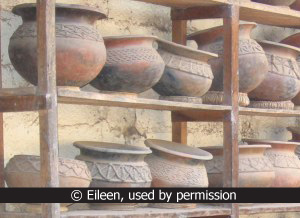
clay pots on shelvesSure enough. Only a few seconds after I started my wheel, I realized my clay had a mind of its own. I was trying to focus on pressing the cone tip down to become the base of my pot, but my lump of clay seemed intent on sliding out from under my hands. Two or three times in the process of forming the pot, I felt that obstinate clay go slightly airborne, inching its way off the wheel, and I had to exert extra pressure to bring it back. Why does clay act that way?

Granted, I lacked skill as a potter and really had no idea what I was doing, so the fault was probably mine. But I couldn’t help noting the spiritual analogy and pondering it for days after I left the pottery classroom. Why do I act like that clay when I’m on God’s wheel? Why do I try to maneuver myself out of the “molding” situations His providence puts me in for my own good? Why do I inch away from His hands when He points out a sin I need to confess? Why do I often try to “slide out from under” His loving work of making me more like Christ?

I guess the process of pottery making is anything but comfortable for the clay. But if only that recalcitrant lump could see the beautiful vision of what the Potter has for it, the last thing it would want to do is “spin off the wheel.” It would draw a figurative breath of joyful wonder and say, “Have Thine own way, Lord! . . . Mold me and make me after Thy will, while I am waiting, yielded and still.”

Reference

Adelaide A. Pollard, “Have Thine Own Way, Lord,” Rejoice Hymns (Greenville, SC: Majesty Music, 2011), 494 (emphasis added).

Filed Under: Devotions Tagged With: classroom, clay, lesson, molded, Potter, pottery

  • Page 1
  • Page 2
  • Page 3
  • Go to Next Page »

Primary Sidebar

As parents, teachers, or former homeschool students, we are passionate about homeschooling from a biblical worldview. We hope these teaching tips, fun activities, and inspirational stories support you in teaching your children.

Email Signup

Sign up for our homeschool newsletter and receive select blog posts, discounts, and more right to your inbox!

Connect with Us!

                    Instagram     

Read Posts on Specific Subjects

Early Learning
Foreign Language
History
Language Arts
Math
Science

Footer

Disclaimer

The BJU Press blog publishes content by different writers for the purpose of relating to our varied readers. Views and opinions expressed by these writers do not necessarily state or reflect the views of BJU Press or its affiliates. The fact that a link is listed on this blog does not represent or imply that BJU Press endorses its site or contents from the standpoint of ethics, philosophy, theology, or scientific hypotheses. Links are posted on the basis of the information and/or services that the sites offer. If you have comments, suggestions, questions, or find that one of the links no longer works, please contact us.

Pages

  • About BJU Press
  • Conversation Guidelines
  • Terms of Use & Copyright

Archives

© 2026 · BJU Press Homeschool