• Skip to primary navigation
  • Skip to main content
  • Skip to primary sidebar
  • Skip to footer

BJU Press Blog

  • Home
  • Shop
    • Shaping Worldview
  • Simplified Homeschool
  • Successful Learning

thankful

Why Be Thankful?

November 21, 2018 by Guest Writer

be thankful
“Thank you” are two of the first words we parents teach our children to say. Even before our daughters could talk, we taught them the sign for “thank you” in sign language. It’s important to train our children to express gratitude for the things they receive. But it’s also equally vital to teach them why we should be thankful because it’s more than just a matter of using good manners. If we can lay a biblical foundation for thankfulness while they’re young, we will help them develop a habit of gratitude for the rest of their lives.

A Few Reasons to Be Thankful

So why should we be thankful, and why should we teach our children to be thankful? Here are just a few reasons—by no means is this an exhaustive list.

  1. God commands it. Several times throughout Scripture the Lord instructs us to give thanks, and of course whenever He gives us a command, we should obey because we love Him (Psalm 50:14; 105:1; 107:8; Colossians 1:3; 2:7; 3:17; 4:2).
  2. Gratitude is God’s will for us. Probably 1 Thessalonians 5:18 immediately comes to mind: “In everything give thanks, for this is the will of God in Christ Jesus concerning you.” Many Christians want to know God’s will for their lives, and He tells us some very specific things that are always His will for us. Gratitude is one of them. God makes it very clear that thankfulness is always His will for our lives, no matter what our circumstances.
  3. Gratitude is evidence of the Holy Spirit indwelling us. It’s one of the marks of a true believer. If we profess salvation in Jesus Christ, our lives will be characterized by a thankful attitude. When we submit ourselves to the control of the Holy Spirit, He produces the fruit of gratefulness in our lives (Galatians 5:22).
  4. Gratitude is a choice. Our children need to learn that they can choose to give thanks even when they don’t feel like it. As parents, we must learn this ourselves so we can teach them to follow our example. How often do we find ourselves complaining? Do we give God praise only when things go our way? Do we thank Him for trials as well as blessings? These are a few important questions to ask ourselves as we strive to help our children learn true biblical thankfulness.

No Thanks

Our Christian character cannot be complete without thankfulness. Faith apart from gratitude becomes empty and powerless. Love apart from gratitude will disintegrate under adversity and discouragement. Sacrificial giving apart from gratitude will sour into resentment. A British pastor, John Henry Jowett, once said, “Every virtue divorced from thankfulness is maimed and limps along the spiritual road.” In short, we can’t be the Christians God wants us to be without it! Now is the time to cultivate gratitude in our families so we can grow “unto the measure of the stature of the fullness of Christ” (Ephesians 4:13).

• • • • •

Jennifer is a pastor’s wife and mom of two young girls and loves homeschooling them. During her own twelve years of being homeschooled, Jennifer developed a passion for reading and writing. She earned a bachelor’s degree in creative writing and relishes writing during her free time.

Filed Under: Shaping Worldview Tagged With: gratitude, teach, thankful

The Prepositions of Thankfulness

November 24, 2016 by Eileen

About two months ago, I bought a small throw pillow for a chair in my home. The pillow displayed the word thankful in large gold letters. I had a mission for that pillow. Every time I walked by the chair, the pillow would remind me to think of things I was thankful for. My plan worked for a few days. I would walk past the chair and briefly consider one or two pleasant things that had happened that day. But all too soon, the pillow became both literally and figuratively part of the furniture. I had happened to choose the chair where everything tends to land at the end of the day—my purse, a book or two, the mail, and so on. And as the days passed, my plan got covered up by the busyness of life, just like the word on that pillow.

thankful pillow

The other day, after clearing off the chair, I sat looking at the pillow and thinking about my plan gone awry. That’s when I realized that maybe the plan had been tragically flawed from the beginning. After all, it’s not enough to be thankful for without being, first and foremost, thankful to. My hastily muttered prayers of thanks for this and that blessing as I dash past a pillow are not really what God wants. He wants me to sit down and take time. He doesn’t necessarily want me to tabulate all the ways He has added pleasantness to my life. But He does want me to know Him and thank Him for who He is. He wants me to love the Giver infinitely more than the gifts.

It’s only when I’m being thankful to that I can properly be thankful for. When I’ve taken time to meditate on God’s sovereignty, love, goodness, and wisdom, I can filter everything that happens to me through the lens of His attributes. I can rest my head on a pillow of thankfulness—even when the burdens and problems of life multiply or when nothing about my day stands out as a singular blessing. I can be thankful for anything that draws me closer to the God I am thankful to.

Look for ways you can be Sharing God’s Good Works with your children.

Filed Under: Shaping Worldview Tagged With: Giver, giving thanks, God's sovereignty, thankful

Sharing God’s Good Works

March 8, 2016 by Megan

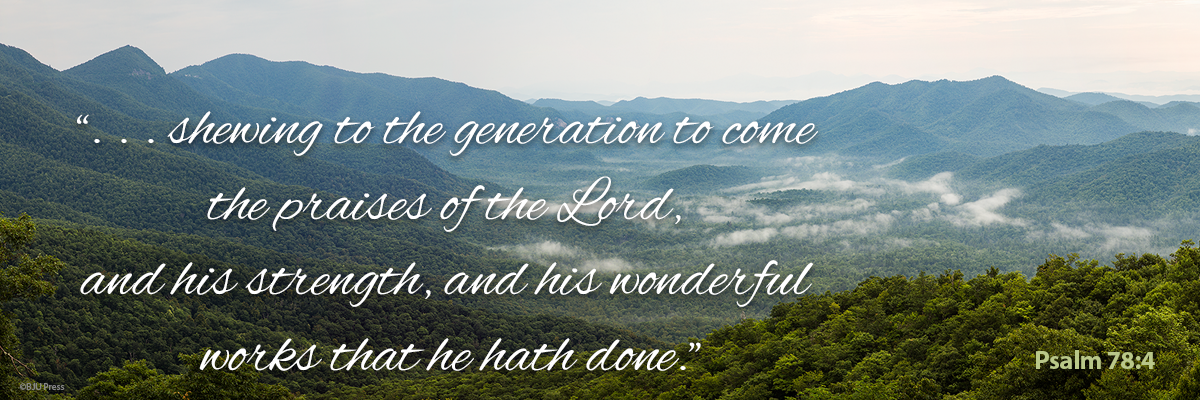
One of my favorite verses is Psalm 78:4, especially the last phrase.

WP-Thankful-1-2016

Let’s face it—it’s easy to overlook the blessings in our lives. Sometimes the Lord blesses us in very obvious ways. He gives a new baby, miraculously provides finances for a specific need, or grants healing after an accident or serious illness. But He blesses us in other ways too. He allows our cars to start so we can go get groceries. He gives us hot water for showers. He gives us strength to feed our children even when we’re so sick we can hardly get out of bed.

My children need to know about all of God’s wonderful works. They need to know He gives only good gifts because this truth is foundational to their development of a biblical worldview. They need to know that God is faithful in small things as well as big things.  It is part of how their faith will grow.

So here’s my list of blessings for today:

  • Cuddles with my toddler
  • The willingness of older men and women to share their wisdom about childrearing
  • Libraries
  • Hot drinks
  • Naps
  • Technology such as cell phones and email that allow me to stay in touch with far-away friends and family members
  • A great deal on a new coat for my middle daughter
  • Supper that’s already made and simmering in the slow cooker
  • Sunshine after more than a week of rain
  • Taking a walk with my children and enjoying God’s creation
  • Observing my children learn new skills—my toddler can now climb a ladder
  • Strangers in the grocery store who graciously allowed me to get in front of them in line
  • Watching the relationships among my children grow stronger
  • The ability to read God’s Word for myself

God has given us so many good gifts. Let’s continually praise God to our children.

Filed Under: Simplified Homeschool Tagged With: blessings, children, praise, thankful

A Pilgrim’s Thanksgiving

November 20, 2014 by Eileen

When you hear the phrase “the first Thanksgiving,” what are some images that come to mind? You have probably seen enough artists’ renderings of this event to have a mental picture of fall trees, a table loaded with traditional Thanksgiving fare, and an assortment of Pilgrims and Wampanoags enjoying a peaceful meal together. A number of historians have exposed the mythical elements in scenes like that. For example, while there might have been turkey at the feast, there would not have been potatoes. The Pilgrims would have lacked sugar for sweetening cranberries and ovens for baking pumpkin pies. The menu may have even included such nontraditional items as mussels, crabs, and eels. Since furniture would have been scarce in Plymouth Colony, even the table itself is a questionable detail.

Historical errors have also crept into the way Pilgrim clothing is depicted. Large buckles on hats and shoes were not affordable for common people, and Pilgrim men probably would not have worn them even if they had been. Written records of the Pilgrims have revealed that they wore bright-colored garments, especially for festive occasions, rather than mournful black.

It’s also possible that the presence of the Indians at the Thanksgiving feast was not entirely comfortable for the Pilgrims. No doubt there were lingering tensions on both sides, despite peaceful relations on the surface.

But perhaps the one thing most of us lack in our mental picture of this feast is an understanding of the Pilgrims’ state of bereavement. The Pilgrims were undergoing a period of deep personal grief. Only about half of their number who had voyaged on the Mayflower had survived the first winter. Nearly every family had experienced a death. Only four of the married women were still living. Most of the Pilgrims at the feast were men or children under the age of sixteen.

The exact character of the 1621 harvest feast is a subject of debate. Some scholars think it was more of a festival than a serious religious holiday. But whatever the mood of the occasion, the fact remains that even in the face of excruciating personal trials, the Pilgrims took a day to celebrate God’s goodness. The Pilgrims at the first Thanksgiving teach us that giving thanks is an act of faith. A truly thankful person looks beyond the present difficulties to see God’s gracious hand opened, giving what is best. May we be reminded this Thanksgiving Day that we too are pilgrims on a journey planned and guided by an all-wise God. May we have the faith to lift our eyes above life’s barren fields to thank God for His bountiful blessings—past, present, and future.

What are you thankful for this year?

Filed Under: Successful Learning Tagged With: faith, Pilgrims, thankful, Thanksgiving

Count Your Blessings

November 7, 2014 by Meredith

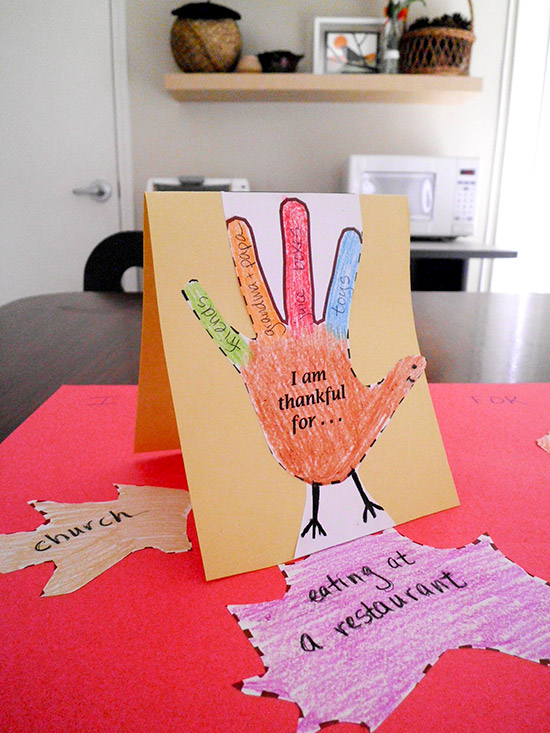
Encourage children to count their blessings and share them with others by making these simple table decorations for Thanksgiving.

Materials Needed

The same materials can be used for both table decorations.

  • Patterns:  (centerpiece) double turkey; (placemat) leaves or single turkey
  • Markers, crayons, color pencils
  • Pencil or pen
  • Scissors
  • Glue (glue stick works best)
  • Construction paper (optional for centerpiece)
  • Clear contact paper (optional for centerpiece)

Thankful Turkeys Centerpiece

  1. Download and print out the double turkey pattern.
  2. Have the kids write out what they are thankful for on the turkey’s four feathers. (They can write the same or different things on both sides.)
  3. Let the kids decorate their turkeys by coloring in the body and feathers. (If you decide not to use contact paper, adding feathers, sequins, and fabric to the turkeys might be fun.)
  4. Make sure the kids follow the dotted lines to cut out the turkeys. (If you want to leave the legs, don’t forget to trace and cut around them!)
  5. Finally, have them fold the printout on the solid black line and set it on the table. (Tips: For added firmness glue the printout to a piece of construction paper before folding it; or cut out the optional bottom piece, fold on the solid black lines, and glue the flaps to both sides of the printout. For added protection trace over the dotted lines on both burkeys. Next, lay a piece of contact paper on the front side of the printout. The contact paper should overlap the edge of the printout by half an inch. Cut out the turkeys and fold the printout on the solid black line.)

Blessings Falling Down Placemat

  1. Download and print out the leaves pattern.
  2. Have the kids write out a blessing on each leaf.
  3. Let the kids color the leaves. (The kids only need to color the side they wrote on.)
  4. Make sure the kids follow the dotted lines as they cut out each leaf.
  5. Encourage the kids to write a title for their placemat on the piece of construction paper. (For example: “I am thankful for . . . ” or “My Blessings”)
  6. Have the kids glue the leaves to either side of  the construction paper. (Preferred paper size is 9×12.)
  7. Cut out a piece of contact paper so that it overlaps the edge of the construction paper by half an inch. Place the construction paper onto the contact paper. Repeat the process so that both sides of the construction paper are covered and the contact paper is sealed; then trim the edges. (Optional: A placemat can also be made using the single turkey pattern.)

I hope you enjoy making these crafts. Making placemats was one of my favorite activities to do while growing up. In fact, I still use placemats, notepad paper, and 3×5 cards to help me reflect on the goodness of God. Teaching children to thank God for all things prepares them to trust Him in the future.

How do you encourage children to express thankfulness?

Filed Under: Successful Learning Tagged With: activity, blessings, centerpiece, leaves, placemat, printable, thankful, Thanksgiving, turkey

Primary Sidebar

As parents, teachers, or former homeschool students, we are passionate about homeschooling from a biblical worldview. We hope these teaching tips, fun activities, and inspirational stories support you in teaching your children.

Email Signup

Sign up for our homeschool newsletter and receive select blog posts, discounts, and more right to your inbox!

Connect with Us!

                    Instagram     

Read Posts on Specific Subjects

Early Learning
Foreign Language
History
Language Arts
Math
Science

Footer

Disclaimer

The BJU Press blog publishes content by different writers for the purpose of relating to our varied readers. Views and opinions expressed by these writers do not necessarily state or reflect the views of BJU Press or its affiliates. The fact that a link is listed on this blog does not represent or imply that BJU Press endorses its site or contents from the standpoint of ethics, philosophy, theology, or scientific hypotheses. Links are posted on the basis of the information and/or services that the sites offer. If you have comments, suggestions, questions, or find that one of the links no longer works, please contact us.

Pages

  • About BJU Press
  • Conversation Guidelines
  • Terms of Use & Copyright

Archives

© 2026 · BJU Press Homeschool