• Skip to primary navigation
  • Skip to main content
  • Skip to primary sidebar
  • Skip to footer

BJU Press Blog

  • Home
  • Shop
    • Shaping Worldview
  • Simplified Homeschool
  • Successful Learning

math

Activity: Learning with a Pumpkin

October 6, 2016 by Justin

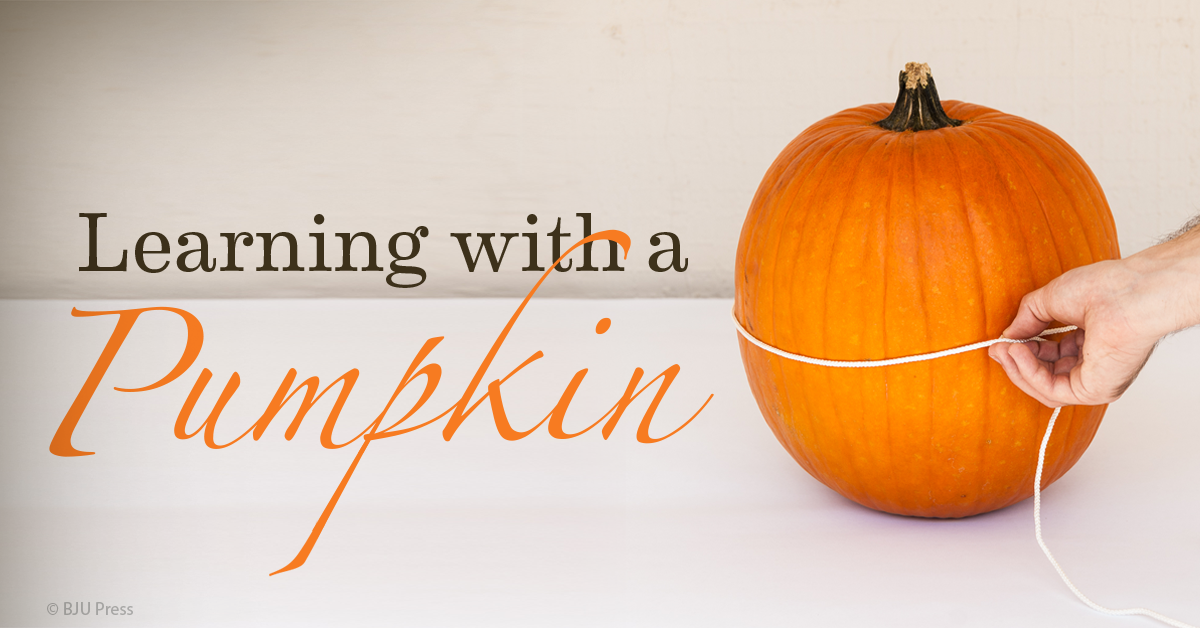
One thing many children look forward to about fall is getting to carve or decorate a pumpkin. As a parent, you can capitalize on that excitement by squeezing some learning in with all of the fun. Here are some ways to practice science and math skills with your child while pumpkin carving.
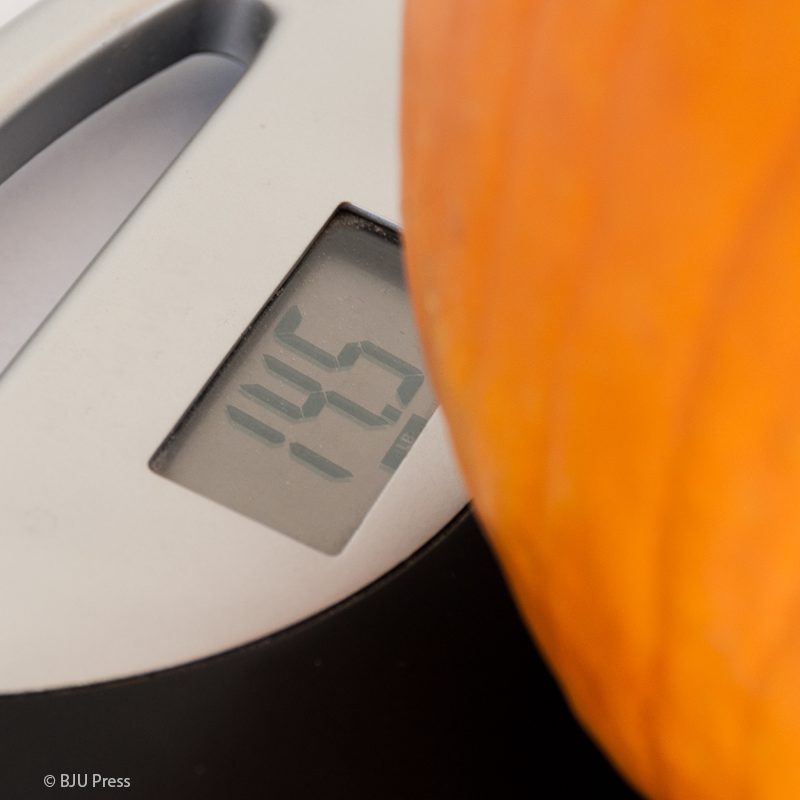
Before carving the pumpkin, start off by weighing it. A normal household scale will do. If the pumpkin is not too heavy, have your child pick it up and guess the weight. Then he can weigh it. This activity will help build his ability to associate perceived weight with an actual measurement. Our pumpkin weighed in at a whopping 14.5 pounds!
pumpkinblogpost-weight

Next, your child can measure the pumpkin’s circumference using a piece of string or yarn along with a yardstick or tape measure. Once he has determined the circumference, take the calculations to the next level (if age appropriate) and have your child use the following geometric formulas to find the diameter and radius.

C = πd (circumference = 3.14 × diameter)

d = 2r (diameter = 2 × radius)
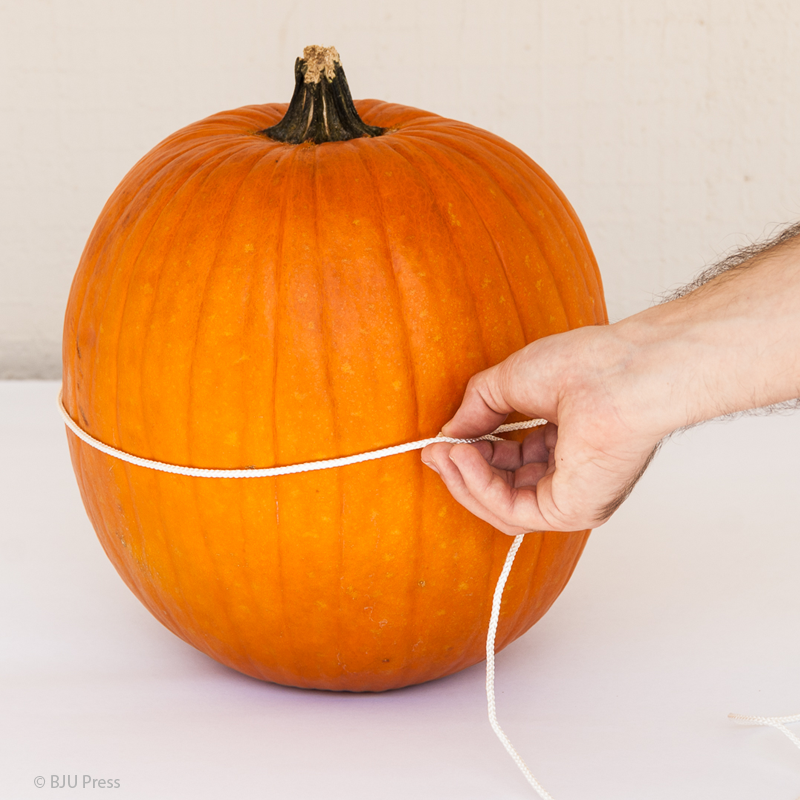
pumpkinblogpost-circumference

After you or your child cut the pumpkin open (we recommend providing supervision), have your children count the total number of pumpkin seeds by separating them into rows of five or ten. This practice is great for helping younger children understand multiplication.
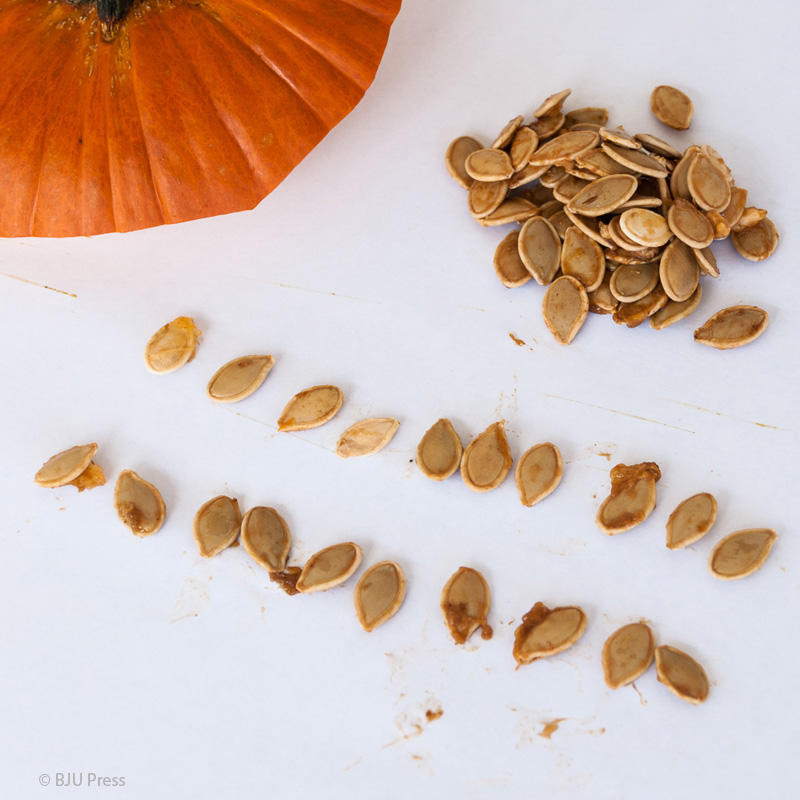
Learning with a Pumpkin-Counting

Once the inside of the pumpkin is cleaned out, have your child fill it with water using a measuring cup to determine how much liquid it can hold. Ask him to estimate beforehand how much he thinks it will hold and then compare that with his findings. Subtract to see how far off the estimate was. Our pumpkin held just over 5 liters of water.
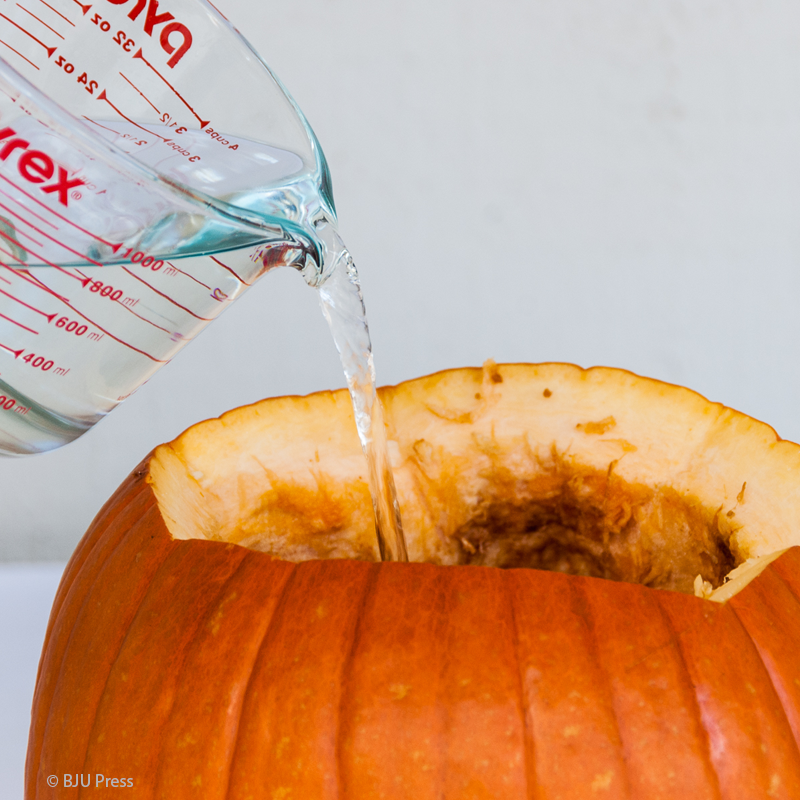
pumpkinblogpost-volume

I hope you enjoy using this learning activity with your child. Be sure to subscribe to our homeschool email for more fun homeschooling ideas!

Filed Under: Successful Learning Tagged With: activity, craft, Fall, hands-on learning, math, pumpkin, science

What Does Math Look Like?

September 22, 2016 by Justin

Typically we don’t think about math as something to look at. It’s a field of study, not a physical object, but being able to see math is a skill that can be invaluable to children. Let me explain.

I regularly volunteer as a math tutor at a ministry that helps adults obtain a GED. Every student I work with learns at a different pace. Some of my students move through the material quickly, doing much of the math mentally. They see the patterns and are able to apply them to new material as they progress.

Other students are able to work though the math, but much more slowly. They stick to procedures, writing out each and every step of all the problems but never really understanding how the math works or how it could be used. It’s usually not a matter of difference in ability; it’s that the one group is able to visualize how math works while the other can’t. This difference probably has a lot to do with how the students were exposed to math when they were in the elementary grades.

JH_Math_2

Visualizing Not Just Repeating

Memorizing steps and formulas and then practicing them over and over might allow someone to pass a test, but it doesn’t promote retention. It also doesn’t train children to be good problem solvers. Teaching children to visualize how math works helps them build the problem-solving skills they will need as they move into advanced math.

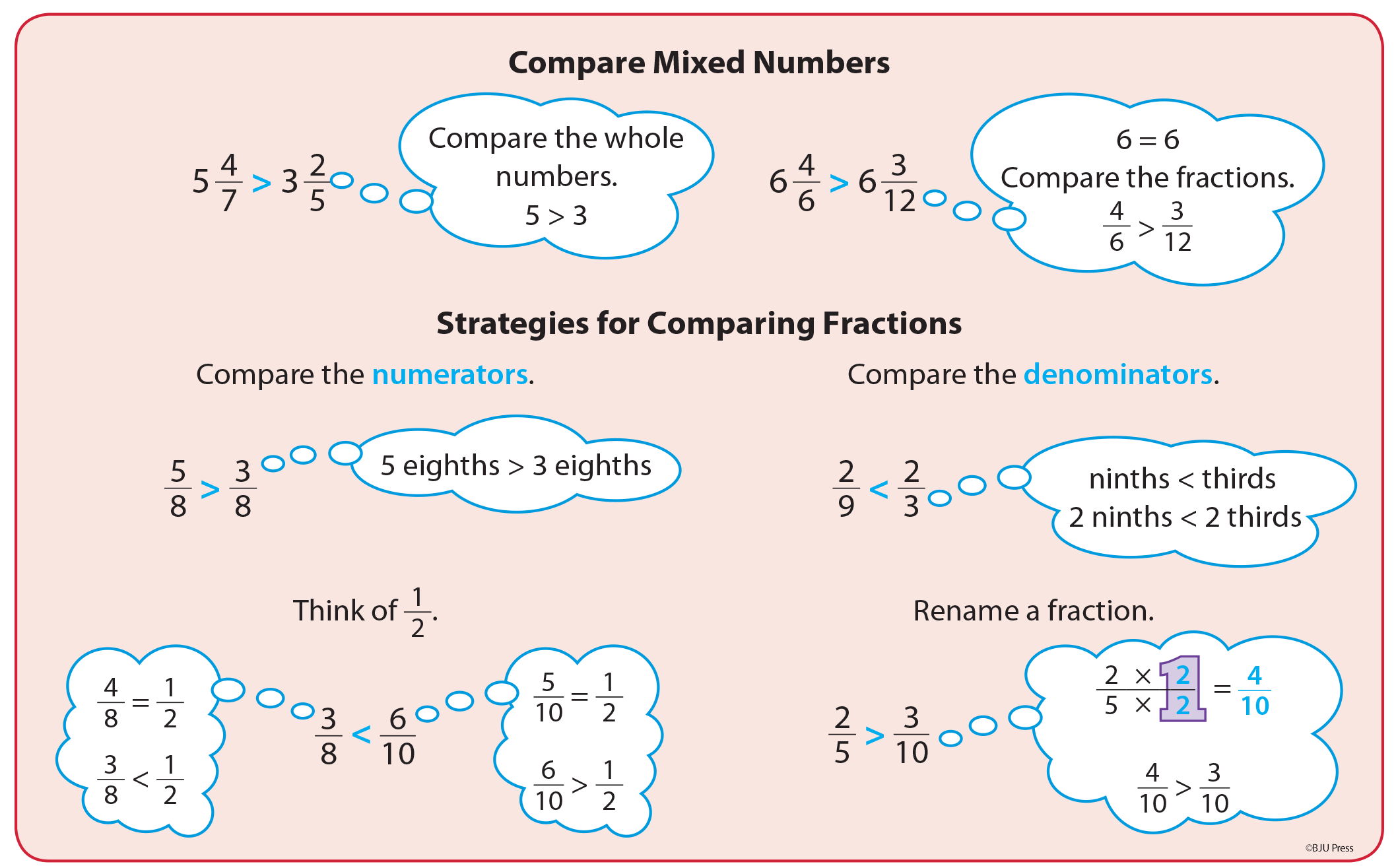
Let’s look at an example page from one of our math worktexts:

math5student_p129-cropped

A student could solve these comparisons by changing the denominators to come up with the right answer. That’s a correct way of solving these math problems. However, as the lesson shows, it’s also important to learn how to solve simple math problems mentally. By using strategies like thinking of ½ and seeing if each fraction is more or less or comparing the denominators, students are able to easily solve simple problems, check their answers, and learn new concepts more quickly.

Learning to See Math

When teaching math, parents should—in my opinion—approach each problem from various angles, even if the child gets the correct answer immediately. Use visuals such as money, cut-out shapes, and manipulatives to show how a problem looks both physically and on paper. Reinforce knowledge by asking questions whenever possible instead of just explaining how things work. As children learn to visualize math, they’ll begin to see math as a series of meaningful challenges to overcome as opposed to a boring list of problems to work though.

For more teaching tips like these, be sure to sign up for our homeschool email.

Filed Under: Successful Learning Tagged With: homeschool, math, problem solving

Making Math Enjoyable with Themes

August 18, 2016 by Meredith

Memorizing math facts may come easy to many people, but some (myself included) have a harder time visualizing a numerical problem and solving it mentally. It’s not that we can’t do it but rather that numbers have little value when they’re separated from a real-life situation.

It’s the application of math that helps us understand the importance of knowing how to solve an equation. But sometimes learning best takes place when there’s an example of how someone else has used math in daily life whether that’s through household chores or an occupation. This type of example does two things. It shows how math can be used, and it also gives motivation to use it.

BJU Press elementary math introduces themes in every grade to help kids understand math and see how it applies to our everyday lives. Each grade has a unique theme that makes math more enjoyable but also relatable. Lower-elementary kids are introduced to special characters. Rhymes, songs, and stories about these characters are included in different lessons throughout the entire course.

MathK5

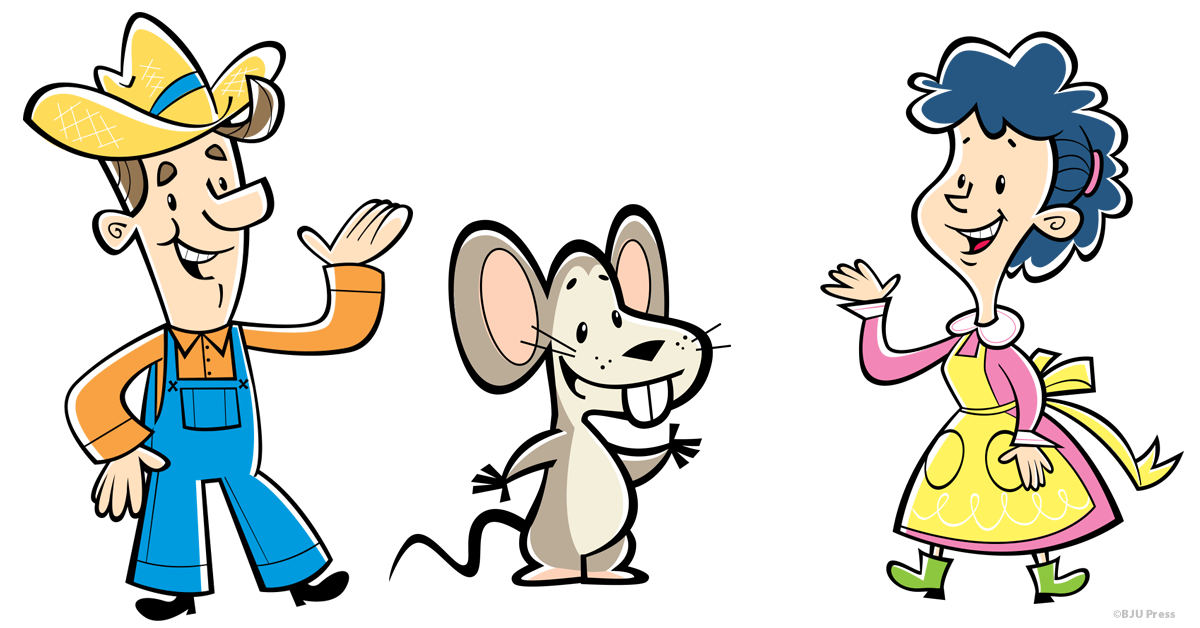
In Math K5, Cheddar the mouse lives on Kindergarten Lane in Mathville. He uses math to help Farmer Brown keep an eye on what’s happening on the farm. In one lesson, your child works with Mrs. Brown to count the number of cabbages in the garden row. Another day on the farm, shapes are found on Farmer Brown’s outfit (like buttons that are circles).

Math6

Once students reach the upper-elementary grades, themes provide your child motivation for using math. For example, Math 6 includes a search-and-rescue theme with read-aloud stories about search-and-rescue events for each chapter. Chapter 7 opens with the true account of Balto and other dogs that delivered a special serum to people who were sick in Nome, Alaska. The concepts learned in this chapter are multiplying fractions and decimals—an important skill for measuring out medicine just like Dr. Curtis Welch did when he treated the people of Nome.

See more examples of these themes in BJU Press math curriculum.

Filed Under: Successful Learning Tagged With: characters, early learning, homeschool, math, Math 6, Math K5, themes, understanding

The Creation Blessing

May 3, 2016 by Ben

Often when I leave for work, I say goodbye to my wife and children by offering good wishes. Have you ever thought about the common phrase “have a nice day”? Grammatically, it’s an imperative or command like “be good!”  The way it looks on paper it could be followed up with “or else” as in “have a nice day or else . . .” But no one ever says it that way. We say it more like “may you have a nice day.” We’re actually blessing one another in the form of a command.

Divine Blessing

In Genesis 1:28 we read about a blessing given in the form of a command. After creating humans male and female in His own image, God blessed them. The wording of this blessing is a command; so we often refer to it as the Creation Mandate.

Be fruitful, and multiply, and replenish the earth, and subdue it: and have dominion over the fish of the sea, and over the fowl of the air, and over every living thing that moveth upon the earth.

The-Garden-of-Eden

Divine Command

Unlike our good wishes, God’s blessing carries the weight of a command. We shouldn’t resist His blessing from Genesis 1:28 and expect things to go well for us. For example, in Genesis 11 Noah’s descendants rejected God’s command and all gathered in one place to build the tower of Babel. As a result of their sin, God confused their language and sent the people throughout the world.

Unbelievers can share in God’s blessing by following the Creation Mandate. In fact, many do. In BJU Press science and math textbooks, we highlight how scientists and mathematicians use their knowledge of God’s world to “have dominion.” They use their skill to care for the creation and use the creation for others’ benefit. Many of those professionals following the Creation Mandate are experiencing the common grace of God’s creation blessing in their lives.

Divine Reach

Because I’m human, the blessings I speak are little more than well-wishing. I may say, “I hope you have a nice day.” But while I’m at work, I have little immediate control over what happens at home, and some days my wife feels overwhelmed. In contrast, God’s blessing on the first man and woman had power behind it to confer that blessing on all of humanity.

God’s power is infinite, so His action in Genesis 1:28 reaches through time and space to all people. Not even the Fall overthrew His blessing to fill the earth and exercise dominion. The long line of impressive civilizations throughout history with all their remarkable achievements, technological advancements, and beautiful artwork evidences God’s power and kindness to humanity expressed in His first words to mankind.

As parents, we have a tremendous opportunity to demonstrate God’s blessing. We get to teach our children how to follow God’s blessing to care for the world. Since our teaching is influenced by the textbooks we use, it’s important to choose a homeschool curriculum that reinforces the truth of God’s creation blessing.

Filed Under: Shaping Worldview Tagged With: Creation, Creation Blessing, Creation Mandate, math, parenting, science

How to Make Sense of Math

March 3, 2016 by Meredith

Growing up, I didn’t like math. The subject became slightly more enjoyable for me when I got to “play” with the math manipulatives. Shapes were for making art mosaics. Paper money facilitated a pretend shopping spree to the bookstore. And Unifix cubes were (and still are!) just plain awesome for making patterns or sculptures.

You see, I was the homeschooled child who was unwilling to memorize number facts or equations unless I knew the reason why. Using manipulatives gave me a better understanding of the concepts being introduced in BJU Press Math. Instead of trying to calculate abstract numbers in my head, I was able to associate the equation with a concrete object.

A good math curriculum links concepts with tangible elements that visually demonstrate the problem.

BJU Press Math manipulative place value mat

Place Value Mat

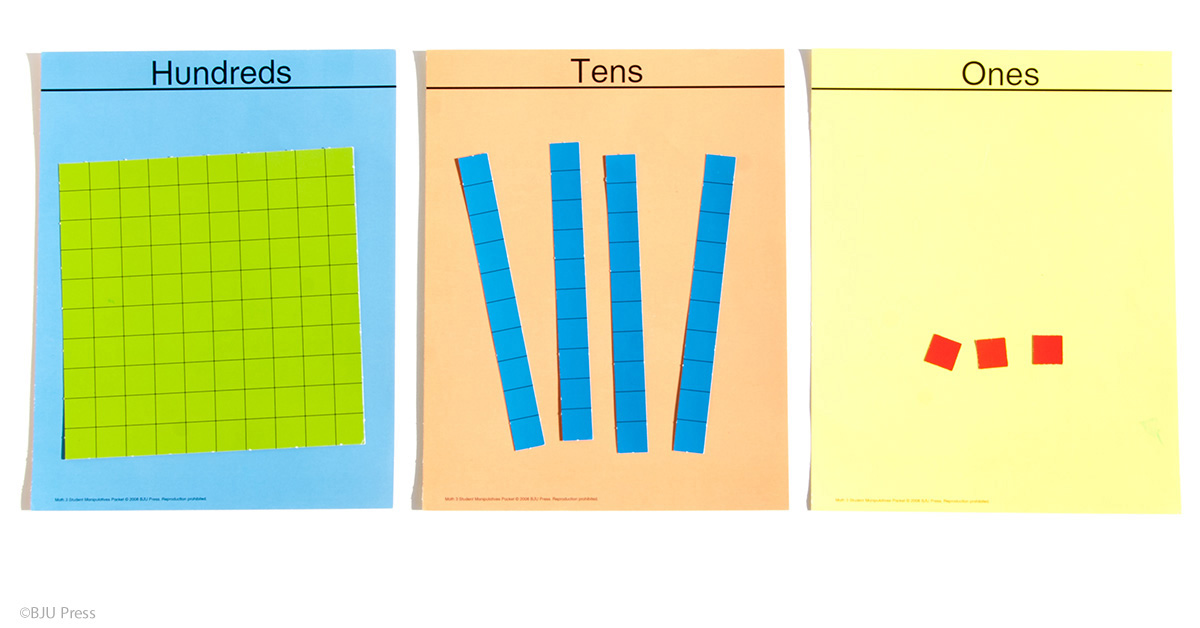
Take, for instance, the concept of renaming in subtraction. How can a child understand that adding ten to the next place value (such as the tens or ones place) allows her to accurately find the answer? Using a place value kit with ones, tens, and hundreds reinforces the mental calculation of an equation using the senses of sight, touch, and sound (if she counts aloud).

Build Understanding over Memory

Building number sense through this hands-on learning experience allows your child to understand how a problem is solved and not just memorize a formula to get an answer. Teaching what math feels and looks like by using manipulatives builds a true understanding of the subject. This fun math “playing” helped to develop my number sense without my even knowing it, and other children can benefit from this same experience.

The BJU Press Elementary Math curriculum introduces new concepts using manipulatives. Beginning with a tangible demonstration of math concepts builds your child’s understanding so that she can solve problems when those concepts are presented on paper. The goal is to develop her thinking skills so that she can be a lifelong problem solver because knowing how math applies to everyday life prepares your child for success in the role God has planned for her.

Today, math isn’t my favorite subject, but I do credit my ability to understand and solve real-life math equations in the kitchen, at the office, or at the store to my hands-on learning experiences as a child. Yes, math manipulatives are that foundational.

Which math manipulatives do your kids enjoy the most?

Save

Save

Save

Filed Under: Successful Learning Tagged With: curriculum, math, math manipulatives

  • « Go to Previous Page
  • Page 1
  • Page 2
  • Page 3
  • Page 4
  • Page 5
  • Go to Next Page »

Primary Sidebar

As parents, teachers, or former homeschool students, we are passionate about homeschooling from a biblical worldview. We hope these teaching tips, fun activities, and inspirational stories support you in teaching your children.

Email Signup

Sign up for our homeschool newsletter and receive select blog posts, discounts, and more right to your inbox!

Connect with Us!

                    Instagram     

Read Posts on Specific Subjects

Early Learning
Foreign Language
History
Language Arts
Math
Science

Footer

Disclaimer

The BJU Press blog publishes content by different writers for the purpose of relating to our varied readers. Views and opinions expressed by these writers do not necessarily state or reflect the views of BJU Press or its affiliates. The fact that a link is listed on this blog does not represent or imply that BJU Press endorses its site or contents from the standpoint of ethics, philosophy, theology, or scientific hypotheses. Links are posted on the basis of the information and/or services that the sites offer. If you have comments, suggestions, questions, or find that one of the links no longer works, please contact us.

Pages

  • About BJU Press
  • Conversation Guidelines
  • Terms of Use & Copyright

Archives

© 2026 · BJU Press Homeschool