• Skip to primary navigation
  • Skip to main content
  • Skip to primary sidebar
  • Skip to footer

BJU Press Blog

  • Home
  • Shop
    • Shaping Worldview
  • Simplified Homeschool
  • Successful Learning

biblical worldview

The Dilemma of Fantasy

June 28, 2016 by BJU Press Writer

fantasy

As your children pick out books for their summer reading, you may wonder whether fantasy is an appropriate option. Consider these key questions before making up your mind about fantasy.

What is fantasy, and what is its purpose?

Simply put, fantasy is a genre of literature with fanciful or imaginative settings, characters, or plot devices. The purpose, according to C. Hugh Holman, coauthor of A Handbook to Literature, may be “for the whimsical delight of the author or reader, or it may be a means used by the author for serious comment on reality.” Fantasy as a genre is much like a car, a means of getting from one place to another, and whether it’s good or bad depends on how a person uses it.

Why have some had a negative opinion of fantasy?

Some people argue that fantasy (and even fiction in general) is just “a lie” because the events and settings and characters aren’t found in real life. However, at least twice in the Bible, fanciful fiction appears in service of truth (Judges 9:8–15; 2 Kings 14:9). Again, it’s not the genre itself but rather the use it is put to that determines its value. Some Christians reject fantasy because some stories present lurid violence, graphic sensuality, or the triumph of evil over good. However, these characteristics are unacceptable in a work of any genre, not just in fantasy. Rather than judging a novel by its genre, we should determine whether the work has a solid moral tone (i.e., whether it presents good as desirable and evil as offensive). (For a thorough look at this topic, see The GEM Approach.)

How can fantasy benefit your children?

Fantasy offers an opportunity to teach children to think biblically. The whimsical element of fantasy allows young readers to enter a new world with new experiences where good and evil are easily seen and identified. They learn there to be discerning readers and develop literary skills that are key in understanding biblical themes. Reading The Pilgrim’s Progress, for example, which presents a journey as a metaphor for the Christian life, will enrich their appreciation for the beauty and meaning in Psalm 23 since it also speaks of life as a daily walk with dangers and joys.

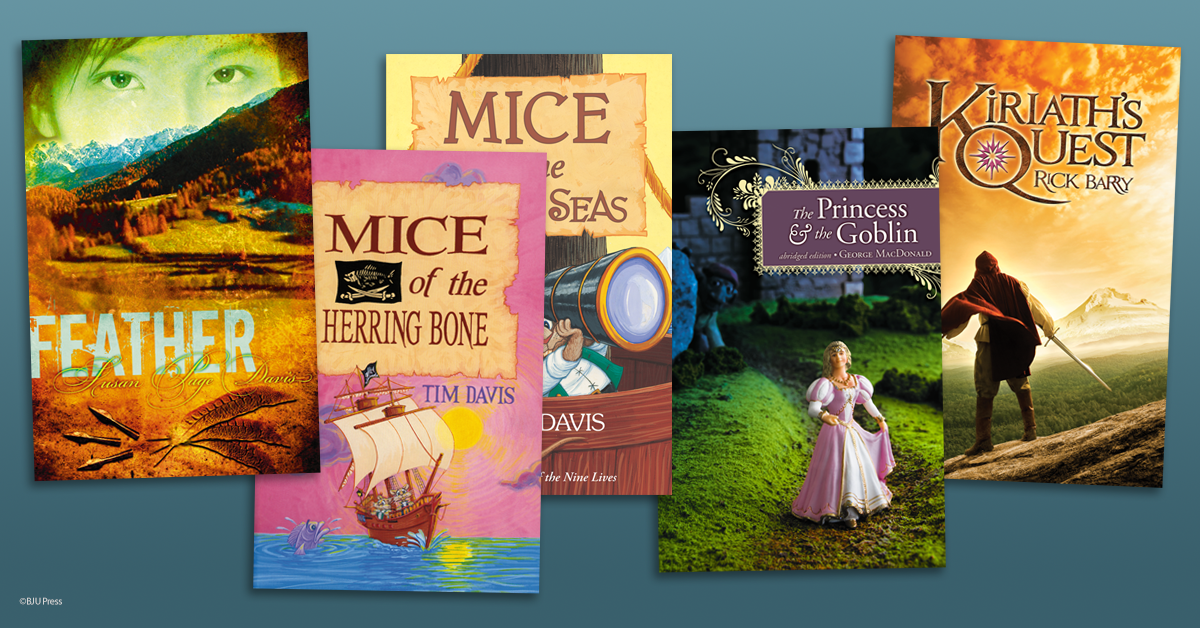
If you’re looking for good books from a Christian worldview, consider these fanciful fiction books from JourneyForth.
Filed Under: Shaping Worldview Tagged With: biblical worldview, fantasy, language arts, reading

Putting on Your Worldview Glasses

February 4, 2016 by Kevin

BWV_blog3

The Need for a Biblical Worldview

We have always lived in a fallen world, but it seems to be going from bad to worse (2 Timothy 3:13). The issues are snowballing; rebellion against God rages like an avalanche overtaking any chance of escape (Psalm 2:1–3). Will the rebellion of this world swallow up or smother your own children?

Truth claims and moral values that were once clear to many Christian parents are now being questioned by their professing Christian children. Some of the classmates I grew up with—who still profess Christ—have fallen into the traps that seem to be everywhere: justifying their indulgence in immorality, downplaying compromise with evolution, or gravitating toward the edges of orthodox Christianity.

As godly parents, you watch your young people growing up and see that they’re about to depart from home. You’re rightly motivated to equip your children to respond with biblical wisdom to the cultural upheaval: gay marriage, the murder of babies for profit, “safe zones” for the entitled on college campuses, and frequent mass shootings. The cultural situation is grim.1

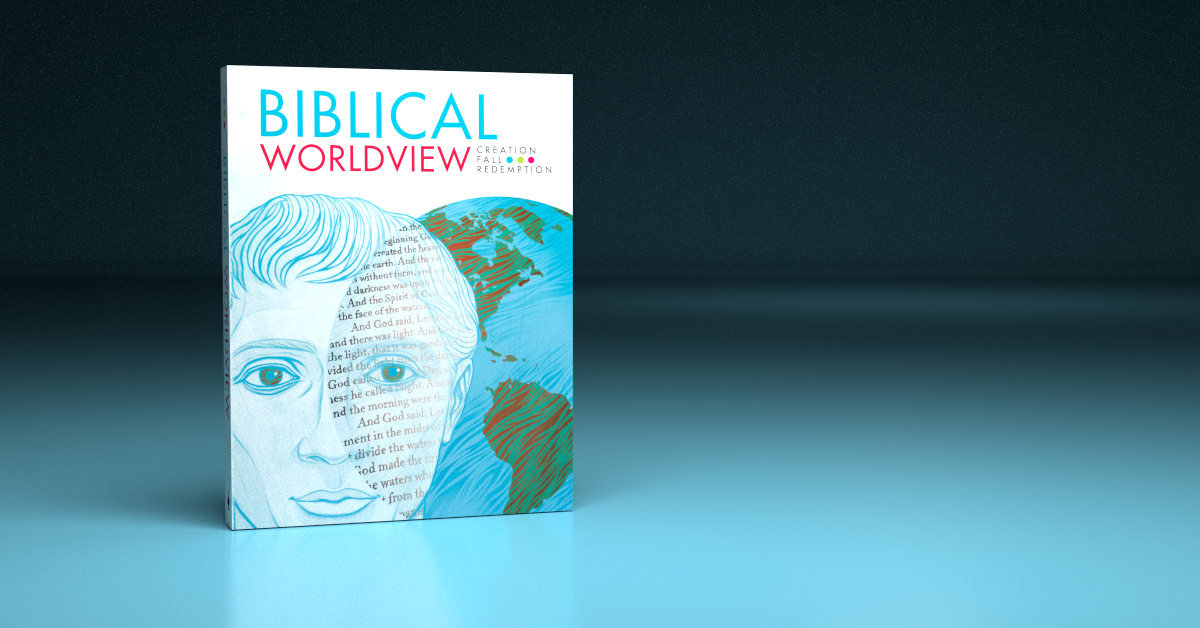
The biblical worldview team at BJU Press is motivated to provide the tools you need to equip your young people to face the chaotic world in which they live and to stand firm. That’s why we wrote Biblical Worldview: Creation, Fall, Redemption—to protect Christ’s little ones who truly belong to Him by providing them with biblical worldview glasses.

Biblical Worldview: Creation, Fall, Redemption

This one book brings together the biblical worldview approach that is integrated into all of BJU Press’s curriculum. First, it helps students understand what a biblical worldview is and its significance to all of life. Second, it helps students to specifically understand the biblical worldview of Creation, Fall, and Redemption. Third, it guides an application of this worldview to multiple social institutions and disciplines (marriage and the family, government, science, history, and culture and the arts).

In the process, it introduces students to apologetic methods and guides them to discern and refute false worldviews. Particular attention is given to motivating students to contribute positively to the social institutions and disciplines—to rebuild them according to a biblical worldview.

Four distinctives summarize our approach to teaching a biblical worldview:

  • Focus on a biblical worldview: The goal is to focus students on a constructive presentation of Creation, Fall, Redemption rather than to overwhelm them with information about a multiplicity of false worldviews. False worldviews will be evaluated, but always in the context of reinforcing the true biblical worldview.
  • Bible-first perspective: The starting point, the ultimate authority source, is God’s Word. It’s the standard by which all evidence and claims must be evaluated, and not vice versa.
  • Emphasis on evaluation and positive response: Students should be challenged not only to evaluate ideas intellectually but also to apply the biblical worldview as they become salt and light in the culture.
  • Content that is both accessible and compelling: This textbook was purposefully written in a style that’s more enjoyable to read and draws from several conservative Bible translations. Rather than introducing students to an encyclopedic overview of abstract philosophical concepts, our approach to worldview studies is designed to be engaging by being set in the context of the unfolding story of the world.

The Student Text is complemented by these additional resources: Teacher’s Edition, a Student Activities Manual and Student Activities Answer Key, and Tests and Tests Answer Key.

Take a look inside the book to learn more.

1. Ken Ham, “The Chasm Is Widening: Are You on God’s Side?” Answers in Genesis (website), April 29, 2013; D.C. Innes, “The Fight for Religious Liberty,” World (website), January 26, 2015.

Filed Under: Shaping Worldview Tagged With: biblical worldview, Creation, Fall, high school, new, Redemption, textbook

Serving God and Studying Science

November 5, 2015 by Ben

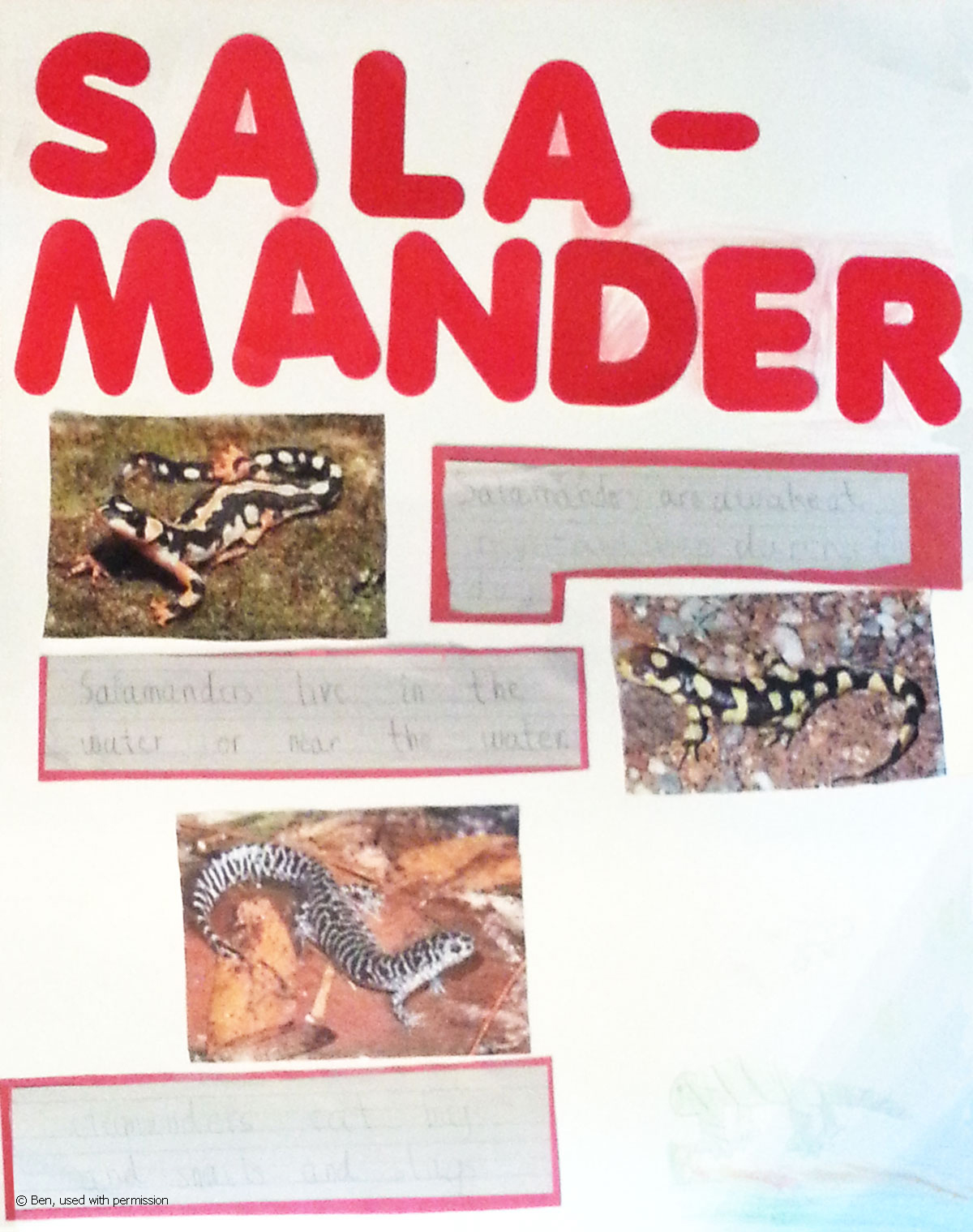
poster with salamander images and factsAfter we finished family worship, my wife asked me to work with our first grader on a science project. The assignment instructed her to make an informative poster about a wild animal. The week before, we’d found a salamander on a camping trip, so my daughter wanted to do a project on salamanders. She’d gotten a couple of books from the library, and we set out to find a few pictures.


I must confess that it was easy for me to fall into the trap of secularism that evening. Instead of remembering that God is relevant in all areas of life, I initially bought into the idea that this activity could be approached without involving Him.

It seems to me that Christians too often buy into this secular approach. We think certain activities are holy service to God, such as our family worship time, church attendance, or personal devotions. Other activities, such as cooking and cleaning, marketing, or finance are things we have to get through. They aren’t service to God. They have to be done, and we should obey God while we do them, but there isn’t a “Christian” way to do them.

church on top of house

The image in this blog post helps me understand this wrong way of thinking. The first story of the “house” is a typical suburban home. The second story is a church. Everything in the top story is “redeemable.”  Everything in the bottom is “unredeemable.” Sometimes we wrongly assume that the people who work on the upper floor in “full-time Christian service” are doing God’s work and the rest of us working down on the lower floor are second-class Christians who only serve the Lord when we participate in spiritual tasks.

But God doesn’t teach this way of thinking, secularism does. God says that everything belongs to Him, and He has something to say about it.

As I helped my daughter with her project, my mind at first fell into the trap of thinking we’d moved from God’s things to earthly things, but thankfully my daughter’s textbook didn’t take that approach. BJU Press Science teaches that everything should be service to God.

So that evening as I helped my daughter with her salamander project after family worship, we were really moving from one service to God to another. My daughter and I learned what salamanders eat and where they live. On a small, first grader level, we were learning how to obey God’s command to take care of the world.

What kind of teaching are your children receiving?

Filed Under: Shaping Worldview Tagged With: biblical worldview, salamanders, science

I Am a Mom and a Teacher Too

September 22, 2015 by Megan

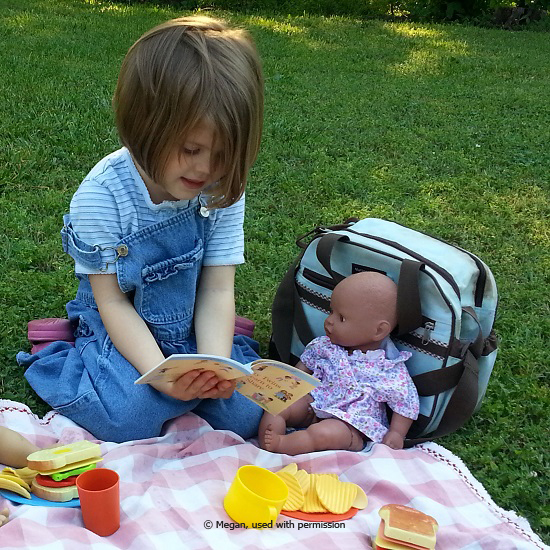
Girl sitting outside on a picnic blanket reading a book to her doll

As a stay-at-home mom of three, my days are filled with teaching moments. Today, I taught my oldest what kind of clothing is appropriate for playing outside in eighty-degree weather. I taught my preschooler how to respond when her baby sister pulls her hair. I taught my youngest that putting plastic beads in her mouth is a bad idea.

Some days, it seems like my children don’t listen to a thing I say. I don’t seem to be making any progress, and I wonder if I will always have to remind them to pick their clothes up off the floor, brush their teeth in the morning, and use a fork when eating their green beans.

But then there are moments when I get to silently observe my oldest two children at play. I watch them play with their dolls. Sometimes they are taking their “children” to church and sometimes they are feeding them a snack or putting them to bed. My daughters talk to their dolls, and, as I listen, I realize they sound exactly like me. Their words are like mine. Their tone is like mine. Their actions are like mine. It is then that I realize that they are listening. And they are learning from me, even when I don’t realize it.

It’s a little scary to realize that small people are constantly watching me and mimicking everything I do. What am I teaching them? I’m not just teaching them about how to do simple chores around the house, practice good hygiene, recognize their alphabet, and count to a hundred. I’m teaching them about life. I’m teaching them how to relate to other people. I’m teaching them what it means to be a Christian wife and mother.

I’m not perfect. There’s a lot about me that I hope my children will never mimic.  But teaching my children is not something that I can shy away from. My only hope is the only hope I need—God. More and more, I find myself on my knees begging for the grace and strength to lead my children in the paths of righteousness. I pray for the fortitude to get up and try again after yet another miserable failure. I pray for wisdom and discernment to know what and when to teach them. And God always answers. He always provides what I need.

As I write this, my children are napping. When they wake up we will have a snack and then take a walk to a nearby playground. As we walk, I will try to point out all the wonderful things that God created, but we will probably end up talking about whatever random things come to their minds. They might not let me talk at all. But even if I don’t speak a single word, I will be teaching. And they will be learning.

Filed Under: Simplified Homeschool Tagged With: biblical worldview, family, homeschool, moms, parenting, teaching children

The Special Way God Made You

September 15, 2015 by Justin

young child's face

Spend some time around young children, and you’ll quickly realize how interested they are in the human body. They’re extremely observant and love to compare and contrast noses, ears, eyelashes, fingers, and toes, pointing out every little difference from size to color. My four-year-old nephew is fascinated with my beard. Every time we’re together, he asks why I have “whiskers,” and wants to know why he doesn’t. What children like my nephew may not realize is why each person is so different.

All people are valuable because God made every one of them in His image (Genesis 1:26). Each person’s differing characteristics show the vastness of God’s creative genius (Ps. 139:13–16). Children love to ask “why” questions all the time, and you might be surprised how often the Bible has an answer that is easier and better than “it just is.” I’ve found that it’s never too early to begin shaping a worldview that has the Bible as its foundation.

Using Scripture as the basis for lessons for young children

As homeschool parents, you have a unique opportunity to point out God’s goodness to children starting at a young age by basing academic lessons on the Bible. As an example, let’s look at elementary science. The human body is a topic typically covered in Grade 1. First graders are given a basic overview of the human body, the functions of its main parts, and basic tips on how to care for it. Integrating the Bible into a lesson like this isn’t that difficult, and our homeschool textbooks do a good job of this.

The Bible says that God created every part of us for a purpose (Job 10:11–12). As you work through the parts of the human body, talk with your children about His purpose for each. God knew that we would need to be able to chew food, so He designed our teeth. Our fingers allow us to pick things up. Some children are born with differences. They might be missing parts that others have. Use the Bible to talk with them about God’s special plan for them and their special differences (John 9:2–7, Romans 5:3–5, Exodus 4:11, Jeremiah 29:11).

Why caring for our bodies is important

Teaching your children to care for their bodies (proper washing, toothbrushing/flossing, doctors’ visits) is not always easy. These everyday tasks are often seen by children as interruptions in their play time, and it can be difficult to convey the value of these things. Ask your children what they would do if God loaned them something special that He had designed. Would they take good care of it? Tell them that their bodies belong to the Lord (1 Corinthians 6:19–20), and that includes every part, for example, their teeth. Remind them that they need to take good care of their teeth because they belong to God and are part of His plan.

Let’s try another example, the yearly eye exam. Young children don’t always understand the importance of checking the health of their eyes, but something they generally do understand is that God wants us to do things that the Bible says are good. Ask them to notice how we see everything in color. How would life be different in black and white? Remind them that God wants us to be able to appreciate the beauty of His world (Psalm 19:1), and having healthy eyes is very important to being able to do what God wants. This approach can be used to talk about any doctor’s visit and may alleviate a lot of anxiety as well.

Bible integration doesn’t have to be a scary concept. It can be a simple process of making Scripture your starting point and developing lessons with a little creativity and awareness of your child’s natural curiosities. So the next time your child asks you why something is the way it is or why he has to do something, check the Bible first. It has the answers he needs to know.

Filed Under: Shaping Worldview Tagged With: Bible integration, biblical worldview, homeschool, science

  • « Go to Previous Page
  • Page 1
  • Interim pages omitted …
  • Page 3
  • Page 4
  • Page 5
  • Page 6
  • Page 7
  • Page 8
  • Go to Next Page »

Primary Sidebar

As parents, teachers, or former homeschool students, we are passionate about homeschooling from a biblical worldview. We hope these teaching tips, fun activities, and inspirational stories support you in teaching your children.

Email Signup

Sign up for our homeschool newsletter and receive select blog posts, discounts, and more right to your inbox!

Connect with Us!

                    Instagram     

Read Posts on Specific Subjects

Early Learning
Foreign Language
History
Language Arts
Math
Science

Footer

Disclaimer

The BJU Press blog publishes content by different writers for the purpose of relating to our varied readers. Views and opinions expressed by these writers do not necessarily state or reflect the views of BJU Press or its affiliates. The fact that a link is listed on this blog does not represent or imply that BJU Press endorses its site or contents from the standpoint of ethics, philosophy, theology, or scientific hypotheses. Links are posted on the basis of the information and/or services that the sites offer. If you have comments, suggestions, questions, or find that one of the links no longer works, please contact us.

Pages

  • About BJU Press
  • Conversation Guidelines
  • Terms of Use & Copyright

Archives

© 2026 · BJU Press Homeschool