• Skip to primary navigation
  • Skip to main content
  • Skip to primary sidebar
  • Skip to footer

BJU Press Blog

  • Home
  • Shop
    • Shaping Worldview
  • Simplified Homeschool
  • Successful Learning

biblical worldview

Storytelling and Worldview

September 10, 2015 by Ben

three beach balls in the blue sky

At times the challenge of developing a biblical worldview in my three little girls, five and under, overwhelms me. How can I equip these young minds with something as complex as a worldview? The writings of Paul David Tripp encourage me. In particular, Paul’s simple explanations and illustrations demonstrate that I can develop my daughters’ worldview.

I love Paul’s story about his three-year-old son, who after falling down the stairs exclaimed, “Thank you!” When Paul asked his son who he was talking to, the boy responded, “The angels. And I know how they did it.”

“Who did what?”

“The angels! One stands on this side, and the other stands on that side. They both hold beach balls. When you start to fall, they put the beach ball out to keep you safe.”

Tripp observes that even three-year-olds interpret what’s happening. In this case, the conclusion was immature, and it confused Sunday school lessons with family vacations. But even very young children are capable of understanding stories, synthesizing them, and using them to explain daily occurrences.

Thankfully, our heavenly Father has given us His perspective in terms of a story. It’s a story that even toddlers and preschoolers can learn and use to interpret everyday life. It’s a true story with a beginning, middle, and end. It’s a story that dramatically affects the way we interpret the learning that makes up education. It’s the story of Creation, Fall, and Redemption.

Creation

The story begins with “God created the heaven and the earth” (Genesis 1:1). But when the story reaches Genesis 1:26–28, we learn that we’re special. God creates man and woman in His own image. God tells them to fill the world with little image-bearers and to take care of the world. Then He gives the first man a home (Eden), a wife (Eve), and a job (to name the animals and to work the garden).

Fall

Then Adam rebels and everything breaks. Death, sadness, and fighting come because of Adam’s wrong choice. His sin means that our hearts have been broken and our minds have been polluted. Adam and Eve make clothes out of fig leaves and then hide from God. Adam blames his wife for the sin, and Eve blames the serpent (Genesis 3:7–12).

Redemption

Next, we see that God immediately sets in motion His plan to redeem His fallen creation (Genesis 3:15). He promises that there will be conflict between the anointed one and the serpent. He promises that the anointed one will win and redeem God’s creation. This redemption plan is fulfilled in Christ’s death on the cross, His burial, and His resurrection from the dead.

The story applied to . . . math?

I share this story, not because it’s new or insightful, but because it’s simple and familiar. This is a story I share with my girls during family devotions. It’s a story they hear in Sunday school, and it affects the way they interpret learning, even math!

  1. Math is a powerful tool to help us take care of the world (Genesis 1:28)
  2. Because of the fall, some people use math to deny God (Romans 1:21–23)
  3. The people of God can live in light of redemption by using math to love their neighbors (Luke 10:27–28)

The Creation-Fall-Redemption story doesn’t make worldview shaping easy, but it does make it attainable for my precious little ones. Using this story to interpret learning is critical for providing my children a thoroughly Christian education.

Filed Under: Shaping Worldview Tagged With: biblical worldview, Creation, Fall, family, homeschool, math, Redemption

My Commitment to Biblical Worldview Education

June 16, 2015 by Ben

family reading the Bible together

As a dad, I’ve appreciated Karin’s posts on family devotions. Family worship offers me the opportunity to disciple my children with intentionality. As I gather my three daughters daily to read God’s Word, I’m trying to obey the command in Deuteronomy 6:7 to “teach them diligently.” So it’s encouraging to hear about others practicing family worship and to learn that they’re experiencing (and overcoming) the same difficulties.

Of course, our obligation to diligently teach our families to love God isn’t fulfilled in a routine Bible time. We’re supposed to teach God’s Word when we’re sitting, when we’re walking, when we’re lying down, and when we’re waking up. It’s an all-day, every-day commitment.

For my girls, a large part of their daily life is education, so it’s important to me that their education is contributing to their discipleship. In fact, since education is worship, I want to give my daughters a biblical worldview education.

Education Is Worship

It’s easy to look at teaching kids how to subtract or read as “neutral.” After all, 2 + 2 = 4 whether you’re a Christian, a Buddhist, or an atheist. But education is far too foundational an undertaking to occur without a purpose. From age five to eighteen, my girls will spend over fourteen thousand hours learning math, science, history, and language arts. All of that effort has to be for a purpose, or it’s a waste of time. Even children know that education needs a purpose. While answering their twenty-three math problems, they will ask the critical question: “Why do I have to learn this?”

In his book The End of Education: Redefining the Value of School, Neil Postman observed that education is worship when he said, “For school to make sense, the young, their parents, and their teachers must have a god to serve, or even better, several gods.” He argues that American public schools are dedicated to serving, among others, the god of consumerism. Worshipers of consumerism learn so that they can get jobs and buy the best cars, houses, and vacations. If Postman, who was a secular humanist, sees the religious nature of education, we Christian dads need to think through the worship implications of the education choices we make for our children.

The Purpose of Education

After my wife and I got engaged, we would take long walks where we’d discuss how we planned to run our household. Since both of us received a biblical worldview education, we wanted this same education for our children. It was and still is important to us that we teach our children to glorify God and love their neighbor as themselves through math, science, history, and language arts. My daughters need to know that math isn’t the key to financial security and prosperity; it’s a tool God gives us to obey His commands. That context is crucial for using education to serve God instead of the god of consumerism. If I am going to obey Deuteronomy 6:7, I have to diligently teach my daughters that the purpose of their education is serving God.

Before I was born, my dad determined that his children would be homeschooled so that they could receive a biblical worldview education. I owe so much to my dad for that gift. Now as a dad, I want to teach my daughters that worshiping God isn’t limited to Sunday church services. We serve God through the right kind of education; therefore, my wife and I are committed to providing our daughters with a biblical worldview education.

Filed Under: Shaping Worldview Tagged With: biblical worldview, education, family, homeschool

How to Apply Deuteronomy 6

June 9, 2015 by Karin

a woman with a Bible opened to Deuteronomy 6 taking notes

In a six-part series, we explored family devotions—the importance of it as well as ways to structure the time, to overcome obstacles, and to keep the gospel central. A regular family devotions time enables us to systematically disciple our children in “the whole counsel of God” (Acts 20:27 NKJV). But God’s Word should so permeate our hearts and minds that we naturally talk about it throughout the day with our children (Deuteronomy 6:4-9).

God’s command to the Israelites to teach their children His words is reiterated to believers in the New Testament. After instructing children to obey and honor their parents as taught in the Ten Commandments, the apostle Paul admonished parents, “Do not provoke your children to wrath, but bring them up in the training and admonition of the Lord” (Ephesians 6:4 NKJV).

In order to diligently teach God’s Word to our children, we must first treasure it in our own hearts (Deuteronomy 6:6). When we are deepening our love for the Lord and saturating our minds with His Word, talking to our children about the things of the Lord will be a regular overflow. In an effort to be more intentional, for a few months I kept a journal about opportunities I had to point my children to the Lord during normal events of the day.

Here are some entries from my journal. These moments are not intended to be replicated but to be examples of implementing Deuteronomy 6 teaching in day-to-day life. Many of my journal entries include analogies (tying a life event or an item in creation to a spiritual truth). As you share, seek to be gospel-centered.

Journal of Deuteronomy 6 Teachable Moments

  • Tuesday: My young children got scared and ran to me when there was a loud series of fire alarm tests in our apartment building. When we are afraid, we run to someone stronger, and that should ultimately be the Lord. I reminded the kids that God is in control and that He is with us. We talked about how a fire alarm is good because it warns us of a fire so we can escape. God’s Word has fire alarms, warning us about the lake of fire and how to escape the punishment for our sins through trusting in Jesus.
  • Wednesday: My child confessed doing something wrong while I wasn’t watching. We talked about how God always sees us, even when Mommy isn’t looking. We can’t get away with secret sin. Through a song, we’ve learned this verse: “The eyes of the Lord are in every place, keeping watch on the evil and the good” (Proverbs 15:3 NKJV).
  • Thursday: We were playing in a room where the curtains were closed. We talked about how there was a curtain in the temple separating the holy place from the most holy place. When Jesus died, that curtain was torn in two (at that point, we flung open the curtains), symbolizing the access we have to the Father because the flesh of Jesus was torn on the cross for our sins (Matthew 27:51; Hebrews 10:19–22).

I no longer keep a journal of my Deuteronomy 6 opportunities, but perhaps I’ll begin writing them down again if I find myself falling into complacency. Teaching my children diligently must spring from a heart that is captivated with the glory and grace of the Lord and saturated with a personal knowledge of His Word.

May the Lord bless you with wisdom as you seize the opportune, fleeting moments to teach your children along the way. “From childhood you have known the Holy Scriptures, which are able to make you wise for salvation through faith which is in Christ Jesus” (2 Timothy 3:15 NKJV).

Filed Under: Shaping Worldview Tagged With: Bible, biblical worldview, Deuteronomy 6, gospel, homeschool, parenting

Gaining Wisdom

June 2, 2015 by BJU Press Writer

image of BJU Press homeschool branding gaining wisdom and knowledge and joy.

There was a time when people thought an educated person was someone with lots of information. But information is easy for everyone these days, too easy. Most people struggle to finish reading a post like this one because they know they’re just clicks away from the latest post about their favorite celebrity. (Thankfully, you’re not like most people!) Everyone has information. But most people still lack something that only education—true education—can give.

What is that something?

It’s the ability to look at information and see it in proper perspective. It’s the ability to sift through the piles of data that all of us slog through and discern what’s true and what’s really important. And it’s the ability to know how to take what is most important and put it to use so that success—lasting, satisfying success—is achieved. It’s wisdom.

How do you get something as precious as wisdom?

Proverbs has the answer: “The fear of the Lord is the beginning of wisdom” (Proverbs 9:10).

Fear? Modern secular education tells us to abandon our fears. Learning is possible, we are told, only if we are willing to call everything into question—our sexuality, our beliefs about where we came from, our beliefs about God. But such advice is a lie. The wise person has come to accept that some questions need not to be asked. He knows that God is to be feared. This doesn’t mean that the wise man runs away from God in terror. But it does mean he takes God seriously.

What else does wisdom require?

Proverbs says that the fear of God is the beginning of wisdom. You can’t be wise without fearing God, but you can’t be wise without a lot of other things too.

Anyone who would be wise must also be a learner, a careful observer, a student. With the fear of God firmly in his heart, a person needs to study the world all around. He cannot make wise decisions unless he has a great deal to be wise with. So he’ll have to know about science, math, language arts, and social studies.

But he’ll have to know about these from the perspective that only the fear of the Lord can provide. He’ll need to understand that science is a powerful tool for ruling over God’s world under God’s greater rule over him. He will have to see math as a way to model God’s world for God’s purposes. He’ll need to understand that human communication is the result of humans having been made in God’s image and therefore it must be used to imitate God’s character and deeds. And he’ll have to learn about society with the understanding that government exists to ensure justice—justice on God’s own terms.

Where does a person develop this kind of understanding?

All the way through life in whatever situation he finds himself. But the best way to begin is through education. Not just any education, of course. A Christian education. An environment where Christian parents, students, and textbooks all work together to produce something far more profound and useful than mere information.

This post is part of our series highlighting our 2015 theme Gaining Wisdom and Knowledge and Joy. Bryan has worked in Christian education for over twenty-five years. Since 2003, he has served at BJU Press as the senior manager for biblical worldview formation. He and his wife have six children. 

Filed Under: Shaping Worldview Tagged With: biblical worldview, homeschool, philosophy, wisdom

Family Devotions (Part 6)

April 6, 2015 by Karin

As we teach our children the Scripture during family devotions, we must not miss the main point, which is the gospel, the good news of God’s redeeming plan through Christ. The Bible isn’t merely a book of character-building stories to orient a child’s moral compass; rather, it uncovers our spiritual bankruptcy before a holy God and reveals our wonderful Savior and Lord Jesus Christ.

While the gospel is central, there’s a reason the Bible isn’t a four-point salvation presentation in tract form. We ought not to ignore any of God-breathed Scripture, all of which is “profitable for teaching, for reproof, for correction, and for training in righteousness, that the man of God may be competent, equipped for every good work” (2 Timothy 3:16–17, ESV). Even the genealogies, long and tedious as they can be, show the authenticity of the Bible’s history and the faithfulness of God in preserving the line of Christ.

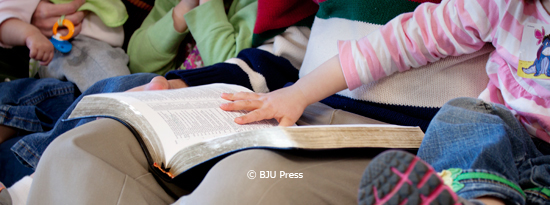
image of a family sitting around having devotions

Law, history, poetry, and prophecy in the Old Testament also serve a purpose.

Law

Passages on the law of God point our children to God’s perfection, our inability to meet God’s righteous demands, and the Lamb of God, who perfectly fulfilled the law and shed His blood for our sin “that we might be justified by faith” (Galatians 3:24 NKJV). God gives new hearts so believers have the power to obey the imperatives given in the New Testament (1 John 2:3–4, 3:9).

History

The historical books in the Bible dramatically tell our children the story line of redemption, as each character and every event bring us closer to the climax of Christ’s coming. The New Testament writers demonstrated how the Old Testament characters showed our need for Jesus and salvation by faith:

  • Adam and Eve: Romans 5:12–21
  • Cain and Abel: Hebrews 11:4
  • Noah: Hebrews 11:7
  • Abraham: Galatians 3
  • Moses: Romans 10:5–10
  • David: Acts 2:25–36

Poetry

The Bible’s unsurpassed poetry reveals God’s character and works. The worshipful psalms and instructive proverbs teach our children the fear of the Lord, which is the beginning of wisdom (Psalm 111:10). Such reverence should drive them to be reconciled with God through the cross. On the cross, the sinless Christ bore our sin and then rose from the dead in victory over sin and death, granting eternal life to all who turn to Him in repentance and faith.

Prophecy

Reading the books of prophecy with our children reveals man’s stony heart and need for God to give a heart of flesh (Ezekiel 36:26). This regeneration was made possible through the perfect life, death, and resurrection of the Messiah. Detailed prophecies pinpointed the person and work of Christ, hundreds of years before He fulfilled them.

As we engage our children in family devotions, we must remember that our children aren’t born with neutral hard drives that simply need to be programmed with the right software. They’re born with the deadly virus of a sin nature passed on from our first father Adam. That’s why Jesus said we must be born again (John 3:3–8).

We can’t cause this change of heart in our children, so that they repent and believe in the Lord Jesus. But we can be faithful to pray for them and teach them through family devotions, so that they when they’re grown, we can remind them of their biblical heritage (2 Timothy 3:14–15).

May the Lord grant us grace in the task of family discipleship. What a privilege we parents have to lead our little ones to the Savior!

Read the previous family devotions posts.

Filed Under: Shaping Worldview Tagged With: Bible, biblical worldview, Deuteronomy 6, family devotions, gospel, homeschool, parenting

  • « Go to Previous Page
  • Page 1
  • Interim pages omitted …
  • Page 4
  • Page 5
  • Page 6
  • Page 7
  • Page 8
  • Go to Next Page »

Primary Sidebar

As parents, teachers, or former homeschool students, we are passionate about homeschooling from a biblical worldview. We hope these teaching tips, fun activities, and inspirational stories support you in teaching your children.

Email Signup

Sign up for our homeschool newsletter and receive select blog posts, discounts, and more right to your inbox!

Connect with Us!

                    Instagram     

Read Posts on Specific Subjects

Early Learning
Foreign Language
History
Language Arts
Math
Science

Footer

Disclaimer

The BJU Press blog publishes content by different writers for the purpose of relating to our varied readers. Views and opinions expressed by these writers do not necessarily state or reflect the views of BJU Press or its affiliates. The fact that a link is listed on this blog does not represent or imply that BJU Press endorses its site or contents from the standpoint of ethics, philosophy, theology, or scientific hypotheses. Links are posted on the basis of the information and/or services that the sites offer. If you have comments, suggestions, questions, or find that one of the links no longer works, please contact us.

Pages

  • About BJU Press
  • Conversation Guidelines
  • Terms of Use & Copyright

Archives

© 2026 · BJU Press Homeschool