• Skip to primary navigation
  • Skip to main content
  • Skip to primary sidebar
  • Skip to footer

BJU Press Blog

  • Home
  • Shop
    • Shaping Worldview
  • Simplified Homeschool
  • Successful Learning

Shaping Worldview

You homeschool because your child’s faith is important to you. We want to support you in training up your child. These blog posts show how to give your child a biblical worldview of each subject.
Start here:

  • How Is God Involved in Math?
  • The GEM Approach: A Biblical Approach to Objectional Elements in Literature
  • Understanding Science Through Faith

5 Ways to Combat the Subtle Messages of Secularism

August 25, 2016 by BJU Press Writer

2016 September Blog Post_TB

You’ve chosen to educate your children at home to protect them from secular influences during their formative years. But what about the books we bring into our homes? Sometimes a book’s agenda is obvious—you can tell by what authors put in or what they leave out. I recently surveyed a selection of secular textbooks and found the following topics of concern: the acceptance of evolution as scientific fact, the glorification of pop culture icons such as humanist authors and fierce feminists, and the affirmation of extreme environmentalism. These are obvious, but many books just leave God out, which is at the foundation of secular thought. So what can we do to protect our children from textbooks packed with secular philosophies?

Here are five ways Christian textbooks can support your goal of teaching your children to think biblically.

1. Redeeming the Minds of Our Children

As Christian parents, we want to redeem our children’s minds for God’s glory. We want them to acknowledge that “in Him we live, and move, and have our being” (Acts 17:28), and that whatever is done must be done “heartily, as to the Lord” (Colossians 3:23). To achieve that goal, we need Christian textbooks—books that do more than merely purport to have a “moral emphasis” or tack a Bible verse onto the title page. A thoroughly Christian textbook helps a parent to support the spiritual growth of the child and to equip that student for God’s service.

2. Reaffirming a Biblical Worldview

A genuinely Christian textbook promotes a biblical worldview. For example, when discussing the women’s rights movement of the ’70s, a Christian history text factually discusses the positive and negative outcomes of the movement, basing its analysis of the movement on Scripture. In a secular book, students often encounter statements that deny God as Creator, such as “millions of years ago” or “before civilization got started.” Using a Christian text, a parent can spend time actually teaching, rather than un-teaching the errors.

3. Putting God Back into the Textbooks

Sometimes the danger lies in omission. One secular science textbook discusses babies and bees and rainbows but never mentions the God who made them all (Genesis 1:1; John 1:1–3). Daily bombarded with humanism, materialism, hedonism, and socialism, a student may begin to think, “God can’t be too important since He isn’t mentioned anywhere in this scholarly work.” Christian textbooks can effectively combat this God-omitting worldview.

4. Teaching Children How to Live Right

Christian textbooks emphasize the characteristics of God and principles of godly living. They reveal God in every branch of study. A writing textbook reflects a God of creativity and beauty, a science book reflects a God of infinity and order, and a Christian history text showcases events planned by an omniscient, omnipotent God. Students understand the conflict between righteousness and unrighteousness, explore real-life examples of the principles of sowing and reaping, and see illustrations of the providence of God.

5. Training Students to Think for Themselves

Christian textbooks further support and equip Christian students by encouraging discernment and teaching them to analyze content using biblical principles. For example, in one Christian literature text, students are asked to compare and contrast Geoffrey Chaucer’s Canterbury Tales with various biblical accounts. The textbook also evaluates the advice of Sir Francis Bacon’s essays in light of God’s Word.

Choosing Hope for the Next Generation

How can we fight the philosophies that stunt our children’s spiritual growth and the secular texts that cram their minds full of the world’s wisdom? With God’s help, we can use Christian texts to give our children access to a higher wisdom. There is still only “one God, and one mediator between God and men, the man Christ Jesus; who gave himself a ransom for all” (1 Timothy 2:5–6). Christ remains the ultimate answer—our one true Hope. Why use a textbook that undermines that Hope, subtly or not?

• • • • •

A word-lover and grammar enthusiast, Kim Stegall writes for WORLDteen, a magazine published by WORLD. In her spare time, she serves as dramaturge for the Greenville Shakespeare Company, a local nonprofit theater. In addition to working on dozens of writing, grammar, and literature textbooks for BJU Press, she has written a number of plays and published two children’s books with JourneyForth: Mumsi Meets a Lion and Rodney Robbins and the Rainy-day Pond.


Filed Under: Shaping Worldview Tagged With: Christian textbook, Christian textbooks, secular textbooks

Homeschooling During an Election Year

July 28, 2016 by Justin

JH Politics and HS

The controversies surrounding elections have at times made me want to shut politics out of my life until the election is over. But each time, I decide against that because I know how important it is.  As Christians, we can’t hide from the issues since many directly impact us. It’s our responsibility to make sure that both we and our children are well informed and ready to cast our votes now and in the future. There is no better time than an election year to be teaching children what the political process of our nation involves and how to evaluate the issues and candidates from the perspective of a biblical worldview.

Our Biblical Worldview: Creation, Fall, Redemption textbook (pages 239–40) says it well:

God laid the foundation for government as He laid the foundation of the earth. Government has been part of God’s good and glorious plan from the beginning. . . . Governments have power from the Highest Power. But governments are made up of fallen people who twist that power in frivolous ways.

Government in itself is not bad and is something that has been planned by God (Romans 13:1). So it’s important for all Christians to understand their nation’s government and participate in it appropriately. However, it’s also true that all governments are made up of fallen individuals, making it equally important for us as Christians to be well informed about what the Bible has to say about the issues and the candidates who take positions on those issues. It’s also our responsibility to make sure our children are prepared to do the same.

I strongly encourage teenagers who are looking forward to voting in this election for the first time to work though Biblical Worldview: Creation, Fall, and Redemption. It takes the biblical values they have been hearing from you as well as from BJU Press curriculum and applies those values to politics, government, and adult life. It also can help you prepare them to defend their Christian faith against the many challenges they’ll encounter as they transition into college and adult life.

Take a look inside the book here.


Filed Under: Shaping Worldview, Successful Learning Tagged With: Bible, election, history, politics, teenagers, teens, worldview

The GEM Approach: A Biblical Approach to Objectional Elements in Literature

July 21, 2016 by Ben

Ever since we started reading picture books to our daughters, my wife and I have evaluated the content of the books we bring into our home. Now that our six-year-old is reading on her own, evaluating for objectionable elements is even more important. Below is an excerpt from Elements of Literature Teacher’s Edition. This is the philosophy we use when reviewing books for our children, and it has served me well ever since I read it as a student. I hope you find that it is helpful for your family as well.

JD Article Revision

“Educational censorship remains one of the most controversial issues in public life, linked as it is to political censorship and freedom of the press. The basis of a truly biblical position concerning censorable elements is the following distinction. If a work of literature or other element of the curriculum treats evil in the same way that it is treated in the Scriptures, we regard it as not only acceptable but also desirable reading. If it does not treat evil in the way evil is handled in the Scriptures, its content is not good.

“Evil in the Bible appears dangerous and repulsive. Reflections of evil appear in the form of negative examples so as to create a defense against what they represent or to give hope to the fallen for forgiveness and recovery from sin.

“We may draw the following three criteria from the Scriptures for judging literary and other works with respect to their content.

Gratuitousness

“Is the representation of evil purposeful or is it present for its own sake? We know that ‘all scripture is given by inspiration of God, and is profitable for doctrine, for reproof, for correction, for instruction in righteousness: That the man of God may be perfect, throughly furnished unto all good works’ (2 Timothy 3:16–17). Nothing in the Scriptures is superfluous or irrelevant to this high spiritual purpose.

Explicitness

“Is the representation of evil, if purposeful, present in an acceptable degree? Or is it more conspicuous or vivid than the purpose warrants? No one with a high view of Scripture would charge it with inappropriateness or excessiveness in its representation of evil. The presentation of evil in the Bible is realistic enough to convince us of its threat as a temptation but not so realistic as to become for us a temptation.

Moral Tone

“Is evil made to appear both dangerous and repulsive? What is the attitude of the work toward it? ‘Woe unto them that call evil good, and good evil,’ says the Lord through the prophet Isaiah (Isaiah 5:20). A good work of literature does not glorify human weakness or encourage tolerance of sin. It allows evil to appear in a controlled way in order to develop in the reader or hearer a resistance against it. In literature, ‘vice,’ wrote Samuel Johnson, ‘must always disgust.’ Its purpose is to initiate the reader through ‘mock encounters’ with evil so that evil cannot later deceive him—so that he will be better able to maintain a pure life in a fallen world.

“These three criteria are complementary. None is alone sufficient to justify the censorable in a work of literature or another element of the curriculum. Together they work powerfully, because they work biblically, to preserve moral purity while providing for a developing moral understanding and judgment.”

Editor’s note: Excerpted from Elements of Literature Teacher’s Edition  (p. viii), published by BJU Press. 

Image source

Filed Under: Shaping Worldview Tagged With: biblical worldview, language arts, literature, objectional elements, reading

The Dilemma of Fantasy

June 28, 2016 by BJU Press Writer

fantasy

As your children pick out books for their summer reading, you may wonder whether fantasy is an appropriate option. Consider these key questions before making up your mind about fantasy.

What is fantasy, and what is its purpose?

Simply put, fantasy is a genre of literature with fanciful or imaginative settings, characters, or plot devices. The purpose, according to C. Hugh Holman, coauthor of A Handbook to Literature, may be “for the whimsical delight of the author or reader, or it may be a means used by the author for serious comment on reality.” Fantasy as a genre is much like a car, a means of getting from one place to another, and whether it’s good or bad depends on how a person uses it.

Why have some had a negative opinion of fantasy?

Some people argue that fantasy (and even fiction in general) is just “a lie” because the events and settings and characters aren’t found in real life. However, at least twice in the Bible, fanciful fiction appears in service of truth (Judges 9:8–15; 2 Kings 14:9). Again, it’s not the genre itself but rather the use it is put to that determines its value. Some Christians reject fantasy because some stories present lurid violence, graphic sensuality, or the triumph of evil over good. However, these characteristics are unacceptable in a work of any genre, not just in fantasy. Rather than judging a novel by its genre, we should determine whether the work has a solid moral tone (i.e., whether it presents good as desirable and evil as offensive). (For a thorough look at this topic, see The GEM Approach.)

How can fantasy benefit your children?

Fantasy offers an opportunity to teach children to think biblically. The whimsical element of fantasy allows young readers to enter a new world with new experiences where good and evil are easily seen and identified. They learn there to be discerning readers and develop literary skills that are key in understanding biblical themes. Reading The Pilgrim’s Progress, for example, which presents a journey as a metaphor for the Christian life, will enrich their appreciation for the beauty and meaning in Psalm 23 since it also speaks of life as a daily walk with dangers and joys.

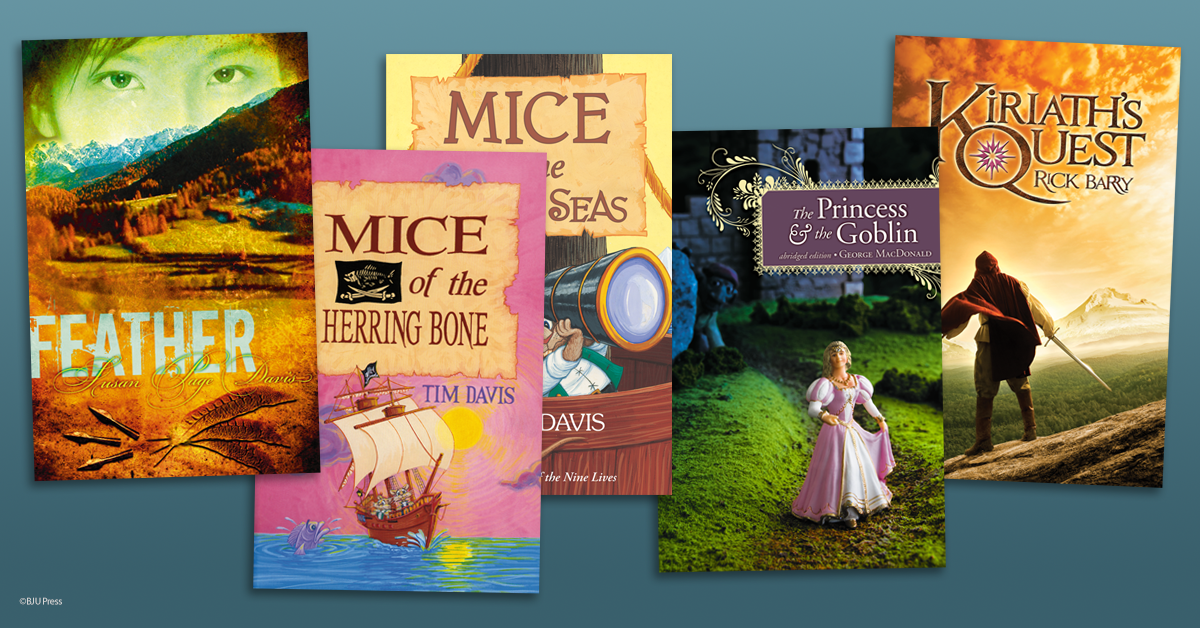
If you’re looking for good books from a Christian worldview, consider these fanciful fiction books from JourneyForth.

Filed Under: Shaping Worldview Tagged With: biblical worldview, fantasy, language arts, reading

The Moral of the Story: How Not to Read the Old Testament

June 16, 2016 by Kevin

Have you ever gotten lost in the middle of reading the Old Testament? Getting lost is easy because the Old Testament is long, the culture is foreign, and your recollection of the history may be fuzzy. From childhood, most of us have been taught to approach Scripture looking for morals to apply to our lives today. (Or maybe we just fall into this approach naturally.) But the Old Testament just doesn’t seem to provide what we’re looking for—unless we’re willing to stretch or twist the text out of context.

What’s the solution?

  • First, our approach to Scripture needs to change.
  • Second, we need to focus on the structure of the larger story of Scripture.
A God-Directed Approach to Scripture

Teaching children a foundation of biblical facts is important, and guiding them to make practical application should be an end goal. But the driving focus must be God-directed, not self-directed. Otherwise, children may learn all the morals for how to behave without recognizing the point—a right relationship with their Creator. For example, the point of the David and Goliath narrative isn’t to teach children to find courage in themselves. The point is to trust God because “the battle is the Lord’s” (1 Samuel 17:47).

Children need to be taught from a young age to look for what God reveals in His Word about Himself. And from those truths they can learn to look for what God has revealed to humans about having a relationship with Him. If we don’t teach children to approach the Bible this way, they may miss the Person at the center of it all; they may miss the all-powerful, self-existent God overflowing with love—the one all creation points to (Psalm 19:1).

Story of the OT
The Creation, Fall, Redemption Structure

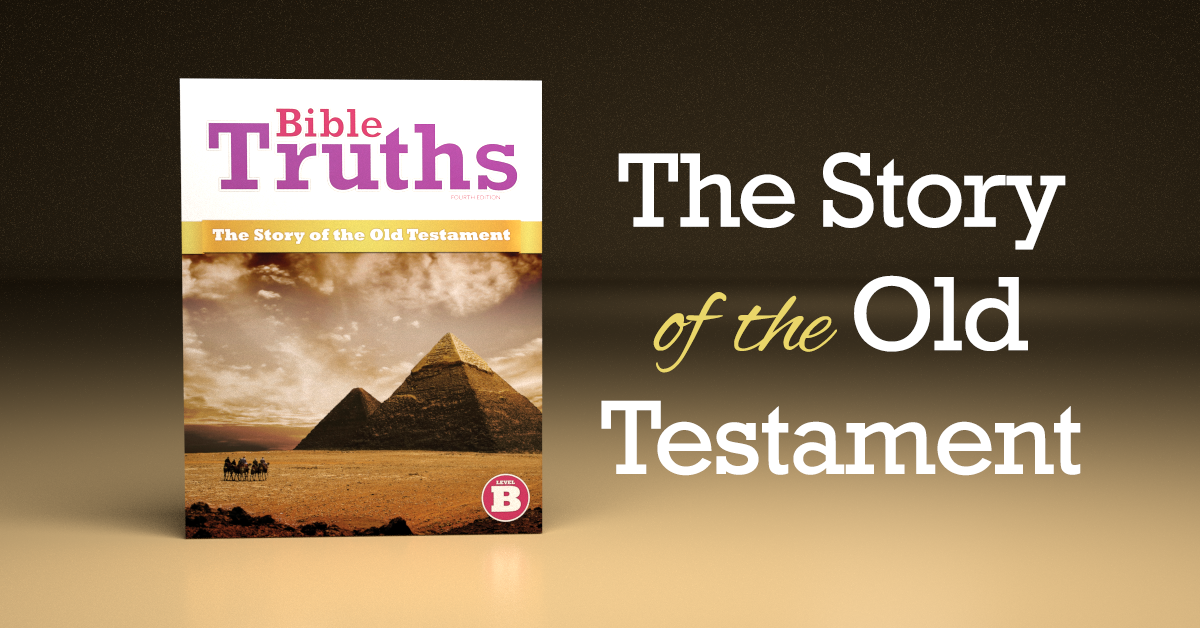
Children need to learn to understand individual Bible stories according to the larger context of what the Bible is all about. The BJU Press textbook The Story of the Old Testament teaches young teens to approach Scripture theologically. That means that they understand the Bible to be the true story of what God is doing to glorify Himself by redeeming His fallen creation (Creation, Fall, Redemption). Why is this important?

The Bible isn’t a random collection of stories or moral platitudes like the Qur’an or the sayings of Confucius. Biblical morality must be grounded in the reality of the larger story of this world. And that story tells your children how to have a relationship with their Creator. No other moral system teaches what the Bible does; every other religion is false, no matter how laudable its morals, because the larger story of the world told in those other religions is false.

Even the truth of our need to trust God (another moral that can be drawn from the account of David and Goliath) doesn’t make sense unless children understand that David’s trust in the Lord rested on the covenant God had made with Israel when redeeming them out of Egypt. Similarly, the New Covenant cross work of Christ teaches us and our children to trust in God. Every story, every moral has to be seen in the larger context of the Creation, Fall, Redemption story line.

When you read the Old Testament and teach it to your children, remember that the morals that you want to teach only make sense when grounded in the overarching story (Creation, Fall, Redemption) that reveals who God is. Right behavior ought to be grounded in right beliefs (Titus 2:11–12).

Filed Under: Shaping Worldview Tagged With: application, Creation, Fall, homeschool, morals, Old Testament, Redemption

  • « Go to Previous Page
  • Page 1
  • Interim pages omitted …
  • Page 12
  • Page 13
  • Page 14
  • Page 15
  • Page 16
  • Interim pages omitted …
  • Page 21
  • Go to Next Page »

Primary Sidebar

As parents, teachers, or former homeschool students, we are passionate about homeschooling from a biblical worldview. We hope these teaching tips, fun activities, and inspirational stories support you in teaching your children.

Email Signup

Sign up for our homeschool newsletter and receive select blog posts, discounts, and more right to your inbox!

Connect with Us!

                    Instagram     

Read Posts on Specific Subjects

Early Learning
Foreign Language
History
Language Arts
Math
Science

Footer

Disclaimer

The BJU Press blog publishes content by different writers for the purpose of relating to our varied readers. Views and opinions expressed by these writers do not necessarily state or reflect the views of BJU Press or its affiliates. The fact that a link is listed on this blog does not represent or imply that BJU Press endorses its site or contents from the standpoint of ethics, philosophy, theology, or scientific hypotheses. Links are posted on the basis of the information and/or services that the sites offer. If you have comments, suggestions, questions, or find that one of the links no longer works, please contact us.

Pages

  • About BJU Press
  • Conversation Guidelines
  • Terms of Use & Copyright

Archives

© 2026 · BJU Press Homeschool