• Skip to primary navigation
  • Skip to main content
  • Skip to primary sidebar
  • Skip to footer

BJU Press Blog

  • Home
  • Shop
    • Shaping Worldview
  • Simplified Homeschool
  • Successful Learning

Shaping Worldview

You homeschool because your child’s faith is important to you. We want to support you in training up your child. These blog posts show how to give your child a biblical worldview of each subject.
Start here:

  • How Is God Involved in Math?
  • The GEM Approach: A Biblical Approach to Objectional Elements in Literature
  • Understanding Science Through Faith

Is Bible the Icing on the Cake?

January 26, 2017 by Ben

Icing on the cake. We use this phrase to indicate that something good has been added to something that is already good. There’s no change to the thing being added to, but it makes the thing extra nice.

In her book Total Truth, Nancy Pearcey uses this metaphor to describe a mistake that many Christian educators make. They’re trying to change the educational cake to make it Christian by adding the icing of prayer and devotionals, but the core of the material covered doesn’t change. It’s the same secular education that public schools peddle.

So often Christians take something that is fundamentally secular and spread the Bible on it like icing on a cake. But it isn’t a good cake to start with; it’s poison.

When we decide to educate our children at home, we may do it because we want them to have a wholesome atmosphere. Or we want to personally teach them the gospel and challenge them to walk according to God’s Word. But what about the academic education we’re giving them? Is it a biblical cake? Or have we merely added icing to the secular cake?

Christianity on the Surface

As Christian homeschool families, we should try to make sure the education our children receive is Bible based. We don’t teach evolution as science, which is very important. But beyond observing that God created all things, is our teaching different from what they would hear in a public school classroom?

Here are some attempts at making teaching Christian that I’ve observed. As you read through them, ask yourself if they’re using a new recipe or only adding a devotional layer to the teaching.

  • “The plus sign looks like a cross, so every time we do addition we can think about Jesus dying on the cross for us.”
  • “We have to have consistency in verb tense. Remember that we should be consistent in our Christian lives.”
  • “Caterpillars go through a process called metamorphosis to become butterflies. Just like caterpillars, Christians are transformed at salvation.”

In each of these examples, the academic subject is used as an opportunity to consider something Christian. It’s not that such analogies related to math, grammar, and science are bad or wrong. The problem is that they’re merely icing on the cake. The subject matter is still the same; we’ve just added something on the surface that is biblical.

Beneath the Surface

What will happen if we fail to remake the teaching of a subject? What if we only make analogies when we stop talking about history or language arts to talk about the Bible? If we continue to teach coursework in a similar way to the public school down the road, we’ve failed to approach all learning from a biblical starting point. We’re adding Christian icing to the secular cake. And if you start with a poisonous cake, good frosting isn’t going to fix it.

As our children get older, they’ll recognize that the icing can be removed and they’ll still have the same secular cake. Math, language arts, science, and history all work without the icing that we spread on top of the subjects. Perceptive children will see that they can drop God’s authority in their lives and still use math, science, and other subjects.

Take math as an example. Our children must learn that our use of math is subject to God. If not, they may believe that they can use math without submitting themselves to the Lord, using it fraudulently instead of lovingly. They need to understand that we use tools like math to follow God’s commands to rule over God’s good creation in ways that are in keeping with His law.

That’s why we need to go beyond just adding icing onto the cake. We need to use a new recipe for a new cake—that is, learning transformed by the Word of God.

Worldview Shaping 

We transform learning through biblical worldview shaping. In future posts, I’ll explore what worldviews are and provide a model that helps us use the Bible to transform our children’s education.

In the meantime, think about your children’s education at home. Are you using a new recipe for their cake or putting icing on a secular cake?

Image Source

Filed Under: Shaping Worldview Tagged With: biblical worldview, Christian education, Christian Homeschooling, math

Learning About the Big Story in Reading

December 13, 2016 by Megan

The world is preparing for yet another Christmas. My family enjoys a lot of things about Christmas—the lights, the food, the special family time, the gift-giving—but I don’t want us to become preoccupied with those things to the extent that we forget about why we celebrate the holiday in the first place. I want my children to understand how the Christmas story fits within the storyline of the Bible. BJU Press reading curriculum is helping me reach that goal.

(Image use) WP 12/2016

One of the things I love about the third edition of Reading 2 is the Bible retellings. When BJU Press revised the curriculum, they added four Bible retellings (one in each reader) in order to help develop a child’s biblical worldview. These selections recount the main storyline of the Bible (Creation, Fall, and Redemption) and challenge the student to apply these worldview-shaping truths to other selections as well.

The first Bible retelling at the end of the first reader deals with the first two major parts of the biblical storyline—Creation and the Fall. Honestly, this was one of my favorite selections in the entire first reader, and I felt that it was one of the most profitable. My second-grade daughter has heard this story countless times at home, at church, and during the first couple of weeks of our Bible curriculum. But covering it during “reading class” was different because we were able, with the help of the Reading 2 Teacher’s Edition, to dig deep into the narrative. The questions in the Teacher’s Edition not only deepened my daughter’s understanding of the significance of Creation and the Fall but also paved the way for some needed spiritual conversations.

During this Christmas season, we’ll have the opportunity to read the second Bible retelling that’s located at the end of the second reader. This selection recounts the birth of Jesus and highlights how God fulfilled His promise to Adam and Eve by sending mankind a Redeemer. Again I’m impressed by the questions in the Teacher’s Edition. They will help my daughter understand the significance of the incarnation as well as its connection to the Creation/Fall narrative in Genesis. I’m already anticipating some good discussions about the evidences of true faith and the sovereignty of God. What wonderful truths to have on our minds throughout the Christmas season!

Later on this year, we’ll continue learning about God’s redemptive plan by reading two more selections: one about the life, death, and resurrection of Jesus and one based on future events foretold in the book of Revelation. Again, these selections cover material familiar to us. But they’re a vital part of my daughter’s education. They explain the big story of the world. They teach her to value the things God values.  And they help her think biblically and rightly about the world around her.

Interested in learning more about this reading curriculum? View some sample pages from the student readers and the Teacher’s Edition of Reading 2.

Filed Under: Shaping Worldview Tagged With: Bible stories, biblical worldview, Christmas story, language arts, reading curriculum

The Prepositions of Thankfulness

November 24, 2016 by Eileen

About two months ago, I bought a small throw pillow for a chair in my home. The pillow displayed the word thankful in large gold letters. I had a mission for that pillow. Every time I walked by the chair, the pillow would remind me to think of things I was thankful for. My plan worked for a few days. I would walk past the chair and briefly consider one or two pleasant things that had happened that day. But all too soon, the pillow became both literally and figuratively part of the furniture. I had happened to choose the chair where everything tends to land at the end of the day—my purse, a book or two, the mail, and so on. And as the days passed, my plan got covered up by the busyness of life, just like the word on that pillow.

thankful pillow

The other day, after clearing off the chair, I sat looking at the pillow and thinking about my plan gone awry. That’s when I realized that maybe the plan had been tragically flawed from the beginning. After all, it’s not enough to be thankful for without being, first and foremost, thankful to. My hastily muttered prayers of thanks for this and that blessing as I dash past a pillow are not really what God wants. He wants me to sit down and take time. He doesn’t necessarily want me to tabulate all the ways He has added pleasantness to my life. But He does want me to know Him and thank Him for who He is. He wants me to love the Giver infinitely more than the gifts.

It’s only when I’m being thankful to that I can properly be thankful for. When I’ve taken time to meditate on God’s sovereignty, love, goodness, and wisdom, I can filter everything that happens to me through the lens of His attributes. I can rest my head on a pillow of thankfulness—even when the burdens and problems of life multiply or when nothing about my day stands out as a singular blessing. I can be thankful for anything that draws me closer to the God I am thankful to.

Look for ways you can be Sharing God’s Good Works with your children.

Filed Under: Shaping Worldview Tagged With: Giver, giving thanks, God's sovereignty, thankful

History Begins at Creation

September 13, 2016 by Ben

History_Creation

By Faith Begin History with Creation

When I took world history in high school and college, the textbooks began with civilization in ancient Mesopotamia. My Christian teachers dismissed evolutionary “prehistory,” but they never replaced these myths with the account of the beginning of human events in the Garden of Eden. When we as parents start to teach “history” without the creation account, we treat it as a secularist would, as something other than an account of how the world actually began. I want my children to approach all subjects by faith. That means taking creation seriously in their history course.

By Faith Understand Humanity in Light of Creation

Secularists try to find ways to define humans. They sometimes call us tool-using-creatures or symbol-using-creatures. Without the creation account, we have a poor basis for understanding human beings. How can our children properly study a subject that records and interprets human events yet doesn’t define our humanity? While the Fall (also covered in our textbook) twisted us, our identity is still rooted in the one in whose image we are made and the directions He gave us in the beginning. Creation is foundational to understanding that humans and humanity are the central focus of historical study.

By Faith See Civilization Through Creation

In general, secularists claim that humans started to congregate and plant crops, which in turn led to civilization. They claim civilization allowed for occupational specializations, such as priests who invented gods. In contrast, the creation account tells us that God ordered humans to “exercise dominion” over the earth. In the first generation, people began cultivating crops (Cain) and practicing husbandry (Abel). Even when murderous Cain began founding cities, he did so because of God’s call to rule over the world. Civilization didn’t beget God, instead God’s direction to man gave rise to civilization.

As your child studies history, these foundational concepts are central to understanding of the events and people they will learn about. That’s why BJU Press Heritage Studies teach that history begins with creation.

Learn more about teaching from a biblical worldview by signing up for our homeschool email.

Filed Under: Shaping Worldview Tagged With: American history, Creation, history

A Simple Method for Teaching Bible

September 8, 2016 by Kevin

Isaiah

How do Bible study skills relate to biblical worldview shaping? First, you must understand that a biblical worldview consists of three ingredients:

(1) the larger story of the world,

(2) the beliefs and values that grow out of that larger story, and

(3) the cultural action or personal behavior that should result from those beliefs and values.

Second, once the purposeful aim for a series of Bible courses has been established, there needs to be a practical method in place for accomplishing that aim of worldview shaping. It’s important to teach children and teens a good process for studying the Bible to ensure that their beliefs and values (ingredient 2) truly grow out of the larger biblical story of the world (ingredient 1) and thus lead to appropriate cultural participation and personal behavior (ingredient 3).

Here’s a simple inductive Bible study method that you can teach your children:

  • Observe (what the Bible passage says)
  • Interpret (what the Bible passage means)
  • Apply (how the Bible passage should become meaningful)

The method can be tailored to multiple age-appropriate learning levels. Each step in the process can be more or less detailed as appropriate.

Example of an Inductive Study

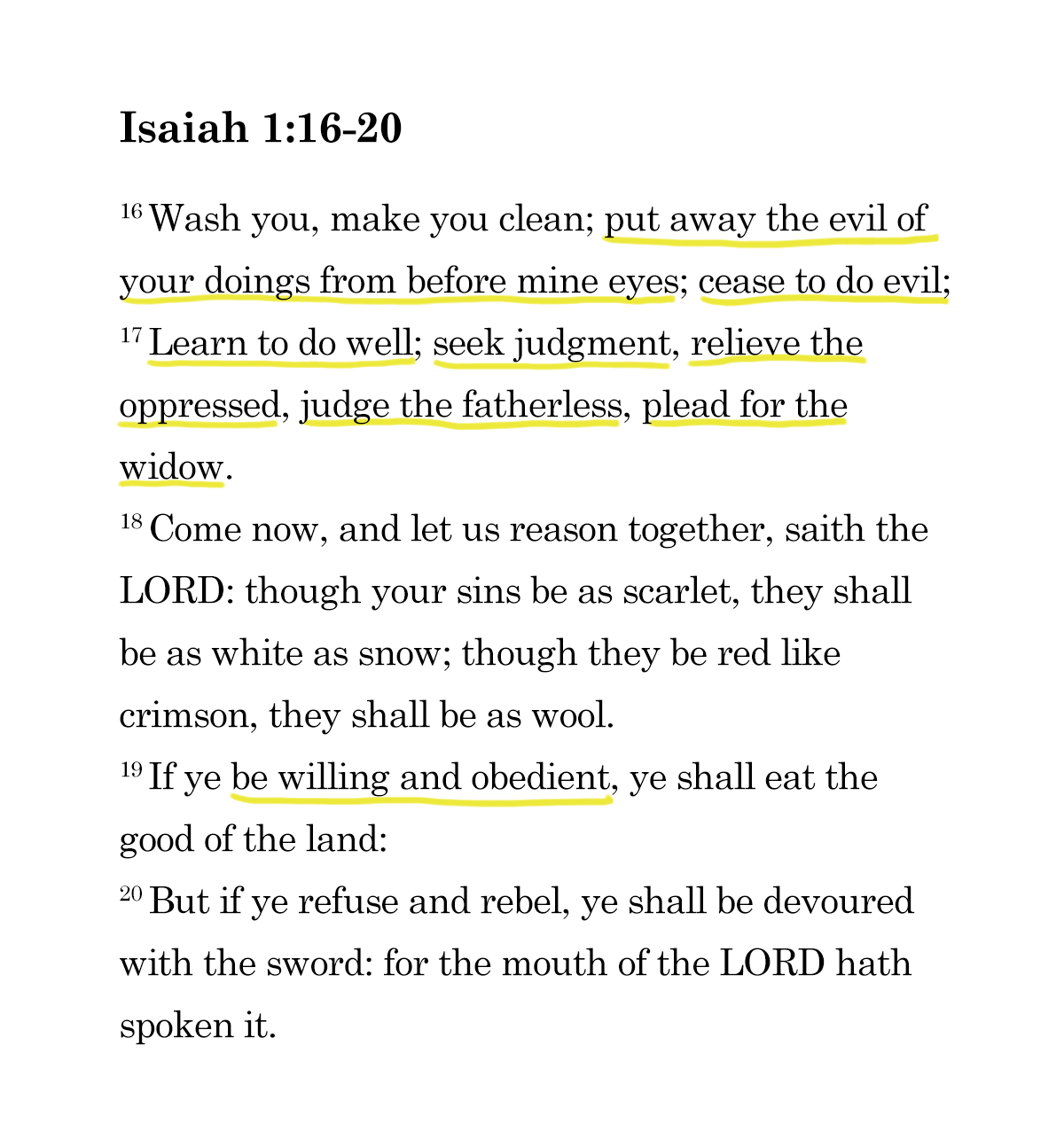
You can use what God said to His people through Isaiah to teach your children a particular value—repentance. But that value will only make sense to your children when they accept the big story of Scripture (Creation, Fall, Redemption) regarding the reality of their condition before God. Only then will that value be personally adopted.

Isaiah passage

Example of how the inductive method can make this passage understandable and practical in terms of a biblical worldview:

  1. Observe (identify the belief/value): This step involves asking your children (at different age-appropriate levels) to mark or point out the word pictures and phrases that describe or show repentance.
  2. Interpret (understand and give significance to the belief/value based on the reality of the big story): This step involves asking your children to explain the word pictures that describe genuine repentance. Why is genuine repentance important to God?
  3. Apply (put the belief/value into practice): This step involves asking your children how the teachings on repentance relate to their own lives. Are there any parallels in their own lives that compare to the examples described in the passage?

Why the Order of the Inductive Method Is Important

Observing what God’s Word says and interpreting what it means must precede the application of its morals to life. If the process is reversed (beginning with application, skipping careful observation and interpretation), then Scripture gets twisted to fit into a preconceived human system of morals. Or the real significance—of relating properly to God in accordance with the larger reality of the world—gets lost.

Filed Under: Shaping Worldview, Successful Learning Tagged With: Bible, bible study, Creation Fall Redemption, homeschool, inductive method, Isaiah 1

  • « Go to Previous Page
  • Page 1
  • Interim pages omitted …
  • Page 11
  • Page 12
  • Page 13
  • Page 14
  • Page 15
  • Interim pages omitted …
  • Page 21
  • Go to Next Page »

Primary Sidebar

As parents, teachers, or former homeschool students, we are passionate about homeschooling from a biblical worldview. We hope these teaching tips, fun activities, and inspirational stories support you in teaching your children.

Email Signup

Sign up for our homeschool newsletter and receive select blog posts, discounts, and more right to your inbox!

Connect with Us!

                    Instagram     

Read Posts on Specific Subjects

Early Learning
Foreign Language
History
Language Arts
Math
Science

Footer

Disclaimer

The BJU Press blog publishes content by different writers for the purpose of relating to our varied readers. Views and opinions expressed by these writers do not necessarily state or reflect the views of BJU Press or its affiliates. The fact that a link is listed on this blog does not represent or imply that BJU Press endorses its site or contents from the standpoint of ethics, philosophy, theology, or scientific hypotheses. Links are posted on the basis of the information and/or services that the sites offer. If you have comments, suggestions, questions, or find that one of the links no longer works, please contact us.

Pages

  • About BJU Press
  • Conversation Guidelines
  • Terms of Use & Copyright

Archives

© 2026 · BJU Press Homeschool