• Skip to primary navigation
  • Skip to main content
  • Skip to primary sidebar
  • Skip to footer

BJU Press Blog

  • Home
  • Shop
    • Shaping Worldview
  • Simplified Homeschool
  • Successful Learning

Shaping Worldview

You homeschool because your child’s faith is important to you. We want to support you in training up your child. These blog posts show how to give your child a biblical worldview of each subject.
Start here:

  • How Is God Involved in Math?
  • The GEM Approach: A Biblical Approach to Objectional Elements in Literature
  • Understanding Science Through Faith

Celebrating the Creation Mandate

December 31, 2015 by Wesley

Imagine this—you’re with a group of friends for a New Year’s Eve party. There’s a fire burning in the fireplace and hot cider in the kitchen. After some holiday food, there’s a time of singing. People begin to share some testimonies about what God is doing in their lives and what they’re learning from Scripture. One girl opens her Bible to share a verse that she just read in her devotions that morning—Genesis 1:28. Hmm . . . that’s an odd choice for a warm fuzzy verse. Then she reads it: “Be fruitful and multiply and replenish the earth  and subdue it and have dominion over . . .. ” Now if this were my party, I would be starting to feel a little nervous right about now. I would want to know where she’s going with this.

composition of both the Western and Eastern Hemisphere of planet Earth

Where is Genesis 1:28 going? Why is it in the Bible? This verse is significant not only because it gives us authority over all the animals. We would have been clear on that by the simple fact that we are made in God’s image (1:26). But it’s also significant because it gives us a mandate—the Creation Mandate—to rule over God’s world in His place and to maximize the usefulness of God’s creation for our good and His glory.

First of all, God commands Adam to have children. God wasn’t satisfied with one image-bearer; He wanted the earth to be full of people made in His own image. These people would use and change the natural world that God created. But that’s what God intended—thus His second command to subdue or govern the earth. God designed humans to be creative and to create in and with the world they live in. Everywhere these people went and lived, they were to rule over the creation. All the plants and the herbs would be for food (1:29). Even the most intelligent, powerful, and majestic of God’s animals would be the servants of human beings (1:28). Human beings occupy a place of awesome privilege because they bear God’s image. It’s a position not only of privilege but also of responsibility.

The weight of this responsibility started to sink in when Adam disobeyed God. Not only would Adam die, but so would all mankind with him (Romans 5:12). His wrong choice as a leader damaged everything he was supposed to be ruling over (Genesis 3:17–18; Romans 8:22). But Adam’s damage didn’t destroy God’s design of the world. Even God’s cataclysmic judgment with a worldwide flood didn’t undo His order. After the Flood, God reaffirmed each part of the Creation Mandate with Noah and his family (Genesis 9:1–20).

Today we are still directed by the Creation Mandate because we still live in the world that God created. Though sin has deeply affected God’s creation, the world still works. People are born every day, and they make useful things. In many cases, they’re fighting back against the effects of sin and the Curse. The Creation Mandate gives us a glimpse of what God created the earth to be and how we can live all of life to the glory of God. And that is something worth sharing with your friends at a New Year’s Eve party.
Filed Under: Shaping Worldview Tagged With: Genesis 1:28, image of God, New Year's Day, New Year's Eve, party, ruling

The Gift of the Gospel

December 24, 2015 by Megan

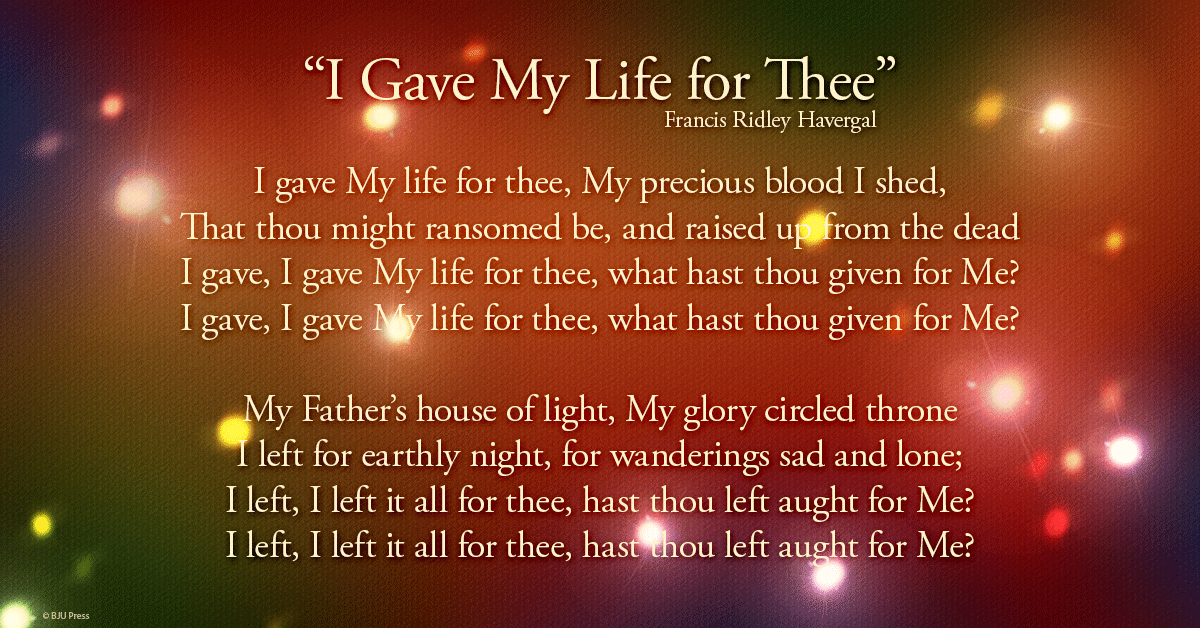
In 1858, Francis Ridley Havergal visited a museum in Dusseldorf, Germany, and viewed a painting depicting the crucifixion. Next to the painting was this caption: “I did this for thee; what hast thou done for Me?” That question inspired her to write the poem that became the text of the hymn “I Gave My Life for Thee.”1

two stanzas of "I Gave My Life for Thee" by Francis Ridley HavergalAll four stanzas of this hymn text often come to my mind during the Christmas season because Christmas involves so much giving. We give gifts to family members and friends. We give toys to underprivileged children. We give money to help families suffering from a natural disaster or devastating diagnosis. The list goes on and on.
But sometimes, even in the midst of all this giving, we lose track of the Person who gave the most. Instead, we get caught up in the shopping, the parties, and even the gifts themselves. We hurriedly call a friend to celebrate the amazing shopping deal we just got, but we pass right by the sales clerk without even thinking about taking the time to give her a gospel tract. At this time of year, we need to be reminded of the precious gift of salvation that we possess. We need to be reminded of the immense price that Christ paid to accomplish our redemption.

The Gift

Francis Havergal’s hymn text reminds us of what Christ left behind when He came to earth. He left the glories of heaven (Philippians 2:7). This is not just a story about a prince becoming a pauper—Christ’s humiliation was far greater. We read in John 3:17 that “God sent not his Son into the world to condemn the world; but that the world through him might be saved.”

That salvation came with a price. The price was incomprehensible suffering and death on a cross. The Gospel of Luke takes several chapters to tell how Jesus endured beatings, mocking, betrayal, desertion, false accusations, physical agony, and even separation from God the Father. He did it all out of love for us, His lost creation.

Thankfully, Christ’s suffering and death aren’t the end of the gospel story. After three days in the tomb, Christ rose from the dead. God’s redemptive plan was complete.

Our Response

Francis Havergal’s hymn text also encourages us to think about our response to the gift of the gospel. We can’t just say “thank you” and move on like we would after receiving a sweater or a box of homemade cookies. Doing so would cheapen the gift. Instead, our gratitude should transform us.

This Christmas season, take time to share the gift of the gospel. Talk to your neighbors about what Christ did for them. Hand out tracts when you’re out shopping. Invite an unsaved relative over and share how Christ has transformed your life. People need the gospel more than anything else you can give them.

1. Francis R. Havergal, “I Gave My Life for Thee,” Majesty Hymns (Greenville, SC: Majesty Music, Inc., 1997), 546.

Filed Under: Shaping Worldview Tagged With: Christ, Christmas, giving, gospel, hymn

Serving God and Studying Science

November 5, 2015 by Ben

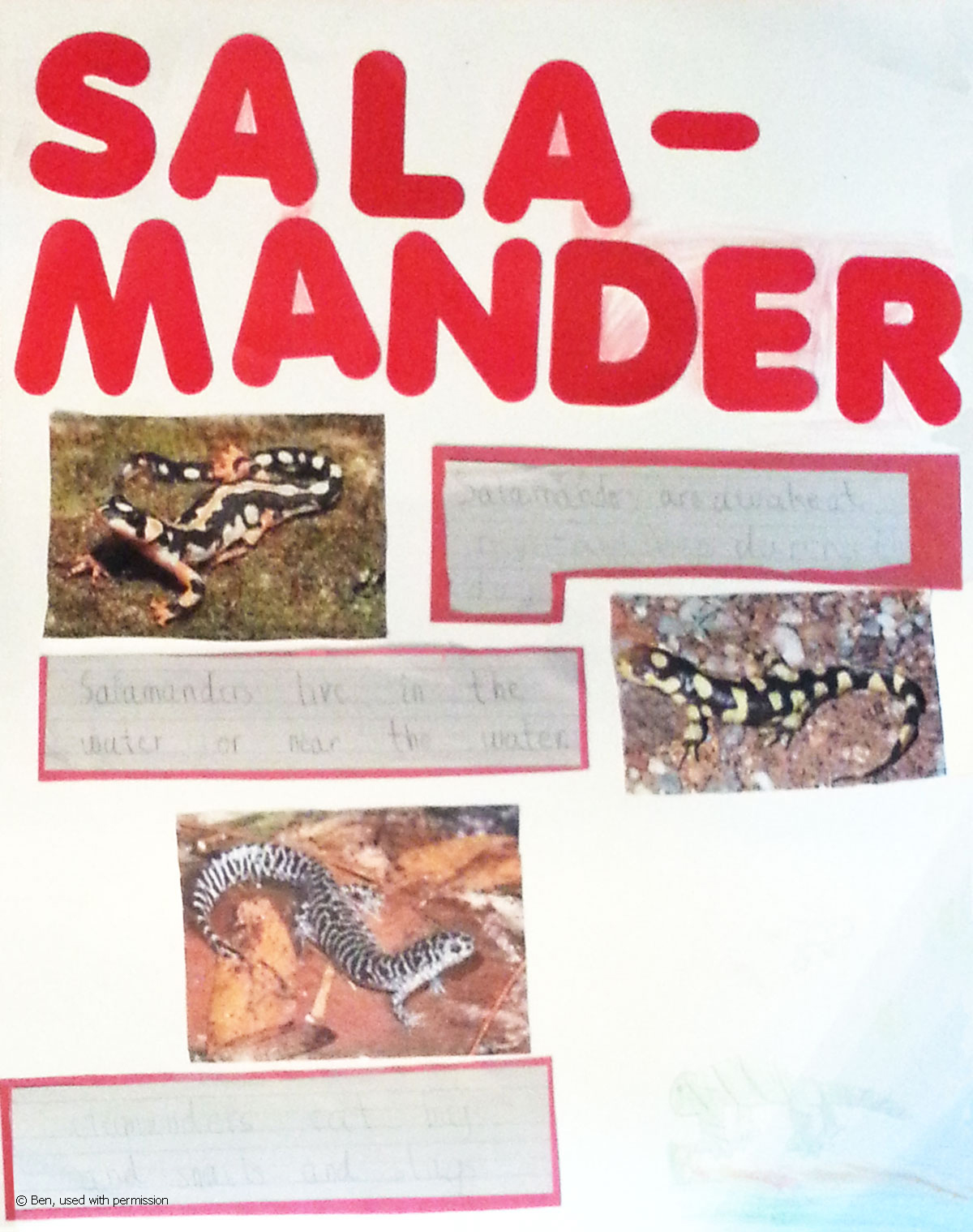
poster with salamander images and factsAfter we finished family worship, my wife asked me to work with our first grader on a science project. The assignment instructed her to make an informative poster about a wild animal. The week before, we’d found a salamander on a camping trip, so my daughter wanted to do a project on salamanders. She’d gotten a couple of books from the library, and we set out to find a few pictures.

I must confess that it was easy for me to fall into the trap of secularism that evening. Instead of remembering that God is relevant in all areas of life, I initially bought into the idea that this activity could be approached without involving Him.

It seems to me that Christians too often buy into this secular approach. We think certain activities are holy service to God, such as our family worship time, church attendance, or personal devotions. Other activities, such as cooking and cleaning, marketing, or finance are things we have to get through. They aren’t service to God. They have to be done, and we should obey God while we do them, but there isn’t a “Christian” way to do them.

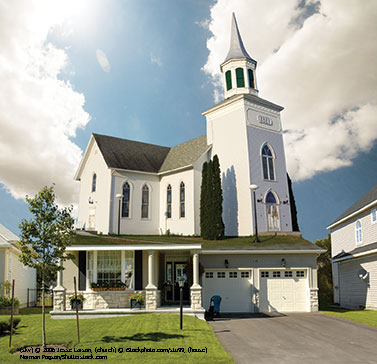
church on top of house

The image in this blog post helps me understand this wrong way of thinking. The first story of the “house” is a typical suburban home. The second story is a church. Everything in the top story is “redeemable.”  Everything in the bottom is “unredeemable.” Sometimes we wrongly assume that the people who work on the upper floor in “full-time Christian service” are doing God’s work and the rest of us working down on the lower floor are second-class Christians who only serve the Lord when we participate in spiritual tasks.

But God doesn’t teach this way of thinking, secularism does. God says that everything belongs to Him, and He has something to say about it.

As I helped my daughter with her project, my mind at first fell into the trap of thinking we’d moved from God’s things to earthly things, but thankfully my daughter’s textbook didn’t take that approach. BJU Press Science teaches that everything should be service to God.

So that evening as I helped my daughter with her salamander project after family worship, we were really moving from one service to God to another. My daughter and I learned what salamanders eat and where they live. On a small, first grader level, we were learning how to obey God’s command to take care of the world.

What kind of teaching are your children receiving?

Filed Under: Shaping Worldview Tagged With: biblical worldview, salamanders, science

God’s Providence, Columbus’s Mistake

October 8, 2015 by Ben

Perspective matters in all of education, but it’s particularly clear that perspective impacts teaching about the past. The scene of an accident illustrates on a miniature scale how perspective influences the retelling of an event. Where a witness was standing and what he was doing at the time of the accident will dramatically affect his view of the event. Most historians aren’t eyewitnesses of the events they record, but they do have perspectives that color their narratives.

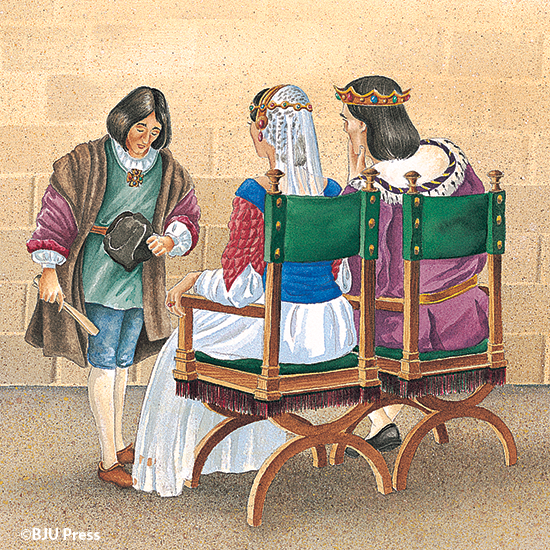
illustration of Columbus standing before the kind and queen

Christopher Columbus provides an excellent example since historians have many different perspectives about this world figure. My friend Wes wrote a blog post that questioned the morality of Columbus’s actions. But I’d like to discuss two different perspectives taught about Columbus’s scientific knowledge.

Columbus—Heroic Individualist

One educational television show teaches children about Columbus by having an “interview” with him. The man playing the part of the explorer explains that most people in his day thought that the world was flat and that anyone who sailed far enough west would fall off the edge. Columbus, however, believed the world was round and therefore thought he could reach the East Indies by sailing west.

In this widely held perspective, Columbus is seen as a heroic individualist, bucking the religious, intellectual, and political establishments of his time by boldly charting a path based on scientific fact. Secularists like this story because it pits the rationality of science against irrational notions of religion. But those details aren’t accurate. This common perspective on Columbus is one that professional historians are trying to dissuade popular culture from believing.

Columbus—Mistaken Merchant

Actually, the scientific controversy in Columbus’s day wasn’t about the shape of the earth but its size. Most people during that time knew the earth was round but thought it was a little smaller than it really is. Since Columbus was convinced that the earth was much smaller than it is, he believed Asia could be reached faster by sailing west.

The religious/intellectual establishment actually had a more accurate estimate of Earth’s size than Columbus did, but nobody at that time knew there was a large landmass in between Europe and Asia.

I appreciate how BJU Press concludes this historical account in the 3rd edition of Heritage Studies 1 (page 121):

Columbus did not reach Asia by sailing west. Though Columbus did not know where he landed, God did. Columbus did not know he had found new lands to explore. God used the voyage to change the world.

In this telling, Columbus is a mistaken merchant, but God changes the course of human events in a striking way.

Perspective really matters. Some historians want to make people the heroes and ignore what God says and does. As a Christian father, I want my daughters to develop a biblical perspective on the past. This statement from the same textbook (page 123) sums up the perspective I want them to have this holiday.

Columbus Day is celebrated on the second Monday of October. It is a day to remember Christopher Columbus and the land he found. It is a day to remember what God did long ago.

Filed Under: Shaping Worldview Tagged With: Christopher Columbus, Columbus Day, history, perspective, science

The Special Way God Made You

September 15, 2015 by Justin

young child's face

Spend some time around young children, and you’ll quickly realize how interested they are in the human body. They’re extremely observant and love to compare and contrast noses, ears, eyelashes, fingers, and toes, pointing out every little difference from size to color. My four-year-old nephew is fascinated with my beard. Every time we’re together, he asks why I have “whiskers,” and wants to know why he doesn’t. What children like my nephew may not realize is why each person is so different.

All people are valuable because God made every one of them in His image (Genesis 1:26). Each person’s differing characteristics show the vastness of God’s creative genius (Ps. 139:13–16). Children love to ask “why” questions all the time, and you might be surprised how often the Bible has an answer that is easier and better than “it just is.” I’ve found that it’s never too early to begin shaping a worldview that has the Bible as its foundation.

Using Scripture as the basis for lessons for young children

As homeschool parents, you have a unique opportunity to point out God’s goodness to children starting at a young age by basing academic lessons on the Bible. As an example, let’s look at elementary science. The human body is a topic typically covered in Grade 1. First graders are given a basic overview of the human body, the functions of its main parts, and basic tips on how to care for it. Integrating the Bible into a lesson like this isn’t that difficult, and our homeschool textbooks do a good job of this.

The Bible says that God created every part of us for a purpose (Job 10:11–12). As you work through the parts of the human body, talk with your children about His purpose for each. God knew that we would need to be able to chew food, so He designed our teeth. Our fingers allow us to pick things up. Some children are born with differences. They might be missing parts that others have. Use the Bible to talk with them about God’s special plan for them and their special differences (John 9:2–7, Romans 5:3–5, Exodus 4:11, Jeremiah 29:11).

Why caring for our bodies is important

Teaching your children to care for their bodies (proper washing, toothbrushing/flossing, doctors’ visits) is not always easy. These everyday tasks are often seen by children as interruptions in their play time, and it can be difficult to convey the value of these things. Ask your children what they would do if God loaned them something special that He had designed. Would they take good care of it? Tell them that their bodies belong to the Lord (1 Corinthians 6:19–20), and that includes every part, for example, their teeth. Remind them that they need to take good care of their teeth because they belong to God and are part of His plan.

Let’s try another example, the yearly eye exam. Young children don’t always understand the importance of checking the health of their eyes, but something they generally do understand is that God wants us to do things that the Bible says are good. Ask them to notice how we see everything in color. How would life be different in black and white? Remind them that God wants us to be able to appreciate the beauty of His world (Psalm 19:1), and having healthy eyes is very important to being able to do what God wants. This approach can be used to talk about any doctor’s visit and may alleviate a lot of anxiety as well.

Bible integration doesn’t have to be a scary concept. It can be a simple process of making Scripture your starting point and developing lessons with a little creativity and awareness of your child’s natural curiosities. So the next time your child asks you why something is the way it is or why he has to do something, check the Bible first. It has the answers he needs to know.

Filed Under: Shaping Worldview Tagged With: Bible integration, biblical worldview, homeschool, science

  • « Go to Previous Page
  • Page 1
  • Interim pages omitted …
  • Page 14
  • Page 15
  • Page 16
  • Page 17
  • Page 18
  • Interim pages omitted …
  • Page 21
  • Go to Next Page »

Primary Sidebar

As parents, teachers, or former homeschool students, we are passionate about homeschooling from a biblical worldview. We hope these teaching tips, fun activities, and inspirational stories support you in teaching your children.

Email Signup

Sign up for our homeschool newsletter and receive select blog posts, discounts, and more right to your inbox!

Connect with Us!

                    Instagram     

Read Posts on Specific Subjects

Early Learning
Foreign Language
History
Language Arts
Math
Science

Footer

Disclaimer

The BJU Press blog publishes content by different writers for the purpose of relating to our varied readers. Views and opinions expressed by these writers do not necessarily state or reflect the views of BJU Press or its affiliates. The fact that a link is listed on this blog does not represent or imply that BJU Press endorses its site or contents from the standpoint of ethics, philosophy, theology, or scientific hypotheses. Links are posted on the basis of the information and/or services that the sites offer. If you have comments, suggestions, questions, or find that one of the links no longer works, please contact us.

Pages

  • About BJU Press
  • Conversation Guidelines
  • Terms of Use & Copyright

Archives

© 2026 · BJU Press Homeschool