
• Skip to primary navigation
  • Skip to main content
  • Skip to primary sidebar
  • Skip to footer

BJU Press Blog

  • Home
  • Shop
    • Shaping Worldview
  • Simplified Homeschool
  • Successful Learning

Jenna

Giving Back by Serving Others

December 12, 2017 by Jenna

serving others gift

Every Christmas, we celebrate the single most precious gift ever given—the gift of Christ coming as a man to walk among us and to take our sins upon Himself and to die for them. There is no way we could even partially return His gift, but we should actively be doing whatever we can to follow the second-most important commandment—to love our neighbors. And serving others is one of the easiest ways of showing love.

Here are some ways you and your children can serve others this Christmas and give back the love of Christ.

Blessing Bags

Erica from Confessions of a Homeschooler and her children hand out bags of useful goodies to those in need. Even younger children can help in putting bags together and handing them out. Customize your bags for Christmas by including a small wrapped surprise gift along with the other items.

Operation Christmas Child

Pack shoeboxes full of fun gifts for children all around the world. Your child could choose to pack a box for a boy or girl of the same age. By having a child put it together, you know that it’s a box a child will enjoy. But the deadline for turning boxes in is in mid-November to allow time for the gifts to be shipped abroad. Be sure to make a note of it for next year!

Adopt a Family

Invite a family that has lost someone or an older couple that has no family to join your holiday meals. Your children can welcome them by encouraging them to take part in your family traditions. When I was a young teen, the families that “adopted” my dad, my brothers, and me for the holidays were the biggest blessings I could have asked for.

Service Coupons

Make service coupons for your children to endorse and hand out to elderly, sick, or struggling neighbors or church friends as Christmas gifts. The receivers can turn these coupons in for services whenever they need something done, such as taking care of the lawn, cleaning the house, or babysitting. You can make your own or use these printable coupons.

Cuddle Babies

Many hospitals with neonatal intensive care units allow volunteers to come in and hold or spend time with the babies whose parents aren’t always able to be there. Some hospitals even have training programs that teach the volunteers how to handle cuddle sessions. Volunteer baby cuddlers can let the nurses stay on task and encourage parents that there is always someone giving their struggling babies the love they need. Contact a local hospital to ask about volunteer baby cuddling.

Animal Shelters

Your older teens might enjoy helping out at an animal shelter during their Christmas break. Many shelters have seasonal events that they need extra volunteers for or down periods when the regular volunteers are on vacation. And volunteers don’t just spend all their time petting cats and dogs. They often get to work alongside the shelter workers and help potential adopters.

While it’s certainly important to share God’s love during the Christmas season, there’s no reason you have to stop on December 26. Many of these ideas for serving others are applicable all-year-round. So encourage your children to reach out and be blessings during this season and next year too!

Filed Under: Simplified Homeschool Tagged With: Christmas, Christmas Blessings, serving others, volunteer

4 Steps for Teaching Math Comprehension

November 16, 2017 by Jenna

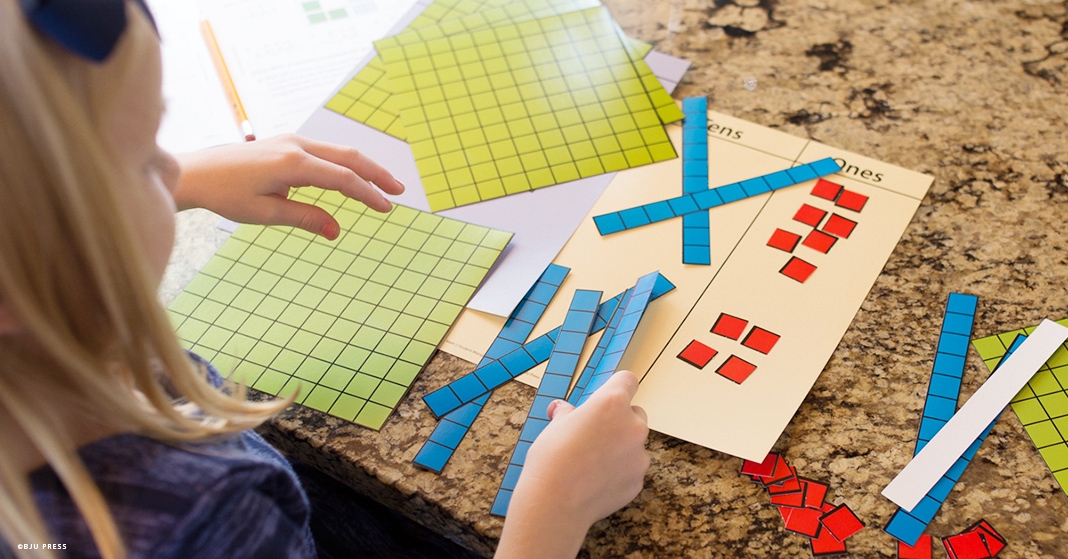
comprehension with math manipulatives
When most of us think back to our experiences with math, we think of endless speed drills and a driving need to get the right answer. As a child, you may have wondered how memorizing formulas was going to help you understand math, and now it’s the same with your children.

You may feel like teaching your children to understand math is some kind of grand undertaking or incredible journey. Looking at it that way can be overwhelming. Where do you begin? How do you keep going? Maybe there’s a different way of achieving math comprehension?

As adults, we often remind ourselves to take everything one step at a time, and that’s probably some of the best advice, but what are the first steps of an approach that teaches your children to comprehend math rather than just memorizing meaningless facts?

1. Connecting numbers to tangible ideas

In and of themselves, numbers are abstract and nebulous. In order to ground number concepts in the real world for your children, you can use manipulatives. The manipulatives can be objects you use every day or the specially designed manipulatives found in the BJU Press elementary math curriculum. This physical understanding of numbers—or number sense—brings math comprehension into your children’s grasp.

2. Building a foundation for future learning

This step is two-fold. Once your children have made strong connections between the abstract concept of numbers and real objects, they’ll need to visualize the processes they’re using so that they remember that numbers mean something. In order to make sure that your children are visualizing math, try asking them questions that encourage them to think about their processes and how math works with real objects.

3. Expanding math comprehension

For math comprehension to grow deeper, it’s important that your children understand base ten math. You and I use base ten every time we break numbers into columns of thousands, hundreds, tens, ones, and so on. Making sure your children understand the concept of base ten math will make grasping the more difficult math processes easier for them.

4. Reaching real-world application

Learning comes full circle to the real purpose of math—a tool to assist us in wisely stewarding God’s creation to serve others—when it begins to reach real-world situations. The skills your children learned during carefully prepared lessons and activities will come into play naturally in real-world situations, such as grocery shopping. These life skills develop as a result of how well they understand math, not because of how well they do speed drills or what grade they make on a test.

Notice how each step after the first relies heavily on connecting numbers back to the real world in some way? As important as all the subsequent steps are, the first is still the key to really comprehending math.

As an ancient Chinese philosopher once wrote, “A journey of a thousand miles begins with a single step.” Once you make strong connections between abstract numbers and tangible objects, the other steps will begin to feel more natural.

Filed Under: Successful Learning Tagged With: homeschool, math comprehension, math manipulatives

What Is the Bigger Purpose of Science?

October 3, 2017 by Jenna

Science
The aftermath of the Fall is all around us. Today’s mounting concern about issues such as global warming, deforestation, and animal extinction is evidence of that, and homeschool families like yours are often more aware of current issues and events than others.

Though we don’t have the power to stop the deterioration of our environment, it’s our duty as good stewards to care for the world God has given us to the best of our ability. While it may be true that those who spend their lives studying the climate, plants, and animals know best how to care for them, that doesn’t mean we all have to become meteorologists, ecologists, and botanists in order to fulfill our responsibilities. You may have dreamed of your child one day making a great scientific contribution—what parent wouldn’t?—but not every child can be a scientist.

So what is the bigger purpose of your children studying science from elementary to high school? Studying science should give your children the tools they need to take better care of creation.

There are two key tools that your children will gain in science lessons.

• A practical understanding of how the world works

When they know how the world works, they can make informed decisions about real-world issues. If your children don’t know the factors that contribute to climate change, they won’t be able to choose a practical solution to incorporate into everyday life. They may choose something that seems effective without knowing the consequences of that choice. On the other hand, if your children do know those factors, they’ll be able to recognize when suggested solutions either won’t last or will merely substitute one problem for another.

• The ability to think like scientists

Science should teach your children to research, observe, and verify under varying circumstances. Rather than expecting them to go into their adult lives pre-equipped with all the knowledge they will need, we should make sure our children are able and willing to do the work of finding answers to problems they’ve never encountered before.

As a graduate assistant, I helped teach a rhetorical writing class. My students all had to write their research papers on energy technology and policy, a subject most of them knew very little about. It was always obvious when my students thought they could succeed in writing the paper through their own knowledge of the subject alone. They weren’t willing to find out what they needed to know about energy in order to do well on the paper.

BJU Press textbooks drive home a practical understanding of the world and of scientific thinking as they weave together a biblical worldview (presenting the Creation Mandate for Christians as well as the demonstration of God’s character in nature) and the discipline of the scientific method. Life Science for Grade 7 explores the potential benefits of biofuels, while Biology for Grade 10 focuses on a balanced view of the conservation of the earth’s resources.

Armed with both an understanding of the world and a willingness to learn, your children will be better equipped to appropriately use creation, even if they don’t develop a revolutionary new fuel system.

Filed Under: Shaping Worldview, Successful Learning Tagged With: biblical worldview, biofuels, Creation Mandate, homeschool science, purpose, science

Building Long-Term Math Mastery

September 28, 2017 by Jenna

BJU Press Math
Have you ever stopped and asked yourself, “Why does one plus one equal two?” Most people who find themselves faced with this math question will probably say something along the lines of “it just does.” But if you thought about it, you could probably come up with a more articulate answer. For example, if you have one marker, then buy another one, and count how many markers you have, you will have two. That’s why one plus one equals two.

What did I have to do in order to answer the question? For most adults, connecting number problems to familiar objects is automatic. That’s because, as children, we learned number sense by working with objects that we could count and move around. You know that manipulatives are key to developing math comprehension. But are there other keys to math comprehension that are essential for long-term mastery?

Yes. Our Math 2 student worktext constantly asks your child questions about the processes he used and how he found his answer.

Students must learn to think about and explain the processes and formulas they use in order for math to have any lasting purpose for them.

For example, in high school, I was at the top of my class in math, but not because I had any idea of what all those numbers meant. It was simply because I could put numbers in the right places in a formula. In fact, I always loved the quadratic equation, and I still remember x equals negative b plus or minus the square root of b-squared minus 4ac all over 2a. But when I got to geometric proofs, I was hopelessly lost. My high school math textbooks never reminded me that the formulas and numbers I loved playing with actually meant something. It was like putting together a puzzle with edge pieces but no middle.

A child’s ability to solve equations doesn’t mean he gets it.

So how do you ensure that your child will be able to make sense of math as he moves into more and more complex ideas?

  • Ask him to explain his process. What would the equation he’s solving look like in real life?
  • Ask him for observations about the concepts he’s learning. Does he see any new patterns? Do other math concepts apply to the new one? Does the new math concept apply to old ones?
  • Incorporate common objects as manipulatives. As he begins learning about area and surface area, can he find the surface area of a tissue box? How would that information be useful to the person designing the box or putting it together?

Look through the thought bubbles in Math 2 student worktext for more ideas of questions to ask your child.

When math has meaning, it also has purpose. If you can create a strong connection between your child and the meanings of the numbers and formulas, you might also connect him to a future career.

Filed Under: Successful Learning Tagged With: homeschool, math, math comprehension, number sense

6 Ways to Combat the Blank Page

August 29, 2017 by Jenna

blank pageYour homeschool year is about to get underway again, and with it, exciting new writing assignments. Whether your writer looks forward to learning more about writing or tries to stay as far away from it as he can, there’s one aspect of writing that he will most likely struggle with.

The blank page.

Looking at the whiteness of a computer document or the empty lines of a notebook page can be overwhelming, as if the blank page asks “Where do you even start?” How do you teach your writer to overcome his blank pages? Here are some tips for encouraging elementary and secondary students to conquer one of the most daunting phases of a writing assignment.

Elementary Writing Assignments

1. Take dictation.

A young writer often has more to overcome than just the blank page itself. He may get hung up on vocabulary, spelling, punctuation, and even handwriting. You can bypass much of his hesitation by having him explain what he wants to write about and writing his explanation down for him. From there, he can revise what you wrote until it matches the assignment’s requirements.

2. Add a visual goal.

In English 2, the textbook explains how to write a paragraph by laying out the various parts of a paragraph and underlining those parts in different colors—green for the topic sentence, orange for details, and red for the ending. By highlighting blank lines in these colors and having your young writer write in the missing parts, you can give him visual cues and goals to work toward. The different colors break up the blankness into manageable pieces.

3. Use writing prompts.

One of the simplest ways to overcome the blank page is to never let it be completely blank. You can give your writer a prompt to put at the top of his page. The prompt you give can be the first sentence of a story, a topic sentence for a paragraph, or even a question for him to answer. This works the same way as the “Apply and Write” sections in BJU Press elementary English textbooks.

Secondary Writing Assignments

1. Fill in the outline.

Papers for secondary writers often involve writing outlines. Your writer can skip the blank page entirely simply by expanding directly from his outline. Even a simple outline will give him something to work with.

2. Keep the thesis at the top.

Almost every secondary paper will involve a thesis of some kind—a thesis gives the writer’s point of view for the paper. Even a simple paragraph essay is often based on one. Once your writer has decided on a thesis, have him write it at the top of each page. Keeping it there will help him focus on his purpose as well as eliminate the blank page.

3. Take a walk.

Sometimes, if your writer really gets stuck, getting him away from the accusing stare of the blank page can be the perfect cure. Once his legs fall into the regular rhythm of walking, his mind will be free to come up with the words that will best begin his writing project—provided that he remembers them long enough to write them down.

Other times, overcoming the blank page is a simple matter of putting down words—any words. The words your writer chooses may be changed many times in the drafting process, and that’s OK. Their real function is to get him over that first hurdle so he can write the rest of the paper. The page only stays blank as long as there are no words on it.

Filed Under: Successful Learning Tagged With: blank page, English, homeschool, writing, writing and grammar

  • « Go to Previous Page
  • Page 1
  • Interim pages omitted …
  • Page 16
  • Page 17
  • Page 18
  • Page 19
  • Page 20
  • Interim pages omitted …
  • Page 23
  • Go to Next Page »

Primary Sidebar

As parents, teachers, or former homeschool students, we are passionate about homeschooling from a biblical worldview. We hope these teaching tips, fun activities, and inspirational stories support you in teaching your children.

Email Signup

Sign up for our homeschool newsletter and receive select blog posts, discounts, and more right to your inbox!

Connect with Us!

                    Instagram     

Read Posts on Specific Subjects

Early Learning
Foreign Language
History
Language Arts
Math
Science

Footer

Disclaimer

The BJU Press blog publishes content by different writers for the purpose of relating to our varied readers. Views and opinions expressed by these writers do not necessarily state or reflect the views of BJU Press or its affiliates. The fact that a link is listed on this blog does not represent or imply that BJU Press endorses its site or contents from the standpoint of ethics, philosophy, theology, or scientific hypotheses. Links are posted on the basis of the information and/or services that the sites offer. If you have comments, suggestions, questions, or find that one of the links no longer works, please contact us.

Pages

  • About BJU Press
  • Conversation Guidelines
  • Terms of Use & Copyright

Archives

© 2026 · BJU Press Homeschool