• Skip to primary navigation
  • Skip to main content
  • Skip to primary sidebar
  • Skip to footer

BJU Press Blog

  • Home
  • Shop
    • Shaping Worldview
  • Simplified Homeschool
  • Successful Learning

Cosette

External Compliance vs. Heart-Engaged Obedience?

October 23, 2014 by Cosette

Christian education is facing a crucial and unsettling time. It has sought for years to lay a thoroughly biblical foundation for students and to impart truth on every hand. But many Christian school students are cold, and even resentful, toward that teaching. As Christian educators, we should try to bring students back to Christianity’s foundation—the truth of the gospel—so that when we address students’ behavior it is motivated by and grows out of our dedication to the gospel.

Since young people sometimes try to define truth by their own subjective perceptions, perhaps we should ask ourselves some questions about what we are teaching them. Are we teaching them the whole truth? Could we actually be dumbing down our presentation of the truth? Amid calls of “Don’t give them doctrine, make it practical!” and an obsession with “principles to live by,” have we maybe lost sight of the basics and unintentionally obscured the person of the gospel, Jesus Christ?

We often respond with more and more behavior-focused instruction when our students’ behavior seems to indicate that they do not understand Christianity. There’s a need to balance our teaching of practical do’s and don’ts with teaching Christ’s perfect sacrifice for us on the cross. Perhaps one reason the gospel has lost its wonder and richness for young people is because of our presentation of the wonderful central figure—Jesus Christ. He is sometimes overshadowed by lesser goals when He should be the focus as well as the motivator behind practical Christian living.

In 1 Corinthians 1:23 Paul also states that there were those (the Jews and Greeks) who found his preaching of Christ unacceptable. Even though the impact of Paul’s ministry on both his own generation and on every generation since is astounding, even Paul’s faithful preaching of the gospel was not welcomed by every person who heard it. The same holds true when we admonish our students. Some will accept it while others may reject the truth.

When faced with such animosity or dismissal of the truth, we may mourn our own lack of power and the great limitations of our flesh that we think make us inadequate to share the gospel that we love. We must remember that God is never frustrated or limited. His promise in Isaiah 55:11 shows that His Word is never “void.” He holds the key to our hearts and has the power to accomplish whatever He intends to—in spite of our sinful nature and wandering hearts.

God alone is able to reach our hearts and those of our students. Whatever work He intends to do in our students’ lives is not impossible. And we can help by trusting in His power, not our own, to guide us as we share His truth through our words and actions.

How do you share the Truth with your students?

Filed Under: Shaping Worldview Tagged With: Bible, Christ, Christian school, truth

Taking Responsibility for Your College Finances (Part 2)

September 16, 2014 by Cosette

This is the third post in our college-planning series. Check out the previous posts—about choosing a major and saving for your college expenses—if you haven’t read them already. And come back next week for the last post in this series.

Got your resources all lined up? The next step for getting your college financial plan laid out is to tally up the total for the program you choose. It goes without saying that majors differ, and you want to move forward without surprises midstream.

Tuition and Fees

A list of tuition and fees per semester or per year appears on most college websites. Record the total tuition and fees for one year, anticipating a slight increase each year following initial enrollment. Take particular note of fees attached to specific programs. This could involve anything from art supplies to music studio rental, the cost of jet fuel (if you’re an aviation major), tutoring, and so on. And don’t forget charges for processing your reservation or taking exams.

Living Quarters—On Campus or Off?

The room-and-board cost listed on the college’s website should cover your living quarters and on-campus meals. Some colleges require freshmen to live on campus their first year. Though convenient, this will definitely impact your total. Estimate the cost of off-campus housing with rental fees, utilities, food, furnishings, housekeeping necessities, and possibly renter’s insurance to see if it will really save you money in the end.

The online option: Many schools offer a wide variety of online courses. This can mean big savings in terms of living expenses. While not possible for all majors and possibly not desirable for every semester of your college experience, distance learning could be a money-saving option for some courses.

Books and Supplies

You will probably want to include an average of at least $350 per semester for textbooks in your cost tally and possibly another $100 for supplies. Once you register for classes and have your book list, you can begin bargain-hunting. With minimal networking effort, you can sniff out used textbooks and sell books you’ve already used. If you enter the ISBN of a textbook on DealOz.com, for example, it will search the main competing websites for the lowest prices on that specific book. Renting books is also a great option for books you don’t want to keep.

You’ll find almost anything you study is going to require at least a few specialized tools—anything from tech devices to art supplies and from poster board to special presentation binders—depending on the major, class, and teacher. It all adds up. So you will want to allow for these in your general expenses.

All That Other Stuff

Perhaps the most dangerous budget-buster is the “catch-all” category that expands to accommodate what doesn’t quite fit in other categories. This could include your cell phone bill, campus vehicle registration, auto insurance, gas, car repairs, school-related trips (e.g., debate club, sports teams, orchestra tour), laundry, recreation, greeting cards and gifts, organizing tools and other dorm room furnishings, coffee and snacks, clothes, shoes, and the list goes on! While you may not want to allot this category a huge amount, make sure to list all anticipated costs that aren’t included in your housing category—like cell phone and vehicle registration. Also, don’t forget big-ticket items such as travel expenses for Christmas break.

The Sum Total

Now comes the reckoning! Add up all the figures in each list, and find the difference between your resources (what you added up in the previous post) and your costs. You should now have a good idea of how much one year in college will cost. You can even multiply your cost (before subtracting your resources) by four and have the approximate total for your bachelor’s degree.

Are you surprised? View this information as a catalyst to seek the Lord for His provision. Don’t be discouraged! God provides where He leads. In His will, you will see His gracious hand working out the details you have put on paper.

How have you planned for college expenses?

Filed Under: Simplified Homeschool Tagged With: college, expenses, family, finances

Taking Responsibility for Your College Finances (Part 1)

September 9, 2014 by Cosette

Last week, we focused on how to choose a major. Today’s post is the first of two posts that focus on the financial aspect of a college education. We hope that you enjoy it and that you come back next week for the second part!

As you near high school graduation, hopefully you’re seeking God’s will for your life and are establishing goals for the future. Selecting a college that will help you reach those goals and develop your God-given talents is a big step. Once you make those decisions, you need to lay out a financial plan to get through.

The best place to start? Your sources of income or funding. Most students have four funding options—savings, work, scholarships or grants, and loans.

Savings

It’s never too late to start putting money into a (mostly off-limits) savings account. Saving doesn’t have to be huge chunks from every paycheck—you can start off by saving just 5 percent of every paycheck. However you decide to save, be sure that you are making good choices in how, when, and where you save or spend your resources.

Work

Find out if the college you’re planning to attend has on-campus jobs available. Besides saving on travel expenses, on-campus work provides an environment compatible with academic demands and schedules. To avoid overcommitting and possibly losing out academically, start out with just a few work hours per week. Then add more if you find you can handle it. Any job, on-campus or off, will be a testing ground for your communication skills, ability to work with others, integrity, and work ethic—traits that will certainly impact your future career.

Scholarships and Grants

Scholarships are a gift without any payback requirement, but they take effort to secure. Selection criteria can range from having a certain GPA to planning to pursue a particular field of study or being able to write a good essay. The usual success rate for scholarships is getting only 10 percent of what you apply for. If, for instance, you’re hoping for $25,000 in scholarships, you may have to apply for $250,000 worth.

Grants, like scholarships, do not have to be paid back. They’re normally awarded on the basis of “demonstrable financial need.” Most grants come through the state or national government or possibly the college you choose. As soon as possible, you should fill out a Free Application for Federal Student Aid (FAFSASM). Plan on spending as much time finding and filling out applications as you would in a part-time job—with a higher return for your trouble. You might even cover your entire college education this way.

Information about financial assistance should be available on the college website and from their financial aid office. Also, the reference section of your local library should stock a reliable scholarship guide. Be careful to avoid websites that request personal information or charge a fee to get into their database.

Loans

You’re likely aware that a loan is borrowed money that the borrower has to repay over time with interest. Borrowing can result in an ongoing burden after your college days are long past. It should be considered as a last resort and only after you’re thoroughly informed concerning every aspect of the transaction.

A loan consists of two elements—principal and interest. The principal is the total you receive from the lender, and interest is the additional cost you accrue until the loan is paid off. The type of loan determines whether interest is due from the beginning or is deferred. Of course, the longer you take to repay it, the more interest you will end up paying.

Education loans can come from either the government or private sources. Federal loans normally offer the lowest interest rates and the most flexible payment options. Besides that, if you have an adequate FAFSA score, you may be eligible for a subsidy—which means the federal government will pay the interest on your loan until you finish school. Subsidized or unsubsidized, loans are limited to a certain amount per school year. You should avoid borrowing more than you plan to make during the first year in your career. (Warning! A common pitfall for students is losing track of how much they borrow. It will help if you keep your documents and notifications in one file.)

College is a big step toward independent adulthood. How you steward your time and money will determine how well that journey begins. And ultimately . . . how well it ends.

How have you planned for college expenses?

Filed Under: Simplified Homeschool Tagged With: college, family, finances, saving

The Beauty of Trust

August 22, 2014 by Cosette

A young woman gracefully makes her way into the king’s court and stands quietly, waiting to be noticed—swan-like, queenly. Her beauty turns heads and, more importantly, leaves the king himself spellbound. The king invites her to approach. But she has been sent there by the hand of Jehovah to do more than take the king’s breath away. She must completely capture his sympathies. She ends up succeeding and thereby becoming one of the most celebrated heroines of all time—a soldier whose uniform is the finery of court. Her mission? Saving her nation and changing the course of Jewish history—a mission she could accomplish only by her willingness to trust.

And her name? Esther.

Trust in a God-fearing mentor

As queen, Esther was in a position far superior to that of her cousin and former guardian, Mordecai. Once she married the king, her days as an orphan under Mordecai’s authority were behind her. Her life was dictated by the expectations of the royal court. Yet she still consulted and trusted Mordecai and obeyed his call to action (Esther 4:10–16). Her loyalty to him remained steadfast in spite of her exalted circumstances, something that could only be attributed to a respect forged by years of tender nurturing and careful training from her youth. Though she had only recently emerged from her teens, she lost none of her high regard for Mordecai.

Trust under a stranger guardian

Esther’s preparation to meet the king was long and appears to have been fairly regimented. The desire to make a strong and favorable impression required great attention to detail. However, Esther’s undemanding spirit is noted in Scripture in contrast to the attitudes of other more forthright women who were vying for the king’s attention. Her trust extended to the one providing her day-to-day needs since “she required nothing but what Hegai the king’s chamberlain, the keeper of the women, appointed” (Esther 2:15). Esther’s contentment no doubt contributed to her beautiful countenance, and she saw her Lord supply all her need through Hegai.

Trust in her King of Kings

Esther’s most powerful demonstration of trust appears when she lays her life on the line for her people—God’s people. Her words of concession (“if I perish, I perish”) to Mordecai ring through the corridors of time and establish her as one of history’s greatest heroines (Esther 4:16). She requests that her people commit to prayer and fasting as she prepares to approach the king. By faith, she submits herself unselfishly to God’s hard task and witnesses God’s astonishing deliverance—not only for her but also for her people.

The deeds of this conscientious queen were not merely forged by extreme circumstances. They came from a heart well-rehearsed in trusting Jehovah. Esther conquered her fears because she had first been conquered by her heavenly Father. Reliance on Him and not herself helped this young queen accomplish her mission.

How do you show your trust in God in your daily actions?

Filed Under: Devotions Tagged With: Bible, trust

Pausing on His Way to Heaven

April 1, 2014 by Cosette

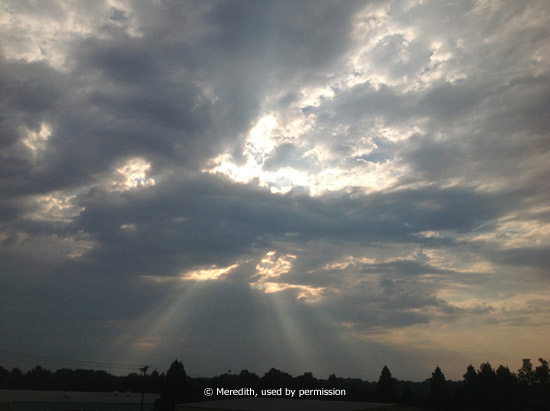
image of the sky with sun rays beaming

In the synagogue at Nazareth, the Lord Jesus introduced Himself with the most powerful, yet tender mission statement ever spoken.

“The Spirit of the Lord is upon me, because he hath anointed me to preach the gospel to the poor; he hath sent me to heal the brokenhearted, to preach deliverance to the captives, and recovering of sight to the blind, to set at liberty them that are bruised.”        —Luke 4:18
 

To the end of His life on earth, our Lord was faithful to this mission; the closing hours and days before His glorious ascension vividly portray His commitment and shepherd’s heart. Throughout the Gospels, we see Him drawn to people with different needs. We see Him pausing on His way back to heaven to preach, to heal, to release, to show, and to convince.

Poor in spirit (Luke 24:13–31)

On the road to Emmaus, the Lord Jesus drew alongside to preach the gospel of His salvation to two downcast disciples who were poor in spirit. His words helped them to piece together the prophecies and promises so diligently taught to them before His crucifixion. They needed to hear it again, and our Lord didn’t think two was too small an audience. With knowledge and authority, steadfastness and patience, His divine instruction lifted them out of despondency. How easy it is for us to forget the power of the gospel. Hearing Him transforms even our bleakest circumstance.

Lonely, broken heart (John 20:11–17)

Then there was weeping Mary Magdelene—not only left alone in the garden—but feeling truly alone in the world.  Tears are the constant companion of the broken heart, and our Lord—yearning to wipe them away—drew near to her. Healing came with joyful recognition. The encounter was briefer than the one with the travelers, but the quiet comfort was lasting. And again, one was not too few for our Lord’s attention—even when His time was short.

Captive of the past (John 21:17)

A captive to his past, Peter, too, became the object of the risen Lord’s mission of mercy. Only a wide-open confession followed by a great commission could free the grief-stricken disciple from believing that his denial had cost him all future usefulness. He had to be singled out for grace. He needed to “taste” forgiveness. Peter: “Thou knowest that I love thee.” Jesus: “Feed my sheep.”  Restoration given, the shackles fell off.

Wounded and doubting (John 20:24–29)

Perhaps we understand doubting Thomas, but wounded Thomas? The Lord understood that in the flesh, sometimes life’s wounds can cause a hard crust of doubt or unbelief to form. Feeling his trust had been betrayed, Thomas refused to hope and be disappointed. He put up barriers; yet Christ was patient with him. He presented Himself to be seen and touched. He set at liberty the one who was wounded.

Unconvinced multitude (1 Corinthians 15:6)

On one occasion He was seen by more than five hundred of His followers—seen not by one or two, but by many. The Lord made Himself recognizable. In the same way today, eyes see and hearts respond. We have all been blinded by discouragement, heartbreak, guilt, or doubt. Only a supernatural work can give us the vision to see He is there and to know that He will never not be there.

Christ’s mission was fulfilled. He was faithful until the very end of His earthly mission—even as He paused on His way heavenward.

How has the ministry of Christ impacted you?

Filed Under: Devotions Tagged With: Christ, Easter, purpose

  • « Go to Previous Page
  • Page 1
  • Interim pages omitted …
  • Page 16
  • Page 17
  • Page 18
  • Page 19
  • Go to Next Page »

Primary Sidebar

As parents, teachers, or former homeschool students, we are passionate about homeschooling from a biblical worldview. We hope these teaching tips, fun activities, and inspirational stories support you in teaching your children.

Email Signup

Sign up for our homeschool newsletter and receive select blog posts, discounts, and more right to your inbox!

Connect with Us!

                    Instagram     

Read Posts on Specific Subjects

Early Learning
Foreign Language
History
Language Arts
Math
Science

Footer

Disclaimer

The BJU Press blog publishes content by different writers for the purpose of relating to our varied readers. Views and opinions expressed by these writers do not necessarily state or reflect the views of BJU Press or its affiliates. The fact that a link is listed on this blog does not represent or imply that BJU Press endorses its site or contents from the standpoint of ethics, philosophy, theology, or scientific hypotheses. Links are posted on the basis of the information and/or services that the sites offer. If you have comments, suggestions, questions, or find that one of the links no longer works, please contact us.

Pages

  • About BJU Press
  • Conversation Guidelines
  • Terms of Use & Copyright

Archives

© 2026 · BJU Press Homeschool