• Skip to primary navigation
  • Skip to main content
  • Skip to primary sidebar
  • Skip to footer

BJU Press Blog

  • Home
  • Shop
    • Shaping Worldview
  • Simplified Homeschool
  • Successful Learning

Picnics with Friends at the Park

June 26, 2018 by Guest Writer

food for picnics
Need an idea for a good summer activity with other homeschool families? Plan a picnic! Picnics are fun, inexpensive, simple to organize, and provide a great opportunity to fellowship with other homeschool families. Whether it’s just two families getting together or several, you can make a picnic as structured or laid back as you want. And what better place to have it than at a local park? With play areas and plenty of green space, it’s the perfect spot to let kids burn off energy while parents get a chance to chat.

First Things First

Now for the planning part, which is the most important in order to have a successful picnic. After you and the other families decide where and when to meet, make a list of possible activities that everyone can enjoy. For example, older children can participate in a scavenger hunt. Ask some of the parents to think of different objects to hide around the park, and then either write down clues or draw a map for the kids to follow. Younger children can play games such as kickball, freeze tag, blind man’s bluff, dodgeball, and so on. They could also have a three-legged race or a water balloon toss. If the adults want, they can bring cornhole, croquet, bocce ball, horseshoes, or other simple games. Some familes can volunteer to bring the necessary items for these different activities.

Getting the Word Out

Social media, email, and texts are great ways to communicate and coordinate more efficiently. There should be at least one “point person” the group can contact with information and questions. This will help avoid confusion and ensure that all the details are taken care of. Whichever method you use to communicate, send out a simple list of what each family is bringing.

Chow Time

Of course, there’s another very important part of the picnic—the food! It may be easiest to have each family bring their own food and drinks; but if people choose to, they can sign up to bring their favorite dishes to share with everyone else. Again, send out a list of what each family is contributing. And remind families to bring their own plates, cups, plasticware, and napkins.

Go with the Flow

Now all that’s left is to come and enjoy a good time with other families at your well-planned summer picnic! Be willing to be flexible; you may find that some of the children would rather stay on the playground than join in organized activities, or that the adults prefer to eat and talk instead of playing games. That’s OK; remember, the goal is to fellowship and have fun with local homeschoolers, and having a picnic is one of the best ways to do just that.

• • • • •

Jennifer is a pastor’s wife and mom of two young girls and loves homeschooling them. During her own twelve years of being homeschooled, Jennifer developed a passion for reading and writing. She earned a bachelor’s degree in creative writing and relishes writing during her free time.
Filed Under: Simplified Homeschool Tagged With: organize, picnic, planning

Educational Summer Activities Your Kids Will Love

June 21, 2018 by Guest Writer

educational summer activities
It’s finally summer break! Your kids are thrilled, but you may already be looking for ways to keep them occupied once the novelty of their freedom wears off. Plus, you’re eager to engage them in learning so they keep their minds fresh for the upcoming school year. Fight the summer slump by planning educational summer activities your kids will love!

Visit a Children’s Museum

Across the country, children’s museums offer kids space to learn, explore, and play. Exhibits often educate children about basic physics or biology concepts as well as other topics including architecture, geology, health, and recycling. From climbing walls to demonstrations, children’s museums are the perfect spot to spend a hot summer day. You may have one in your city; if not, there’s probably one within easy driving distance.

Take a Hike

Nature walks or hikes provide you with plenty of opportunities to reinforce what your children learned throughout the homeschool year. They can bring along notebooks to record what they see and small bags to collect specimens and interesting finds. Your little artists can sketch objects in nature or take photos, while your analytical children may enjoy measuring leaves or weighing rocks. In addition to the beneficial exercise, the kids can practice writing, math and measurement, making observations, and drawing conclusions.

Plan a Day Trip to a Local Landmark

Do you live near the site of a battlefield from the Revolutionary, Civil, or Mexican-American War? Maybe the house of a famous author or the birthplace of a renowned inventor is somewhere near your home. Visits to sites of historical significance make fun, educational summer activities—and often admission is cheap or free! Many of these locations also feature small museums with artifacts, activities, or presentations to enjoy.

More Educational Summer Activities

Looking for additional enjoyable and educational summer activities? Bug-catching is a great way to help your kids brush up on their insect knowledge. A STEM activity like kite-making challenges your children to experiment with shapes and structures to figure out which designs fly best in the summer breeze, while growing flowers or vegetables helps children understand growth cycles and plant life more deeply.

Visit the library and let the kids stock up on DVDs, books, and music CDs. To keep last year’s learning fresh in their minds, assign a couple pages each day from BJU Press Vacation Stations review books. With these activities, plus plenty of time to amuse themselves, your children are sure to have an exciting and educational summer!

• • • • •

Rebecca is a work-at-home freelance writer, novelist, wife, and the mom of two bright-eyed little ones. She credits her success in writing and her love of books to her own mom, who homeschooled three kids from pre-K through high school.

Filed Under: Successful Learning Tagged With: educational activities, summer, summer activities, summer fun

Building Understanding with Negative Numbers

June 19, 2018 by Ben

negative numbers activity
By the time I got to junior high, I was really confused about negative numbers. At first it was simple, but concepts like multiplying negatives and absolute value taxed my understanding. Of course, I joined in on the chorus sung by every math student who doesn’t understand what he or she is supposed to be learning: “When am I ever going to use this?” Once I reached high school, I realized that negative numbers play a significant role in science. Today, negative numbers play a major role in my problem solving in home budgeting and in business.

So how can we set up children for success when they start using negative numbers so they can solve ever more complex problems? The answer is exposure, development, and mastery. We need to expose children to significant concepts well before they need them to problem solve. Next we need to develop their understanding on the path to mastery. Then, children will be ready for success later on.

Exposing a New Concept

I’ve learned that with negative numbers you need to expose your child to the concept in the elementary grades. A good time to begin is in the second half of fourth grade. At this point in their math journey, children are ready to explore negative values but not quite ready to perform mathematical operations with those numbers.

If you live in a northern state, your child may have been exposed to negative numbers through real-life winter temperature. In the South, we’re never sure what to do when the mercury drops below 20 degrees Fahrenheit, so my daughters will need some other exposure to real-world negative numbers.

Interacting with Negative Numbers

So how do we introduce children to negative numbers? As with all math concepts, we need to make observations with our children as we do hands-on activities—but how? What makes negatives difficult for children initially is that you can’t look at or touch negative three apples.

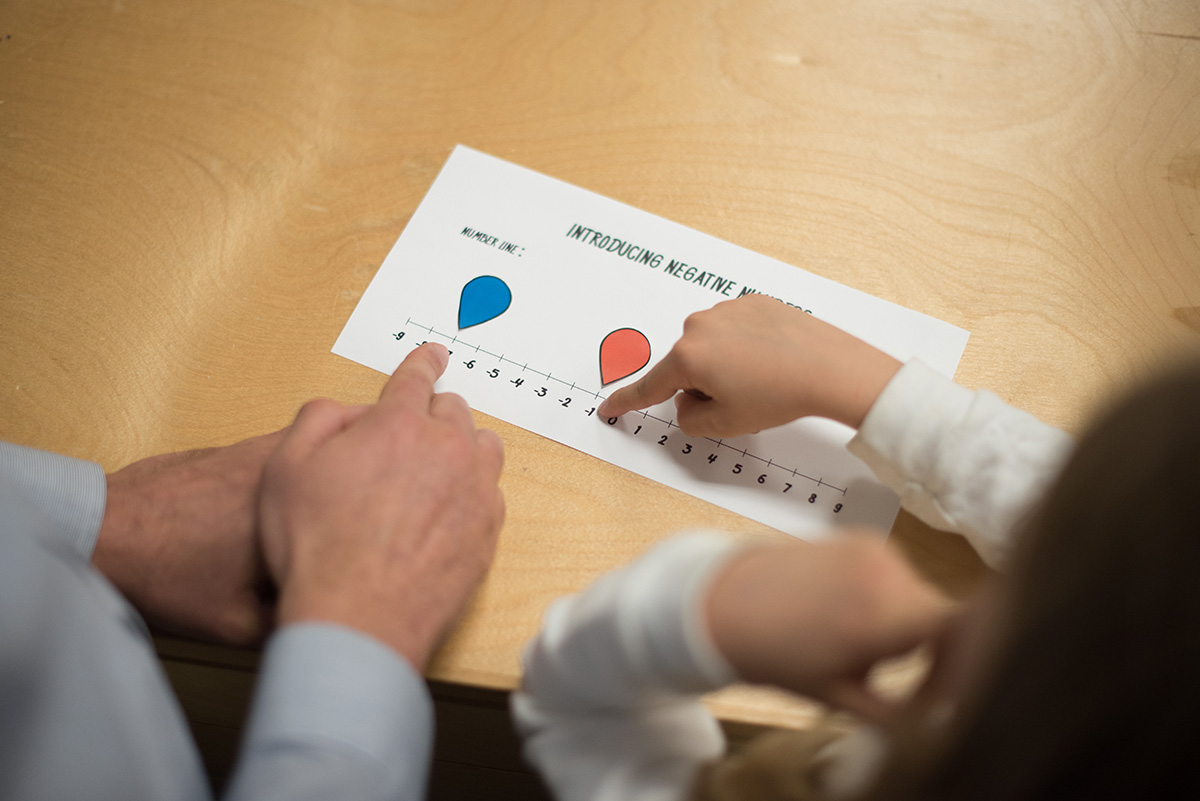
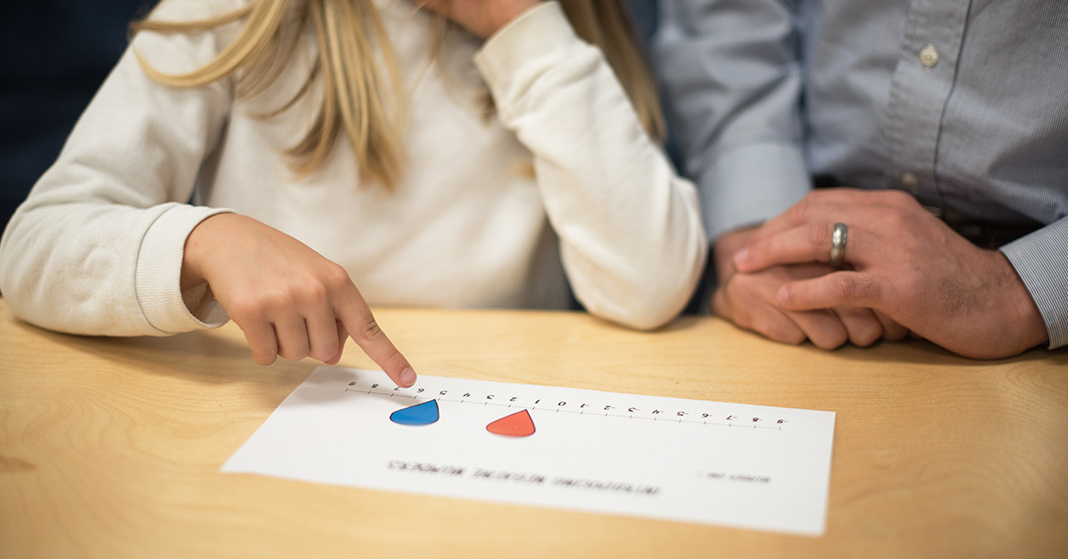
The best way to interact with negative numbers is with a number line. Try the following questioning strategy for introducing your child to negative numbers.

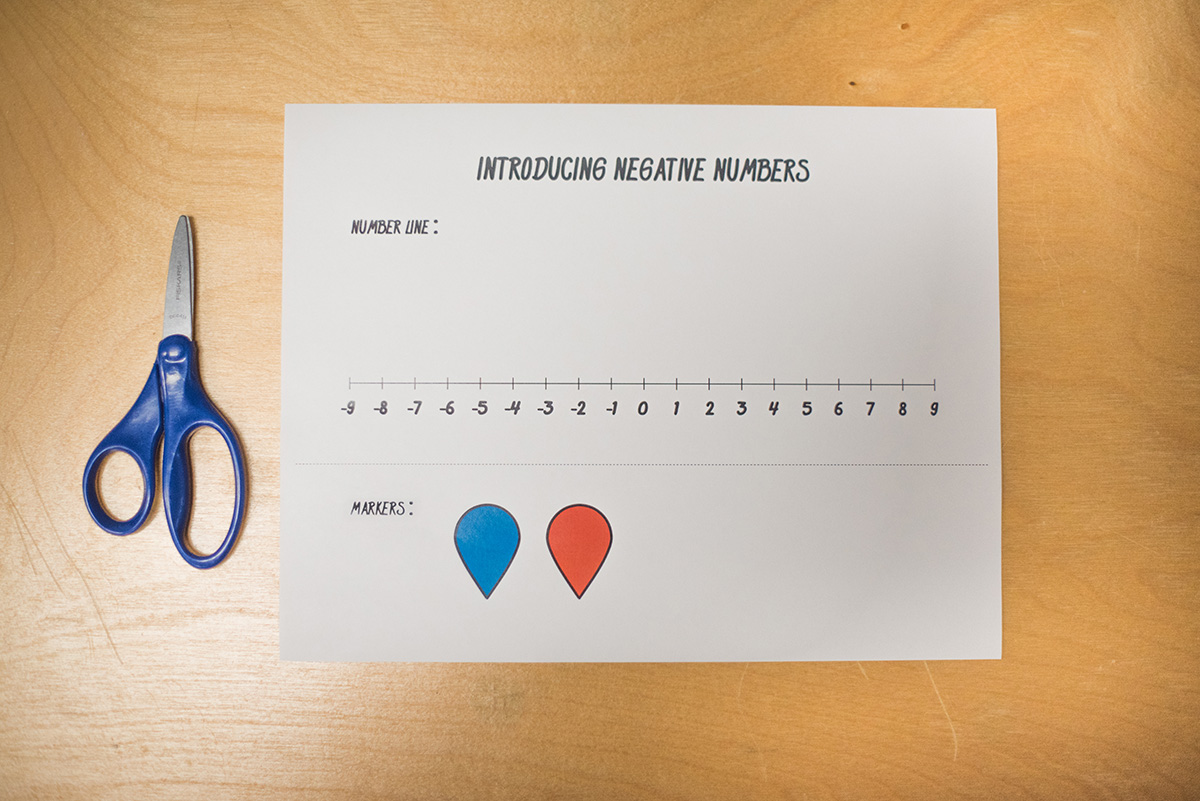
negative numbers activity materialsMaterials

You can use this printable, which includes the following:

  1. Number line (from negative 9 to positive 9)
  2. Markers to cut out

Activity

  1. Give your child the number line and the markers.
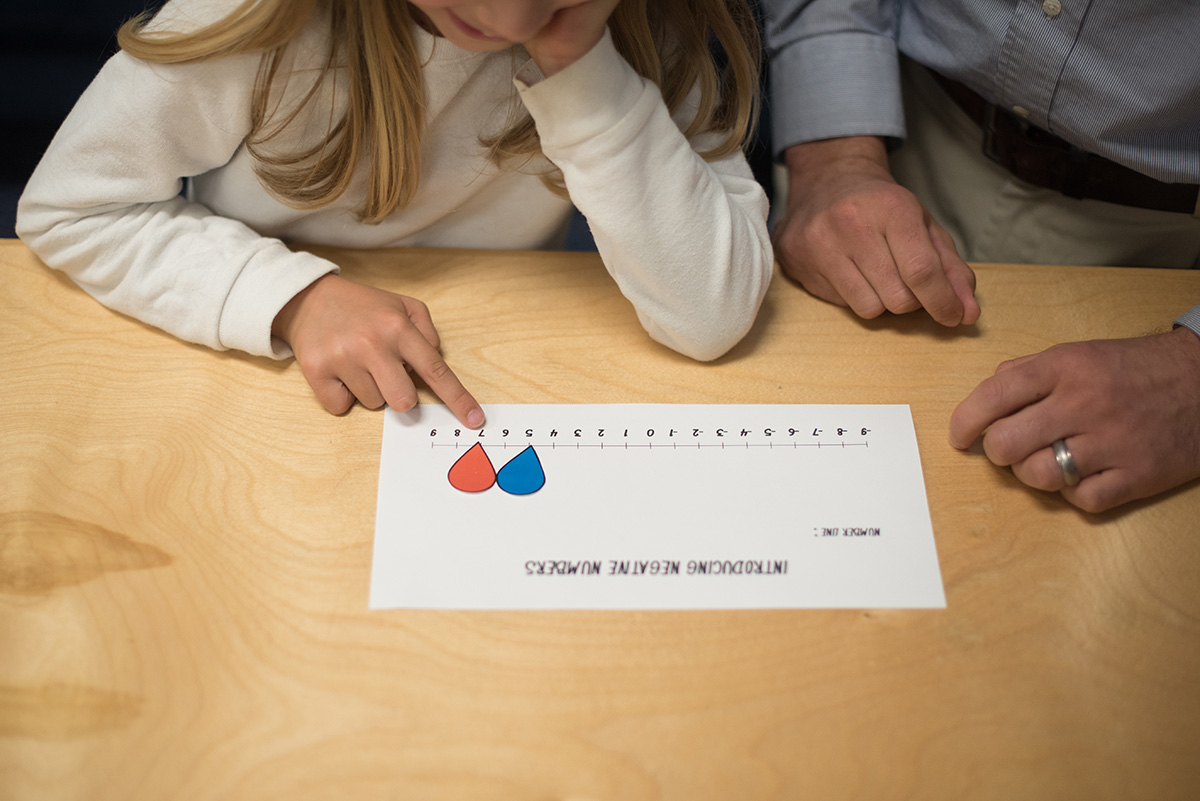
  2. Ask your child to place the blue marker above the number 5. This will be a point of reference.
  3. Ask your child to place the red marker above the number 7. Ask, “Which of the two numbers is larger?” and “Is it farther to the left or farther to the right?” Point out that the larger number is to the right and the smaller is to the left.negative numbers activity
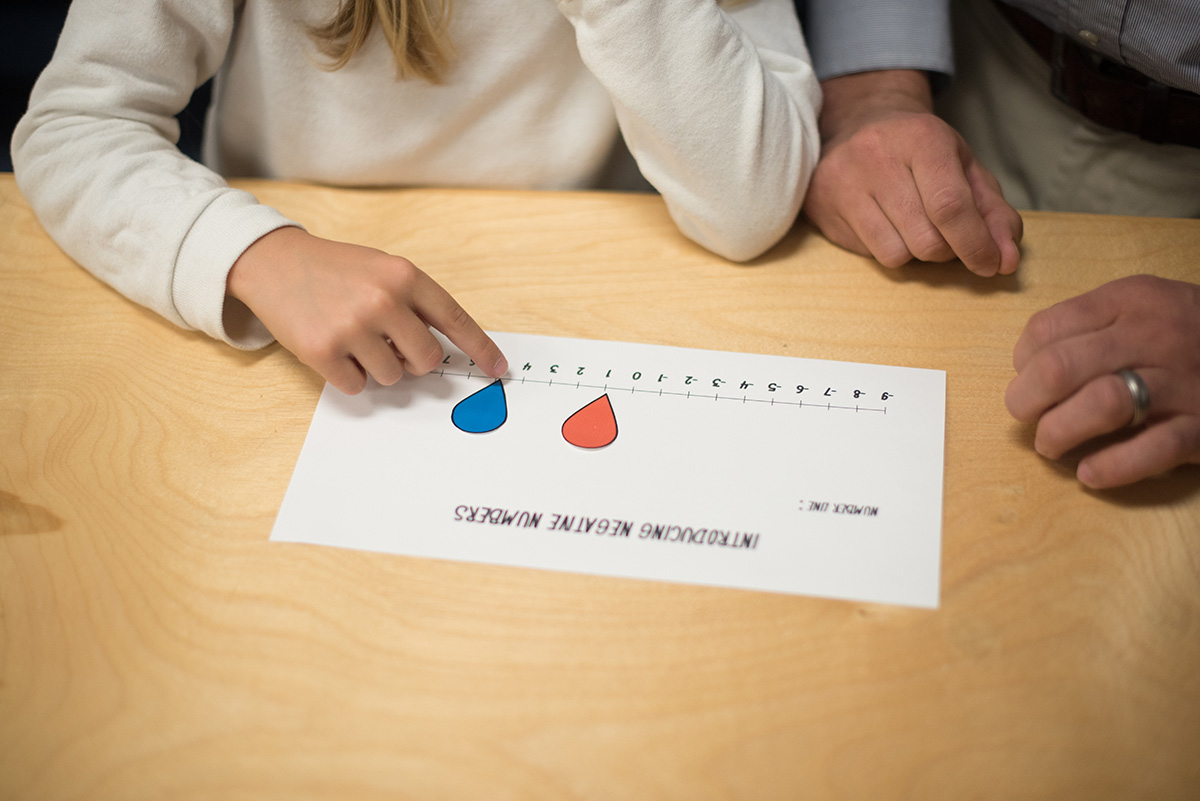
  4. Direct your child to take the red marker from 7 and put it above the number 1.
  5.  Ask, “Now which number is the larger?” and “Is it farther to the left or to the right?”negative numbers activity
  6. Have your child move the red marker above number negative 1.
  7. Ask, “What do we call that first number to the left of zero?” Your child might say, “Minus 1.” Explain that it is called negative one and that any time that negative symbol appears before a stand-alone number, it shows the number is less than zero.

Seeing the Math

This is a critical point because your child is going to compare two negative numbers. In your child’s experience, 7 has always been more than 1. But when both are to the left of zero (negative), the 1 is larger. This may seem obvious to an adult, but to a child it is counterintuitive. Allow your child to be “wrong” without correcting. You can set up the manipulatives so your child can see the difference.

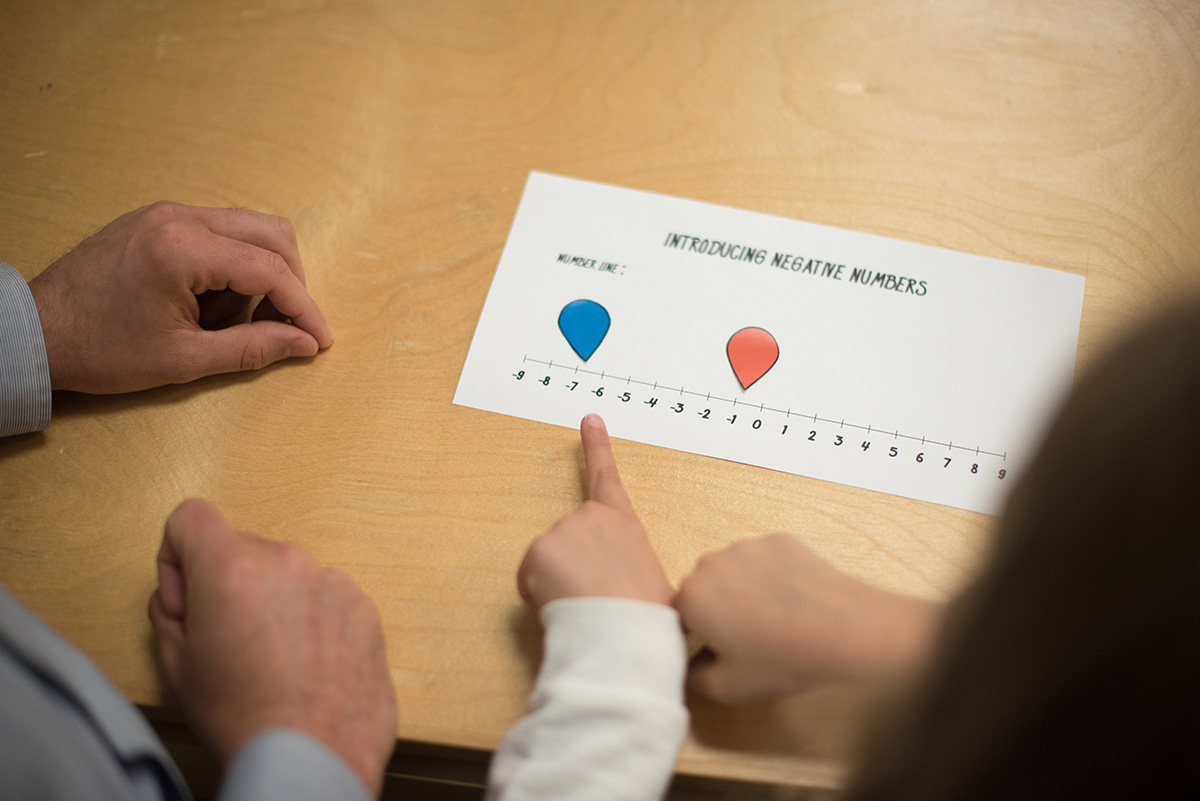
  1. Leaving the red marker on the negative 1, ask your child to move the blue marker to negative 7. Ask, “Which number do you think is larger, negative 1 or negative 7?  Remember when we compared 1 and 5, which number was larger?  Was it farther to the left or farther to the right?”negative numbers activity
  2. Now ask your child to compare negative 1 and negative 7 again. Say, “Remember if the number is the farther to the right, it’s the larger.” Then ask, “Which number is larger, negative 1 or negative 7.”
  3. If your child is struggling with how this can be true, ask, “What would you prefer, to owe me one dollar or seven dollars?”
  4. Explain that a negative number is like owing money when you don’t have any money at all. It is less than zero. So the bigger the numeral, the smaller or less the value.
  5. Try comparing several more numbers.

negative numbers activityDeveloping Understanding

This is a basic introduction to negative numbers. In the next few days, have your child try these exercises to develop his or her understanding:

  • Give your child a number line with negative 10, negative 5, 0, and 10 marked. Have your child fill in the rest of the numbers.
  • Create greater-than and less-than exercises for your child, using negative numbers.
  • Give your child a set of four or five numbers (including both negative and positive) to arrange from smallest to largest.
  • If your child is familiar with coordinate graphs, try extending the x to the left beyond the zero and the y down below the zero.

Try a variety of these activities over the next week or two. Never take more than twenty minutes or so, and make sure you are keeping the time engaging.  You will want to revisit negative numbers again in fifth grade. Once you review what you’ve already covered, you can begin to introduce adding with negative numbers.

If you introduce, review, and develop a mathematical concept in the elementary years, your child will be prepared to be successful in junior high and high school math.

Filed Under: Successful Learning Tagged With: hands-on learning, homeschool, math, negative numbers, Number Lines

How to Bless Your Homeschool Dad

June 14, 2018 by Ben

bless your homeschool dad
Every Father’s Day, children struggle to come up with a way to bless their homeschool dad. “We want to buy him a gift, but what can we get him that he wouldn’t already be able to get himself?” What is the best blessing you could offer a Christian dad?

Psalm 128 provides an excellent way to think about honoring dads on Father’s Day. In six short verses, this psalm inventories the blessing of a father who fears the Lord. The blessings are appropriate goals for every Christian dad, and children can honor him by contributing to those aspirations.

Wise Dominion

For thou shalt eat the labour of thine hands: happy shalt thou be.

Christian homeschool dads work hard to provide for their families and attempt to be wise stewards of the resources God gives them. Psalm 128:2 describes a blessed man enjoying the literal fruit of his work. He has fulfilled the blessing of dominion over God’s creation.

Children can join in on that blessing by diligently contributing to their household. But beyond carrying out chores, children should be preparing for their future vocation as well. Few things bless a father’s heart more than seeing his children study hard and prosper academically. It assures dads that their children are on their way to exercising good and wise dominion within God’s calling on their lives. That is being truly blessed.

Little Olive Plants

Thy children like olive plants round about thy table.

I love the metaphor found in Psalm 128:3. Children gather around the table, enjoying the fruit of their dad’s labor. As he nurtures them, they too will grow to be fruitful olive trees.

One of most basic characteristics of living things is that they perpetuate. If they didn’t reproduce, living organisms would go extinct. And this principle is linked to Genesis 1:28, where God blessed the animals and people to be fruitful and fill the earth.

Little children are such a delight to dads. They are a fulfillment of God’s blessing on their lives.

But more than having physical descendants, believing dads want to see their children experience new birth. We perpetuate by making disciples. Our commission is to perpetuate to the uttermost parts of the earth. For dads, the natural location to begin doing that is in our homes. Knowing the sweetness of our life in Christ makes it natural for us to want our children have the same lifelong experience. Children can bless their fathers by giving their hearts in response to their dad’s efforts to disciple them.

The Next Generation

Yea, thou shalt see thy children’s children.

The final verse of the psalm telescopes out to the third generation. Here, a blessed man (first generation) is enjoying his children’s (second generation) children (third generation.) It envisions the little olive plants growing to maturity and being fruitful themselves. They too are working hard to provide for a family. And God has blessed them with their own little olive plants.

This is the blessing of multigenerational discipleship. God-fearing dads are most blessed when they see their grandchildren also following in their ways. My dad is honored as I seek to disciple his grandchildren.

This Father’s Day, as you seek to honor your homeschool dad, meditate on Psalm 128. God wants to bless your dad, and He knows the best way to bless him. In fact, you’re an integral part God’s means of blessing. So if you give your heart to what God is doing, you will bless your dad.

Filed Under: Shaping Worldview Tagged With: dominion, Father's day, Psalm 128

When Spelling Makes Sense

June 12, 2018 by Megan

spelling games
How does someone become good at spelling?

Is it by practice alone? If so, I would just need to get out the dictionary and have my child start memorizing words. But, thankfully, good spelling isn’t completely dependent on having a good memory. Practice and memory play only a part. Good spellers also have a deep understanding about how letters and sounds work together.

Connecting Spelling to Phonics

One of the ways to build deep understanding of spelling patterns is to study word families. If you’ve taught reading with the BJU Press homeschool curriculum, you’re familiar with the word family approach to phonics. Children learn to read words by identifying the vowel patterns in the words. The vowel pattern will provide the necessary clues to determine the vowel sound and then decode the word. Words with similar vowel patterns are rhyming words that also make up a word family. For example, the at family would include words such as bat, cat, mat, and fat.

This same word family approach is valuable for teaching spelling because it helps students understand the connection between the sounds of a word and its spelling. So, if I learn how to spell might, I also know how to spell words such as fight, bright, and light even if they never show up on a spelling list.

Discovering the Patterns

Another way to build deep understanding of spelling patterns is to help students analyze words to discover those patterns for themselves. To do this, you need to present them with spelling lists that contain words with similar spelling patterns and sounds. The list should also include several other patterns. As children group and sort the words according to the spellings, they will gain a better understanding of how the sounds and letters relate to one another. And they won’t as quickly forget what they’ve learned.

Becoming a good speller doesn’t happen overnight. It doesn’t even necessarily happen during one homeschool year. It happens gradually as your child grows in his or her understanding of the reliable spelling patterns that do exist in our language. Though it takes time, it’s also worth the effort.

I’ve used the BJU Press spelling curriculum in our homeschool for two years now, and I’m looking forward to using it again next year. If you’re interested in learning more about using BJU Press spelling in your homeschool, you can check out the individual products for each grade.

Filed Under: Successful Learning Tagged With: homeschool, spelling, teaching spelling

  • « Go to Previous Page
  • Page 1
  • Interim pages omitted …
  • Page 60
  • Page 61
  • Page 62
  • Page 63
  • Page 64
  • Interim pages omitted …
  • Page 152
  • Go to Next Page »

Primary Sidebar

As parents, teachers, or former homeschool students, we are passionate about homeschooling from a biblical worldview. We hope these teaching tips, fun activities, and inspirational stories support you in teaching your children.

Email Signup

Sign up for our homeschool newsletter and receive select blog posts, discounts, and more right to your inbox!

Connect with Us!

                    Instagram     

Read Posts on Specific Subjects

Early Learning
Foreign Language
History
Language Arts
Math
Science

Footer

Disclaimer

The BJU Press blog publishes content by different writers for the purpose of relating to our varied readers. Views and opinions expressed by these writers do not necessarily state or reflect the views of BJU Press or its affiliates. The fact that a link is listed on this blog does not represent or imply that BJU Press endorses its site or contents from the standpoint of ethics, philosophy, theology, or scientific hypotheses. Links are posted on the basis of the information and/or services that the sites offer. If you have comments, suggestions, questions, or find that one of the links no longer works, please contact us.

Pages

  • About BJU Press
  • Conversation Guidelines
  • Terms of Use & Copyright

Archives

© 2026 · BJU Press Homeschool