• Skip to primary navigation
  • Skip to main content
  • Skip to primary sidebar
  • Skip to footer

BJU Press Blog

  • Home
  • Shop
    • Shaping Worldview
  • Simplified Homeschool
  • Successful Learning

reading

Ready, Set, Read! (Part 2)

May 12, 2014 by Megan

How can you help children with special needs love reading?

The fact that your child cannot lift words from the page without some help doesn’t mean his or her literary taste buds won’t enjoy the story just as much as other children. Customize reading to maximize its effectiveness for your child. You may need to break the reading sessions into smaller segments, or “read” audio books while following along in the print book. You can do the same kind of seeing/hearing with eBooks by using the text-to-speech function of eReaders along with the on-screen text. Some books are available in DVD format so you can watch with the closed captions turned on. The Mice of the Herring Bone DVD is an example of this type of book. If you have other ways that you make reading accessible to your special needs child, we’d love for you share your approach with us.

What’s the most important thing for parents to remember when choosing reading materials for their children?

Summer reading qualifies as leisure reading, so engage your children in the selection process to find topics of interest. Let your children read the materials that they didn’t have time for during the school year. Children learn how to read in school; they learn to love reading when they are immersed in topics or stories that they enjoy.

Don’t be overly concerned about whether the material is “hard enough.” Certainly, you don’t want to let a capable reader slide by and gain little, but experts agree that regular reading in materials of the child’s choice is one of the best ways to strengthen reading skills as well as to develop a love for the written word. And the children who learn to love reading are the ones who will be reading long after the last school assignment is complete. Reading is an accrued skill that develops as children read regularly.

What are some reading challenges that your child faces? Let us know in a comment.
Save

Filed Under: JourneyForth Tagged With: Christian school, homeschool, language arts, reading, special needs

Ready, Set, Read!

April 25, 2014 by Megan

What is your goal for Summer Reading, or what would you say is its purpose?

It is important to keep children reading through the summer months. Research shows that children can lose ground educationally during the summer months, and parents can minimize or eliminate this loss by establishing a pattern of leisure reading at home. Try reading five days a week for eight weeks during your summer. This gives families time for vacations, summer camp, and family activities while still making reading a priority, which in turn advances reading skills and fosters a love of reading.

Do you have some suggestions or encouragement for parents of reluctant readers?

If you as parents know why your child is reluctant, then you have some idea of where you need to focus your efforts.

Maybe you need to start the summer with an engaging read-aloud for your family. This could be the fanciful My Father’s Dragon or the poignant Stone Fox or . . . you get the idea.

Help your child select books appropriate to his or her skills. Scour an anthology or your library’s catalog to find something that is engaging to your child and suitable for your family or talk with your local children’s librarian for ideas. Get recommendations from the readers in your world. Try cooperative reading with your child, taking turns with paragraphs or pages or with each of you reading the words of specific characters. Or one of you signal the other when you are ready to handoff to the other reader. Some children like to reread books; that’s just fine. Who doesn’t like to spend an afternoon with an old friend? Reading skills are strengthened even in rereading. Consider why that book is your child’s friend and then look for books that are similar in some way.

If your child has adequate reading skills but doesn’t like to read, then it may be that he or she just hasn’t found a home-run book yet. Reading fiction may not be your child’s cup of tea, so look for nonfiction that will answer questions or deliver information. It may be that a book about combustion engines or the Smithsonian Magazine can satisfy your child’s need to know. Use the summer to find the kind of reading material that scratches the reading itch for your youngster.

Do you have a reluctant reader in your home or classroom? What have you done to motivate that child?

Save

Filed Under: JourneyForth Tagged With: Christian school, homeschool, language arts, reading, reading program

Celebrate Spring!

March 3, 2014 by Megan

I’m not a big fan of winter. There are some aspects that I enjoy—things like homemade soup and big mugs of hot chocolate. But I don’t enjoy activities such as having to bundle up to go outside to pick up my mail or having to shovel snow out of my driveway. I find myself looking forward to spring every year.

This year, spring officially begins on March 20. And even though it might not feel like spring on that Thursday where you live, you can still celebrate with some fun activities.

Have a Special Snack

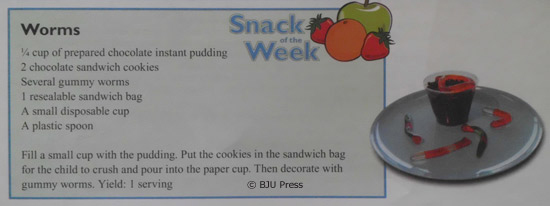
The appearance of earthworms is a sign of the beginning of spring, so why not eat some “worms” for snack time? Try this delectable snack!

recipe for Worms
Ingredients

¼ cup of prepared chocolate instant pudding
2 chocolate sandwich cookies
Several gummy worms
1 resealable sandwich bag
A small disposable cup
A plastic spoon

Directions

Fill a small cup with the pudding. Put the cookies in the sandwich bag for the child to crush and pour into the paper cup. Then decorate with gummy worms. Yield: 1 serving

Read Some Books

Below are some great read-aloud books for young children:

  • Signs of Spring by Justine Fontes
  • Fletcher and the Springtime Blossoms by Julia Rawlinson
  • The Very Hungry Caterpillar by Eric Carle
  • Buttercup Hill by Eileen M. Berry
  • Everything Spring by Jill Esbaum

Make a Craft

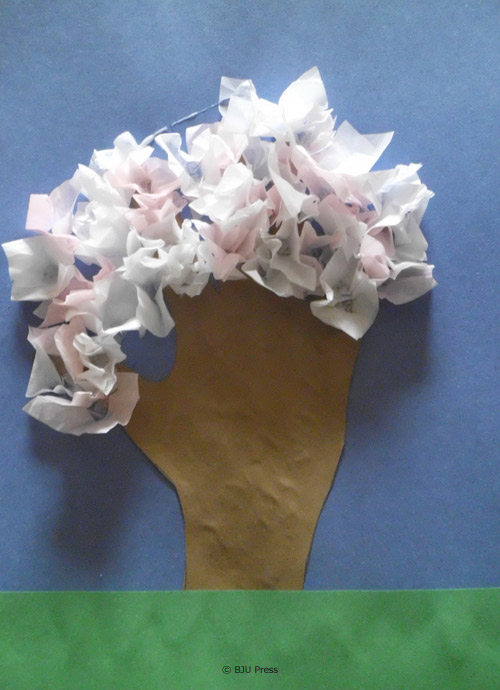
Spring is also the time when you start to see blossoms on the trees. Make your own blossoming tree by following the directions below.

construction paper craft of a flowering tree
Materials Needed
  • Construction paper (blue, green, and brown; 8 ½ x 11 inches)
  • Tissue paper (white and pink)
  • Old pencils (either without an eraser or with “unusable” erasers)
  • Glue
Directions
  1. Cut the green construction paper into strips 3 inches tall and 8 ½ inches wide.
  2. Draw a tree shape on the brown construction paper and cut it out. (Tip: Tracing a child’s hand and forearm makes a great tree shape.)
  3. Glue your tree onto a full sheet of blue construction paper.
  4. Glue a strip of the green construction paper on the bottom to make “grass.”
  5. Cut the tissue paper into 1 inch squares.
  6. Fold a square of tissue paper over the eraser-end of a pencil to form a “blossom.” Put a dab of glue on the bottom of the “blossom” and stick it on one of the branches of the “tree.”

Go for a Walk

If the weather is favorable, go for a walk and look for some of the following signs of spring:

  • Tree blossoms
  • Flowers (especially daffodils and crocuses)
  • Birds
  • Earthworms
  • Butterflies
  • Caterpillars

What do you plan on doing to celebrate the first day of spring?

Filed Under: Successful Learning Tagged With: activities, art, homeschool, language arts, reading, spring

  • « Go to Previous Page
  • Page 1
  • Interim pages omitted …
  • Page 6
  • Page 7
  • Page 8

Primary Sidebar

As parents, teachers, or former homeschool students, we are passionate about homeschooling from a biblical worldview. We hope these teaching tips, fun activities, and inspirational stories support you in teaching your children.

Email Signup

Sign up for our homeschool newsletter and receive select blog posts, discounts, and more right to your inbox!

Connect with Us!

                    Instagram     

Read Posts on Specific Subjects

Early Learning
Foreign Language
History
Language Arts
Math
Science

Footer

Disclaimer

The BJU Press blog publishes content by different writers for the purpose of relating to our varied readers. Views and opinions expressed by these writers do not necessarily state or reflect the views of BJU Press or its affiliates. The fact that a link is listed on this blog does not represent or imply that BJU Press endorses its site or contents from the standpoint of ethics, philosophy, theology, or scientific hypotheses. Links are posted on the basis of the information and/or services that the sites offer. If you have comments, suggestions, questions, or find that one of the links no longer works, please contact us.

Pages

  • About BJU Press
  • Conversation Guidelines
  • Terms of Use & Copyright

Archives

© 2026 · BJU Press Homeschool