
• Skip to primary navigation
  • Skip to main content
  • Skip to primary sidebar
  • Skip to footer

BJU Press Blog

  • Home
  • Shop
    • Shaping Worldview
  • Simplified Homeschool
  • Successful Learning

Guest Writer

This post was written by a guest writer for BJU Press. If you have any questions regarding this post, please direct them to [email protected].

Reaching Out This Fall

October 4, 2018 by Guest Writer

reaching out with marshmallows
I love fall and everything about it: the cooler temperatures (perfect hoodie weather), low humidity, brilliant colors, and a plethora of autumn recipes to try. It’s a perfect time of year to enjoy lots of outdoor activities with family such as hiking, bonfires, hayrides, corn mazes, and apple picking. It’s also a great season to establish family traditions and create lifelong memories. But as we make fall plans, let’s take some time to think about how we as homeschooling families can use some of these activities as a means of reaching out to the unsaved around us.

The Reason for Reaching Out

After all, we’re not here on this earth to just rear our children, work hard, serve in our churches, and enjoy recreational time—although all of these are good things. God left us here after He redeemed us so we may bring Him glory, and one way we can do that is by fulfilling the Great Commission in witnessing to the lost and seeking to bring them to Christ so they can be discipled and grow. And it’s much easier to witness to people when we’ve established rapport and found common ground with them. Yes, we should invite them to church, but we need to find ways to connect with them outside of church as well.

Fun Activities with Purpose

So what better way to get to know non-Christian acquaintances than by enjoying some of these fall activities with them? Ask them to join your family at a local corn maze or for a hayride. Invite them over to your house for a bonfire and s’mores. If they’re outdoor people, plan a hike together and pack a picnic lunch. You could host a pumpkin carving/decorating contest. Maybe you’ve met an unsaved family that is either unable or not quite ready to join you for these activities. A great way to still reach out is by baking them a fall treat such as pumpkin cookies or an apple pie. Consider signing your children up for a community sports league, such as soccer. This is a great way to meet families in your area; not only will you perhaps get an opportunity to witness to someone, but so will your children.

Outreach Opportunities

As the holidays come closer, the opportunities for reaching out and serving others also increase. Does your church do a soup kitchen or other mission projects during the Thanksgiving and Christmas seasons? Plan to help out this year! Your children can also participate in Operation Christmas Child, a special program run by Samaritan’s Purse. Shoebox collections end on November 19, so make sure to get your box together before then. Here are some more ideas for serving others this fall.

Whatever the method, use it as an opportunity to build bridges so you can eventually bring Christ into your conversations. As homeschoolers, we have unique opportunities we can use to spread the gospel to lost families all around us. Let’s pray for God to use us this fall  as we seek to bring the good news of salvation to those who may have never heard it.

• • • • •

Jennifer is a pastor’s wife and mom of two young girls and loves homeschooling them. During her own twelve years of being homeschooled, Jennifer developed a passion for reading and writing. She earned a bachelor’s degree in creative writing and relishes writing during her free time.

Filed Under: Shaping Worldview Tagged With: Fall, gospel, homeschool, missions, outreach

How to Train Young Scientists with Science Hikes

September 20, 2018 by Guest Writer

science hikes
Our family loves hiking. In fact, we think that any time except the dead of winter is the perfect time for a hike! We love the sense of freedom, of adventure, of separation from a too-busy world. And in the fall, hiking can be an even more enjoyable and educational experience.

Creation reveals its Creator, and what better way to train up young scientists than by turning your trek through the forest into a science hike? Here are five things you’ll need for a science hike with your kids.

1. Notebooks for Recording Observations on the Science Hikes

Notebooks and pencils are a must-have on any science hike. Every child, from the toddler to the teen, can take notes about what he or she sees.

For the little ones, making drawings or writing down one-word labels might be as far as they go. Older kids can draw more detailed sketches of animals or plant life and make a few observational notes. You can take breaks throughout the science hike to allow time for drawing and writing.

2. Cameras for Taking Photos

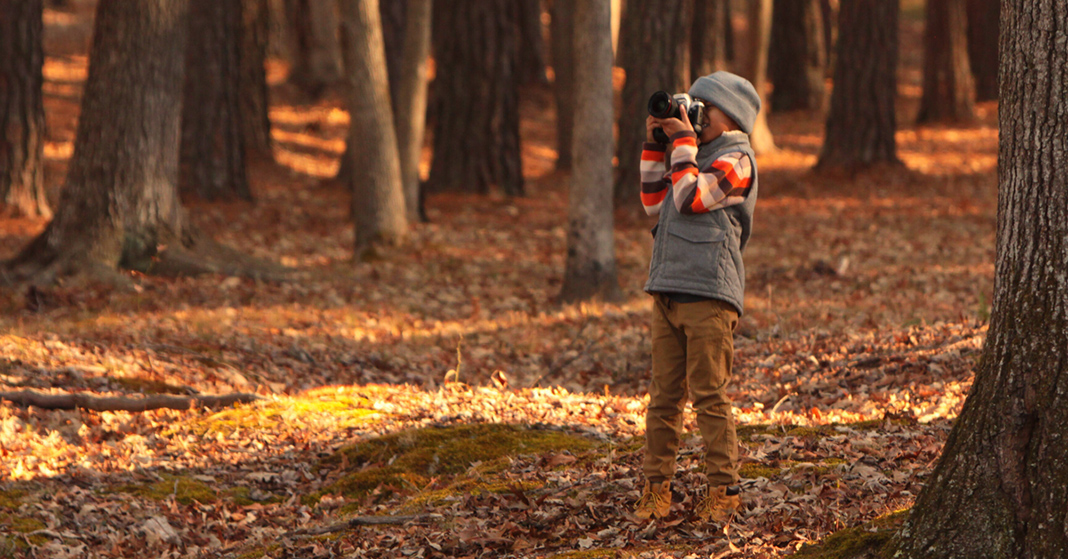
Taking photos of nature is a great way to hone budding observation skills. You may not want to hand over your smartphone to your five-year-old, but there are sturdy, kid-friendly cameras on the market that are ideal for small hands. Or maybe you have an old phone in a drawer, one that you never use and don’t really need. Why not repurpose it as a kid-friendly camera?

Plants, trees, seeds, nuts, buds, flowers, earth, wildlife, insects, and bodies of water are perfect photography subjects for young scientists. If you have been focusing on a particular science unit in homeschool, such as plant life cycles or different kinds of clouds, encourage the kids to photograph anything related to that topic.

3. Sample Collection Containers for Found Items

Kids love to find “treasures” in nature—sparkly rocks, twisted twigs, interesting flowers, dead insects, and brightly colored leaves. Bring along some resealable bags or plastic containers to hold all the samples.

When you get home, have your kids work on identifying what they’ve found. Can they match a colorful leaf to the type of tree it came from? What sort of beetle did they find? Which minerals make that sparkly rock so pretty? They can write their findings on an index card and slip it into the box or bag that contains their treasure.

4. Drinks and Snacks 

As moms, we all know what happens when the kids get hungry and thirsty. It’s not a pretty picture! Keep those hunger pangs at bay by bringing along plenty of snacks and drinks for the trek, even if it’s not a long hike. If you’re carrying a baby on your back, recruit your older children to help tote the provisions.

5. A Sense of Adventure

While it’s a good idea to follow certain safety rules (no running out of sight, no straying too far off the trail, etc.), there’s also a time to let the restrictions relax and just have fun! Nature is beautiful and exciting to your children, and they’ll learn so much from simply running, climbing, scrambling, and skipping through it! Take your time, and enjoy their delight in the big world God has made.

• • • • •

Rebecca is a work-at-home freelance writer, novelist, wife, and the mom of two bright-eyed little ones. She credits her success in writing and her love of books to her own mom, who homeschooled three kids from pre-K through high school.

Filed Under: Successful Learning Tagged With: hiking, homeschool, observation, science hike

Time Flies, So Make It Count

September 4, 2018 by Guest Writer

spending time with children
Recently my husband and I had a conversation that went something like this:

“Can you believe it’s almost time to start school again?”

“No, it seems like we just ordered last year’s materials!”

You can probably relate; and like us, you realize just how quickly the weeks, months, and years are speeding by. The time we still have left with our children at home will be over before we know it; and a good question to ask is, “Are we making the most of the opportunities we have with our children?” Ephesians 5:16 exhorts us to be “redeeming the time, because the days are evil.” The beginning phrase can also be translated as “making the best use of the time.” God wants us as parents to make the best use of the time He has given us with our children. How can we do that?

Time In School

As homeschoolers, we have chosen the role of teacher. Therefore, we have to make sure that our children are getting the most out of their education. This means taking time to assess our children’s academic growth. Are they developing critical thinking skills? Do they know how to accurately apply logic and reasoning in solving problems? Are they forming solid studying habits? Just getting them to complete their assignments and take their tests isn’t enough to redeem the time.

Outside School

In a world where parents and kids are busy with their own separate pursuits, it’s especially important to do family activities. As homeschoolers, we are obviously with our children a lot, but it’s crucial to make family time outside of school. Take walks, play board games, go bowling, throw a Frisbee®, catch fireflies—the list could go on and on. It’s not about doing huge exciting things; it’s about enjoying simple moments with our children, making memories, and drawing closer to each other.

Round the Clock

But the greatest way we can redeem the time is by reading and discussing God’s Word and praying together. Not just at breakfast or bedtime but throughout the day as various circumstances arise. Every success and every failure is an opportunity to teach our children about God and His Word. Deuteronomy 6:7 admonishes us to teach our children His Word when we’re sitting at home, when we’re going places, when we go to bed, and when we get up in the morning—in short, every chance we get! That means we as parents have to constantly keep our minds on eternal spiritual matters so we’ll be ready to engage our children in God-centered conversations. This doesn’t come easily. We have to put a lot of thought and effort into it, but isn’t it worth it? Time is flying, so let’s make the most of it!

• • • • •

Jennifer is a pastor’s wife and mom of two young girls and loves homeschooling them. During her own twelve years of being homeschooled, Jennifer developed a passion for reading and writing. She earned a bachelor’s degree in creative writing and relishes writing during her free time.

Filed Under: Shaping Worldview Tagged With: biblical worldview, homeschool, parenting

Go for the Goal

August 14, 2018 by Guest Writer

setting goals for your homeschool
Setting goals in life can help us grow as students, parents, and disciples of Christ. Paul wrote under the inspiration of the Holy Spirit in Philippians 3:13–14, “Forgetting those things which are behind, and reaching forth unto those things which are before, I press toward the mark for the prize of the high calling of God in Christ Jesus.” Instead of dwelling on past victories or failures, we should be striving to reach the goal before us—ultimately, Christlikeness in every area of our lives. If we don’t set goals to work toward, we will stagnate in our spiritual, mental and emotional growth. As someone once wisely said, “Aim at nothing, and you’ll hit it every time.”

Academic Goals

Setting educational goals is a good place to start. Take some time to discuss with your spouse and children what you all want to accomplish throughout the school year. Perhaps one of your children struggles with a certain subject, so his or her aim is to improve and get better grades in it this year. Maybe a teenager would like to take some extra credit courses in preparation for college. One of your goals may be to make it all the way through a subject you don’t usually finish. After talking through your goals, write them down and display them in a place where everyone can see them. That way you’ll constantly be reminded and motivated to reach those goals.

Spiritual Goals

Next, consider setting some spiritual goals for the year as well. Memorizing a passage of Scripture as a family is a great one. Maybe you’ve been challenged as a family to be bolder witnesses for Christ; set a goal for each family member to share the gospel with at least one unsaved person. Perhaps you want to gain noticeable victory over a certain sin in your life. Again, after discussing these different goals, write them down and post them somewhere in your house. Then pray over them as a family, asking the Lord to help you reach these milestones by the end of the year.

Mission Accomplished

When you do reach one of your goals, write down the date it was completed so everyone in your family can rejoice together. Accomplishing a goal will encourage, excite, and motivate you and your family to achieve even more together; it will also establish a good pattern for your children to continue throughout the rest of their lives. Another benefit is that this process can bring you all closer to each other and to the Lord. Through careful planning, prayer, and determination, your family can experience the satisfaction of reaching your academic and spiritual goals this new school year.

• • • • •

Jennifer is a pastor’s wife and mom of two young girls and loves homeschooling them. During her own twelve years of being homeschooled, Jennifer developed a passion for reading and writing. She earned a bachelor’s degree in creative writing and relishes writing during her free time.

Filed Under: Simplified Homeschool Tagged With: academic, goals, homeschool goals, plan, spiritual

Make Your Own Family Board Game

August 7, 2018 by Guest Writer

creating a family board game
What can you learn from a board game? A lot! When kids play board games, they practice various skills, including counting, color matching, strategy, addition, and reading. Depending on the game, more complex skills such as deduction, money management, or spelling may be involved.

Maybe your family is a little tired of the games you currently own; if so, why not create your own family board game? It’s an interactive activity that everyone can enjoy. Try these tips for getting started.

Start with a Theme or Idea for Your Board Game

First, you need an idea or a theme. Maybe your kids love racecars or dinosaurs or fairy-tale characters—any of those could be the beginning of an exciting game. For additional inspiration, check out blogs and websites that offer ideas for DIY board games.

Decide on the Structure 

You can let your kids run free, so to speak, designing their game with any rules or layout they prefer. However, if you really want it to work as a family board game, you may need to have a hand in planning the structure, especially if your kids are younger. It helps to have a goal or objective in mind—maybe collecting a certain number of items, reaching the end of the path first, solving a specific number of riddles, or completing a variety of challenges.

Are you struggling to come up with a workable game design? Consider modeling your creation after a familiar game such as Chutes & Ladders, Candyland, Monopoly, or another favorite, and then come up with a different layout, game pieces, and extra objectives or rules.

Create the Game Board

This part is probably the most enjoyable, especially if you have kids who love drawing, coloring, and crafting. The board could be simple—just some colored squares glued on paper in the shape of a path. It could be a complex map of a wilderness (complete with cliffs and waterfalls), a floor plan of the rooms of a castle, or a grid of hidden clues or challenges written on sticky notes.

If you have active children, consider making the board life-size! Draw it with markers on a cheap plastic tablecloth or an inexpensive white shower curtain, and let your kids use themselves or their stuffed animals and dolls as the game pieces.

Choose the Game Pieces

If you’re sticking with a traditional size for your family board game, you’ll need some game markers and other pieces. You can make your own spinner or borrow one from another game; a tiny hourglass or some dice are other items you can temporarily grab from a different game box.

If your kids are feeling really inventive, let them try fashioning their own dice, as well as cutting out and coloring the other game pieces. For a quicker solution, use anything you have on hand—Lego minifigures, small toys, craft sticks, cotton balls, pennies, seashells, or bottle caps.

Write Down the Rules—But Be Flexible

Before you begin, write down a few basic rules for your family board game. As you and your kids attempt to play it, you’ll probably discover some rules that don’t work well and others that need to be added. Remind your children that they are game developers and that game developers have to go through a testing phase before the game is perfect.

When it’s finished, you may have a wonderful game that your family can enjoy for years—or you may have a mess of paper and random objects that don’t really work well together. It’s OK either way! At least you’ll have enjoyed a session of creativity together as a family—and you can always try again!

• • • • •

Rebecca is a work-at-home freelance writer, novelist, wife, and the mom of two bright-eyed little ones. She credits her success in writing and her love of books to her own mom, who homeschooled three kids from pre-K through high school.

Filed Under: Successful Learning Tagged With: board games, family board games, family fun, homeschool

  • « Go to Previous Page
  • Page 1
  • Interim pages omitted …
  • Page 18
  • Page 19
  • Page 20
  • Page 21
  • Page 22
  • Interim pages omitted …
  • Page 30
  • Go to Next Page »

Primary Sidebar

As parents, teachers, or former homeschool students, we are passionate about homeschooling from a biblical worldview. We hope these teaching tips, fun activities, and inspirational stories support you in teaching your children.

Email Signup

Sign up for our homeschool newsletter and receive select blog posts, discounts, and more right to your inbox!

Connect with Us!

                    Instagram     

Read Posts on Specific Subjects

Early Learning
Foreign Language
History
Language Arts
Math
Science

Footer

Disclaimer

The BJU Press blog publishes content by different writers for the purpose of relating to our varied readers. Views and opinions expressed by these writers do not necessarily state or reflect the views of BJU Press or its affiliates. The fact that a link is listed on this blog does not represent or imply that BJU Press endorses its site or contents from the standpoint of ethics, philosophy, theology, or scientific hypotheses. Links are posted on the basis of the information and/or services that the sites offer. If you have comments, suggestions, questions, or find that one of the links no longer works, please contact us.

Pages

  • About BJU Press
  • Conversation Guidelines
  • Terms of Use & Copyright

Archives

© 2026 · BJU Press Homeschool