• Skip to primary navigation
  • Skip to main content
  • Skip to primary sidebar
  • Skip to footer

BJU Press Blog

  • Home
  • Shop
    • Shaping Worldview
  • Simplified Homeschool
  • Successful Learning

Jenna

A Thankfulness Project

October 1, 2019 by Jenna

a thankfulness project
During the holiday season, we often try to be more thankful. With Thanksgiving in November and Christmas in December, it’s easy to spend two months out of the year being grateful for God’s grace and His gifts to us. But what about the rest of the year? It’s not that we aren’t thankful during the other ten months. But when you’re not actively thinking about and pursuing a certain mindset, it can go by the wayside. Sure, you’ve taught your children to say “thank you,” and you demonstrate that same thankfulness in your own life. But there’s a difference between reflexively saying “thank you” and being grateful enough to recognize the daily gifts God gives us and to thank Him for them as they come.

For example, not long ago I told a friend that my life had become a series of unfortunate events. My air conditioner had died with two months of summer left. Repairs would cost a pretty penny I couldn’t afford to spend. This was just one of the “unfortunate” events, and not even the most expensive one. I had a whole list of problems. But then I stopped and listed out all the blessings I could think of from the year and found that they greatly outnumbered the unfortunate things. It’s easy to devalue God’s daily blessings to us when all we’re looking at is the negatives. So I have a couple of challenges for you.

• Be Mindful about Being Thankful 

I don’t have to tell you why you should be thankful. For many of us, however, gratitude is a reflex. We’re grateful when someone gives us something or does something for us. We don’t even have to think about it. But 1 Thessalonians 5:18 tells us, “In every thing give thanks: for this is the will of God in Christ Jesus concerning you.” In everything give thanks. I should have been grateful when my AC died. It’s definitely not an automatic response to be grateful when you have no AC during a South Carolina summer.

But if you take the time to think about the things you don’t want to be grateful for, you can see how they can be blessings in disguise. Even if the only thing your trial teaches you is that His grace is sufficient for you (2 Corinthians 12:9), you can be grateful for that. It may take some work, and you may need to reset some of the default settings in your heart, but it is possible to see how God is blessing you when you go through an “unfortunate” event.

• Start a Year-Long Thankfulness Project

If you really want to focus on thankfulness for the entire year, you’re going to need to turn it into a habit. Find some way to record the daily blessings you experience, whether the blessing is a safe field trip or a friend’s support during a hard time. You can fill a jar with slips of paper covered in blessings, or you can dedicate a journal to your family’s blessings. You could even start a OneNote notebook of blessings. When the jar is full, or you run out of pages in the journal, or you just need to remember God’s blessings, reread what you’ve put down. Then empty out the jar, get a new journal, open a new OneNote file, and start over.

Worry can’t tear you down if you’re buried in blessings!

Filed Under: Shaping Worldview Tagged With: gratitude, Thankfulness, Thanksgiving

Adult Life Skills: Preparing Graduates That Think

September 24, 2019 by Jenna

preparing graduates with life skills
Have you ever lost sight of the goal in the middle of the monotony of it all? Every day seems full of diagrams, algebraic equations, dates, and classifications. You can’t help but think, “What’s the point?” That’s the question that math students have always wondered about: “When are we ever going to use this?” But Mom, you’re not immune to that way of thinking either. Sometimes you just need to take time to remember what the point is. Yes, by homeschooling your children you’re ensuring that you have the final say about everything they learn. You’re taking the opportunity to disciple them so that they can live out God’s calling in their lives. And that’s a vital part of homeschooling. But do you really need to teach them the quadratic formula? Remember, you’re not just teaching them facts. You’re teaching them critical thinking skills. In other words, you’re teaching adult life skills.

Beyond the Facts

Those skeptical math students have a valid point. The technicalities of academic subjects aren’t all that useful for adult life skills. That complicated mathematical formula won’t help your child balance a checkbook. But what those math students don’t realize is that they’re not just learning facts. As they wrestle with a new concept, they’re also learning how to learn. They’re learning how to stay focused when working through long processes. They’re learning how to solve for missing information.

In the day-to-day minutia of academic studies, the facts aren’t important. What’s important is that your children are using their minds each day and growing. They’re learning to interact with new information, consider its implications, respond to it, make connections, and create and define new information. In other words, they’re learning to think.

Critical Thinking Skills and Adult Life Skills

Much like the math students questioning why they’re learning an obscure concept, many highschoolers are noticing that they can, say, rattle off all the taxonomic ranks of biological classifications, but they can’t apply for a credit card. It will probably come as a surprise to them, but many of the things they’ll need to do in their adult lives aren’t actually that hard to do. Applications for credit cards and other loans can be so easy to do that many of us do them without thinking about the serious implications of buying on credit. But at the end of the day, that’s exactly the kind of thing you want your graduates to be able to think about.

Young adults don’t need special courses on how to pay their bills and apply for loans. Companies have a vested interest in people paying bills and applying for loans, so they make those processes self-explanatory. But young adults do need to be able to consider the implications of missing a payment or having a credit card. Is a credit card really worth it? Is building one’s credit even as important as it seems? Would it be better to always pay for things with cash on hand? These are questions that your children will have to wrestle with and answer as they grow, but they probably don’t have the maturity and life experience needed to consider them now.

Your children can use the same processes they will use as they consider the implications and wisdom of having a credit card to their own future families. Interacting with their spouses and children will involve tons of new information that they will need to learn, respond to, and determine the implications of on a daily basis.

Ready to Answer God’s Call

God has some purpose in store for your children. They may find it today or not discover it until they’re thirty. The best way for you to prepare them for whatever God has for them is to teach them how to think, learn, and grow. There’s a lot you can teach them yourself, but you can’t possibly teach them all the adult life skills they need. There’s a lot they’re going to have to learn by themselves. But if you’ve been preparing them from the beginning, and if you’ve equipped them to learn, then you have equipped them for life.

Filed Under: Successful Learning Tagged With: Critical Thinking, graduates, homeschool, thinking skills

Getting Credit: Understanding Homeschool Credits

September 10, 2019 by Jenna

getting homeschool credits
“How many credits is this course worth?” Many parents have asked me this question about various courses. It may seem fairly straightforward, but it’s a little more complicated than you might think. What makes up a credit or what counts as a credit varies from state to state and even from city to city. The same amount of work may count differently in New York City compared to the rest of New York state. So, let’s take a closer look at the world of homeschool credits for high school.

What Is a Credit?

The concept of a credit is based on the Carnegie unit, which refers to one daily hour of instruction five days a week for 24 weeks. If you do the math, that’s 120 hours of instruction. This time-based standard helps states and schools determine whether students are present in class often enough to learn and understand the material. In a brick-and-mortar school, the students’ success in a class is usually determined by both attendance and regular assessments. They earn credits by meeting the requirements.

How Do State Standards Affect Credits?

You probably know that most states require 180 days of instruction per school year, which means that most schools’ schedules include way more time than the minimum required for a Carnegie unit. Additionally, each state’s department of education may define the number of hours of instruction required for a credit differently. Larger cities with their own board of education may also have their own definitions. You can usually find out what you need to know about your state’s standards by looking up the graduation requirements set by your department of education.

For example, the New York State Education Department defines a single diploma credit as the completion of the required learning objectives in the class as well as attending 180 minutes of instruction per week (36 per day) through the school year. For graduation, students must have 22 credits total, many of which have to be for specific courses.

However, the New York City Department of Education requires 44 credits total. That doesn’t mean that the city requires twice the amount of work from its students. Rather, completing the required number of hours and assessments earns two credits instead of one. It amounts to the same thing, but the terms are different.

When you’re looking at these state standards, you have to keep in mind that they’re designed for public schools and classroom settings. The teacher must prepare for at least 180 days of instruction, but few students actually attend all of those days. Students have sick days, snow days, doctor’s visits, sports trips, and family emergencies. You know, life happens. Schools may have several buffer days for teacher workdays, weather-related shutdowns, or activity days, but a student’s absences will often overlap with the required days of instruction rather than the buffer days.

What Does This Mean for Your Homeschool Credits?

At the end of the day, homeschool credits aren’t about meeting your state’s regulations for homeschool families. They’re about what you’re going to put on your child’s transcript. You will want to record the credits your student has earned in a way that reflects either your state’s graduation requirements or the admission requirements of your student’s college of choice.

So, keeping records of what you do in your homeschool will be an important part of your daily routine. These records will help you know that you’re at least meeting the 120-hour criteria of a Carnegie unit. This is especially helpful if your state doesn’t have a required number of days of instruction. You can honestly say that your child has met the requirements for a credit even if you don’t have another standard to work toward.

For additional information regarding which subjects your state requires or how many days of instruction you must complete, check the Home School Legal Defense Association database of state homeschool regulations.

The question of how many credits a particular course is worth isn’t actually that helpful. What you should be asking is “Does this meet my state’s requirements?” And, for all current BJU Press courses—provided that you’re following the lesson plan overview or video lesson guide—yes, it does.

Filed Under: Simplified Homeschool Tagged With: credits, high school, homeschooling

Homeschool Resources: What Are They For?

August 13, 2019 by Jenna

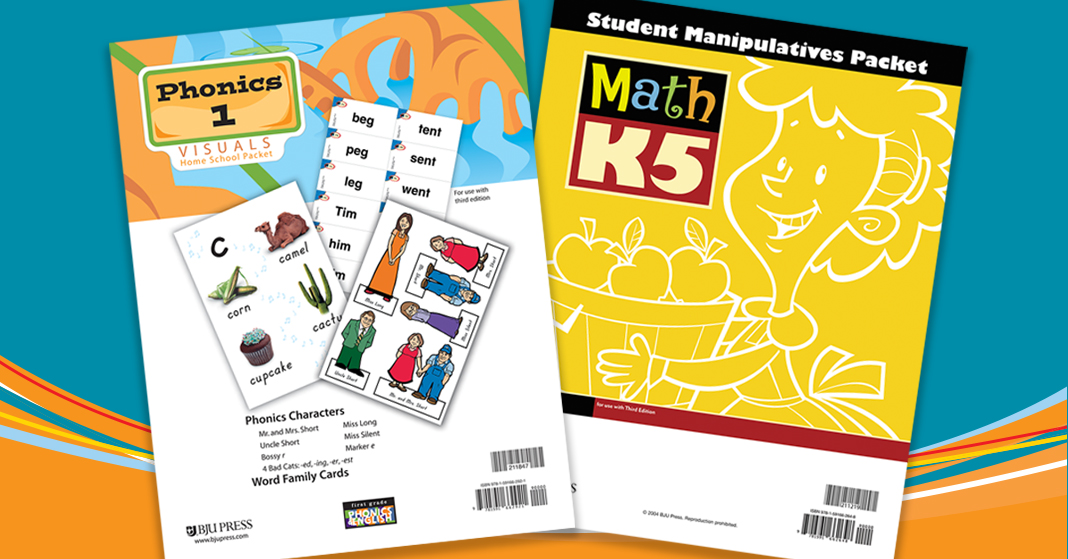
homeschool resources - visual and manipulative packets
Manipulatives and visuals, oh my! If you weren’t sure what all those books are for, then chances are you’re also not sure about all these extra homeschool resources, either. Do you really need them? Are they worth it?

Let’s take a look at some of the homeschool resources you might need on your homeschool journey.

Manipulatives

Manipulatives are perhaps the most essential “extra” resource you can get. They’re incredibly important for young learners. Manipulatives give students a way to physically experience a concept that they wouldn’t otherwise be able to see, touch, or interact with. They give children an opportunity to experience a concept with all their senses. In other words, they’re using multisensory learning. For instance, how do you teach a child that one and one makes two? Most of us might take one pen, then get another pen, and then count again to find that we have two pens. Those pens become manipulatives that give meaning to the numbers. In math, manipulatives are a key components for helping children develop number sense.

Manipulative packets are specifically designed to match the scope of concepts taught in a particular course. They make life easier for you because, when you get to a new concept, you already have the manipulatives on hand and you don’t have to find things to use. BJU Press offers manipulative packets for math from K5 through Grade 6. Manipulatives also apply to other subjects, but on a much smaller scale than math. Cutouts and suggested items to use as manipulatives are available in the teacher editions and activity manuals rather than being available for separate purchase.

The most important thing is having manipulatives and using them regularly. That said, can’t you just use any old thing in place of the items in a manipulative packet? You could, but it will get harder and harder to find objects to use as manipulatives. What will you use for groups of hundreds, fractions, or unusual shapes? You may be able to save a little bit of money by not buying the packets, but you might lose what it was worth in time and effort.

Visuals

Visuals may seem self-explanatory, right? They’re things for your students to look at as they learn. It’s another aspect of multisensory learning—learning by sight. But a visuals packet isn’t just a bunch of pictures that explain a Bible lesson or illustrations for a reading lesson. They’re packets of charts, graphs, and other visuals that help students interact with concepts in a different way.

For example, BJU Press’s Phonics and English 1 includes visuals for the phonics characters—the Shorts, the Longs, and others. The visuals packet introduces the student to the character and what the character represents. Then as they go through their workbooks, they’ll see those characters again to remind them about the different phonetic rules. Children often find it easier to remember stories than lists of rules. The visual characters weave together a story for them to use as they’re learning phonics. Other visuals might give a plot diagram for a story, a chart for creating paragraphs, and so on.

Most visual packets come with a subject kit automatically, but do you really need them? You’ll have to decide based on what you know about how your child learns. But remember: children don’t always learn just one way, and sometimes they learn different concepts in different ways. You might need visuals for one lesson but not the next. It’s important to have them available even if you don’t always need them.

Unlike the books, these homeschool resources aren’t typically core materials that you’ll need every day. And not every curriculum provider offers them. Whether or not you should purchase them depends on what you need to do to teach a concept effectively. And that’s a question only you can answer.

Filed Under: Successful Learning Tagged With: homeschool resources, learning types, manipulatives, visuals

Homeschool Curriculum: Going Beyond the Books

July 23, 2019 by Jenna

homeschool curriculum
What are all these books even for?

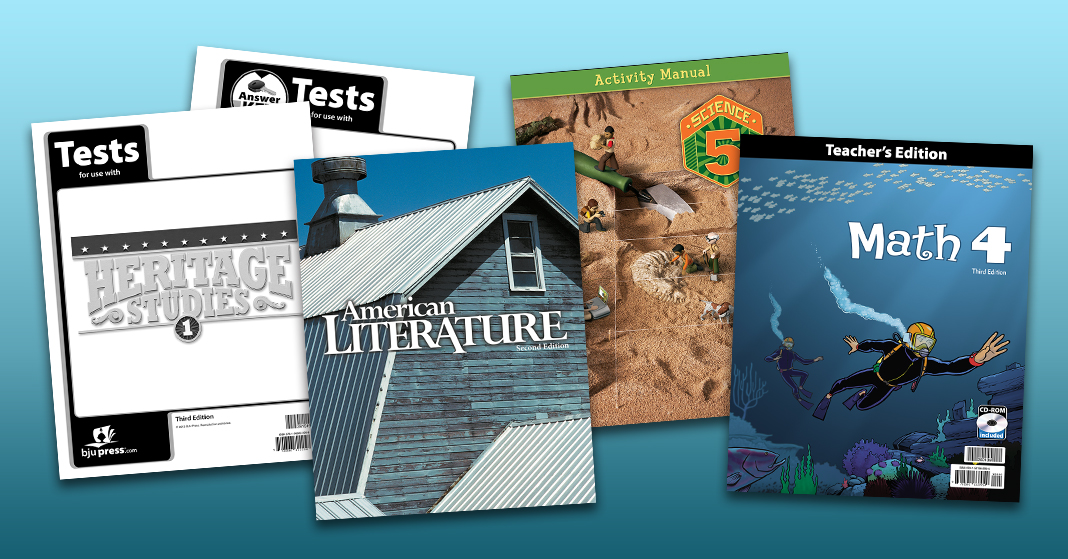
Have you ever caught yourself thinking that as you unpack your boxes full of homeschool curriculum for the year? Especially if you’re teaching the material yourself, there’s a lot of stuff in those boxes. Mixed in with the excitement for the coming homeschool year, you might find yourself asking, “Do I really need all this? What do these books do?”

Teacher Edition

If you really want to teach your children yourself, you need something that’s more than a glorified answer key. A good teacher edition will give you valuable resources that equip you to teach each lesson in a way that enables your children to understand the content.

You don’t have to be a subject expert to teach your children. And, as a parent, you’re probably already an expert or becoming an expert on how your children learn. What you need in your homeschool curriculum is a resource that equips you to create a learning experience that your child needs—without long, fruitless Pinterest searches.

BJU Press teacher editions offer strategies for presenting the content in ways that will bring children into the lesson. Those strategies may use hands-on learning, visual learning, discussions, or even storytelling.

To get your children really thinking about what they’re reading, you need to ask questions. But what kind of questions? Which ones will get your kids really thinking about the content? Discussion questions and worldview development strands that you can choose from get your children thinking about the content. Additionally, they help them know how to think about it from a biblical worldview.

Besides teaching strategies and discussion questions, teacher editions also include lesson guides, background information, rubrics, answers, lesson plan overviews, and suggested schedules for the year. A teacher edition is truly a teaching resource.

Student Edition

The student edition or student worktext will be the most familiar piece. You might think of it as the core of your homeschool curriculum. It’s the book your children go to every day—or most days, depending on your schedule—to read lessons and complete assignments. Some textbooks may give you flashbacks to your high school days or make your homeschool feel like you’re just doing “school at home,” but a good textbook goes beyond the stereotype.

Textbook material will often be the first informational texts that your children read. Reading informational texts is an important skill for kids to develop because they will be reading and interacting with informational texts throughout their school days and as adults. When was the last time you read an instruction booklet, a news blog, or a how-to article? What about a devotional book or a sermon transcript? Even this post is an informational text. Information is all around us, and children need to learn how to read it, think about it, and respond to it appropriately. That’s why every BJU Press textbook is designed to help students as they work with informational texts.

Activities

An activities book seems kind of self-explanatory, doesn’t it? It’s a book full of activities. But what do those activities do? Many of them will be simple exercises that require just the book and a pen or pencil. Even though these activities seem simple, they give your kids a chance to review what they’ve learned so that they can develop mastery with the content. Other activities, especially in science, will be important for approaching the content in a different way. Not all children learn the same way, and your children may need to receive different kinds of information in different ways. So BJU Press activities also give your children the opportunity to draw pictures or diagrams of the content, to create models of it, to act it out, and so forth.

Assessments

Tests may be the bane of most students’ existence, but they do serve the vital function of giving you a way to evaluate whether your children are learning the skills they’re supposed to be learning. You may not plan on keeping track of all their scores, especially if you don’t have to submit grades to your state or a homeschool organization. But even if you don’t use the grades—because the numbers don’t really matter anyway—you can still use the information. Are your children showing that they can comprehend what they’re reading? Are they able to use reasoning skills as they answer questions? Can they think critically about the information? Are they drawing valid conclusions about it? Your children aren’t so much acing or failing tests as they are showing successes or weaknesses in their learning.

Do you know what all these homeschool curriculum pieces have in common? They’re all designed to do exactly the thing you want to do in your homeschool—teach. They give you manageable lessons so that you don’t have to go looking for lessons or create your own. Learn more about our textbook kits to find the perfect fit for your family!

Filed Under: Successful Learning Tagged With: activities, assessments, homeschool curriculum, learning types, teacher editions, textbooks

  • « Go to Previous Page
  • Page 1
  • Interim pages omitted …
  • Page 7
  • Page 8
  • Page 9
  • Page 10
  • Page 11
  • Interim pages omitted …
  • Page 23
  • Go to Next Page »

Primary Sidebar

As parents, teachers, or former homeschool students, we are passionate about homeschooling from a biblical worldview. We hope these teaching tips, fun activities, and inspirational stories support you in teaching your children.

Email Signup

Sign up for our homeschool newsletter and receive select blog posts, discounts, and more right to your inbox!

Connect with Us!

                    Instagram     

Read Posts on Specific Subjects

Early Learning
Foreign Language
History
Language Arts
Math
Science

Footer

Disclaimer

The BJU Press blog publishes content by different writers for the purpose of relating to our varied readers. Views and opinions expressed by these writers do not necessarily state or reflect the views of BJU Press or its affiliates. The fact that a link is listed on this blog does not represent or imply that BJU Press endorses its site or contents from the standpoint of ethics, philosophy, theology, or scientific hypotheses. Links are posted on the basis of the information and/or services that the sites offer. If you have comments, suggestions, questions, or find that one of the links no longer works, please contact us.

Pages

  • About BJU Press
  • Conversation Guidelines
  • Terms of Use & Copyright

Archives

© 2026 · BJU Press Homeschool